
We are reader supported. When you purchase through links on our site, we may earn an affiliate commission. Also, as an Amazon affiliate, we earn from qualifying purchases.
The distance of the three-point line depends on the league: NBA uses 23 feet 9 inches at the arc and 22 feet in the corners; WNBA and NCAA use 22 feet 1.75 inches at the arc, with corners effectively 22 feet in WNBA and most NCAA courts; FIBA uses 6.75 meters (22 feet 1.75 inches) at the arc and 6.6 meters (about 21 feet 8 inches) in the corners; NFHS high schools use 19 feet 9 inches. This article explains how each distance is measured, how referees judge two vs. three, and what these differences mean for players, coaches, and officials.
Quick Answer
Three-point distances by league, measured from the floor point directly below the basket center to the inside edge of the line:
| League | Arc Distance | Corner Distance (shortest) | Units |
|---|---|---|---|
| NBA | 23 ft 9 in | 22 ft | Imperial |
| WNBA | 22 ft 1.75 in | 22 ft | Imperial |
| NCAA (Men & Women) | 22 ft 1.75 in | About 22 ft near corners (by court layout) | Imperial |
| NFHS (High School) | 19 ft 9 in | N/A (uniformly shorter arc) | Imperial |
| FIBA (International) | 6.75 m (22 ft 1.75 in) | 6.6 m (~21 ft 8 in) | Metric |
What “Beyond the Arc” Really Means
Definition and how it’s measured
Across NBA, WNBA, NCAA, NFHS, and FIBA, the three-point line is measured from a point on the floor directly below the center of the basket to the inside edge of the line. The line itself is part of the two-point area—if any part of a shooter’s foot is on or over the line when the ball is released, it’s ruled a two-point try.
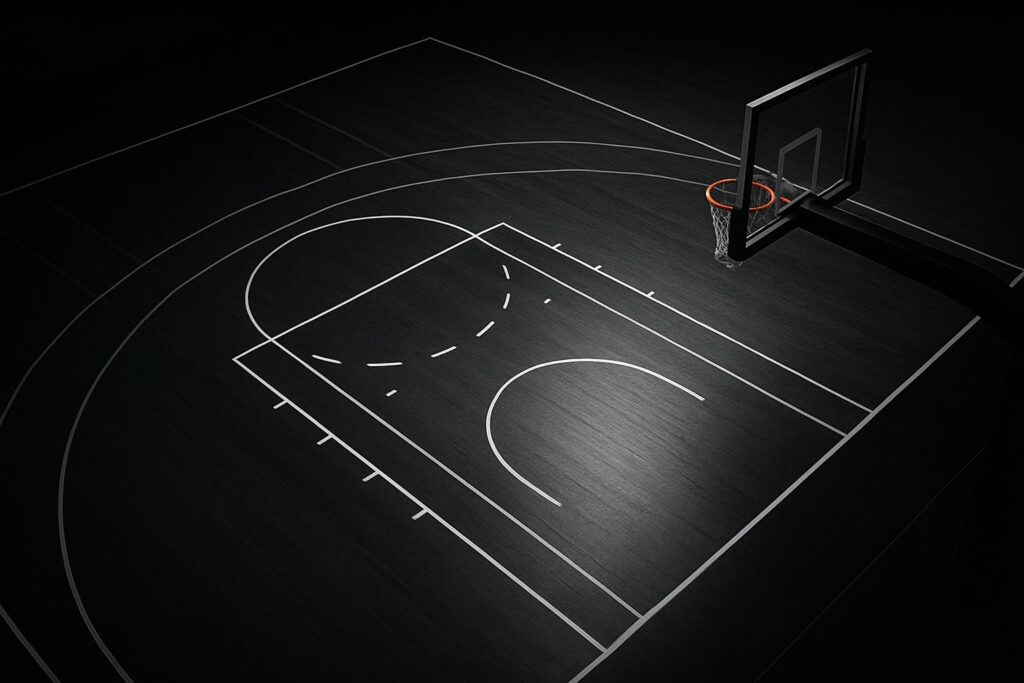
The three-point line is not a perfect circle. It’s an arc that flattens into straight lines near the sidelines to keep the line inbounds. That’s why many leagues list a shorter “corner three” than the top-of-the-arc distance.
Three-Point Line by League
NBA
The NBA three-point line is 23 ft 9 in (7.24 m) at the arc and 22 ft (6.70 m) at the corners. These distances are measured to the inside edge of the line from the floor point under the basket center.
Officials judge a three if the shooter has no foot touching the line or inside the arc at the moment of release. If a made shot is initially scored incorrectly as a two instead of a three (or vice versa), the NBA allows video review and score correction at the next neutral stoppage; in the last two minutes and overtime, reviews can be immediate.
WNBA
The WNBA line is 22 ft 1.75 in (6.75 m) at the arc and 22 ft in the corners, measured to the inside edge. The league uses the same court size as the NBA and a similar arc-and-corner geometry.
Referee judgment mirrors NBA practice: a player must not touch the line or inside area at release for a three. The WNBA also permits replay to confirm two vs. three, especially in late-game situations, and to correct the score if needed.
NCAA (Men & Women)
Both NCAA men and women use 22 ft 1.75 in (6.75 m) at the arc, measured to the inside edge. On most college courts the straight segments near the sidelines place the shortest distance near the corners at roughly 22 ft.
College officials may use the monitor to confirm whether a shot was a two or three at the next dead ball when replay is available (procedures can vary by division and event). As in all levels, the line itself is two; the shooter must be completely behind it at release for three.
NFHS (High School)
NFHS high school courts use a 19 ft 9 in (6.02 m) three-point arc, measured to the inside edge. This shorter line significantly changes spacing and shot selection compared with college and pro levels.
Most high school games do not use instant replay. The crew must get the two/three call live, communicating and mirroring signals to ensure clarity. Score corrections without replay are limited to specific correctable-error windows defined in NFHS rules.
FIBA (International)
FIBA uses 6.75 m (22 ft 1.75 in) at the arc and 6.60 m (approximately 21 ft 8 in) in the corners, measured to the inside edge. Because the FIBA court is 15 m wide (slightly narrower than U.S. courts), the corner three is shorter than in most U.S. setups.
FIBA mechanics are the same conceptually: any contact with the line or inside the arc at release makes it a two. FIBA crew chiefs can use Instant Replay System (IRS) in competitions that provide it, following FIBA’s event-by-event replay protocols.
How Officials Judge Two vs. Three
What referees watch
- Feet at the moment of release: both feet must be completely behind the line, with no part touching the line or inside area.
- Inside edge matters: lines are typically about 2 inches/5 cm wide; touching any part of that paint makes it a two.
- Last contact principle when airborne: if a player jumps from inside the arc and releases while drifting behind the line, it is a two. The shooter’s status is determined by floor contact prior to release.
- Corner hazards: heels on or over the sideline are out of bounds, not a two or three. Officials check both the three-point line and the sideline in tight corner attempts.
When the violation or foul occurs and how play resumes
- Foot on the line at release: not a violation—simply a two-point try. If it goes in, score two points and resume as after any made basket.
- Out of bounds in the corner: if the shooter’s heel touches the sideline before or during release, the ball is dead; award the ball to the defense for a throw‑in at the nearest spot, no free throws.
- Fouled on a made three: counts for three plus one free throw (four-point play). If ruled a two, it’s two plus one.
- Replay corrections (where allowed): points can be adjusted at the next dead ball without changing elapsed time; possession does not change unless required by the corrected score/clock situation under that league’s correctable error rules.
Game Situations and Rulings
Example 1: Toe on the line at the top
A guard rises for a jumper with his lead toe clearly touching the paint of the three-point line. The shot swishes and the nearest official signals two. Even if the shooter’s heel is behind the line, contact with the line at release makes it two at every level.
In NBA/WNBA/NCAA, if the scorer mistakenly posts three, the crew can correct it at the next dead ball (or immediately late-game). Play continues normally; no free throws and no change of possession.
Example 2: Corner three with tight sideline
A wing receives a skip pass in the corner. Her toes are behind the three-point line, but her heel grazes the sideline just before release. That is out of bounds—ball awarded to the defense at the nearest spot. No points, no free throws.
This illustrates why corner spacing and stance matter. Officials are trained to check both the three-point line and the sideline in one visual sweep.
Example 3: Drifting jumper launched from inside the arc
A forward jumps from just inside the arc, drifts backward, and releases while his body is clearly beyond the line. Ruling: two points if successful. His last contact with the floor before release was inside the arc.
Coaches should teach a controlled step-back or hop that establishes both feet behind the line before the rise, eliminating this common miscue.
Example 4: Four-point play vs. three-point-and-one
A shooter is hit on the arm while releasing from behind the arc; the ball goes in. If her feet were completely behind the line at release, count three and award one free throw. If any part touched the line, count two plus one free throw.
Crews often confirm the value via replay in pro/college late-game windows to ensure the correct number of free throws and score value.
Court Geometry and Coaching Implications
Spacing changes by level
The NBA’s 23’9″ arc stretches help more drive lanes and widens closeouts. WNBA/NCAA at 22’1.75″ is still spacious, with corners effectively 22′ on most U.S. courts, making corner threes slightly shorter and tactically valuable.
High school’s 19’9″ compresses the half court. Shooters feel “on top” of the line, and help defense can tag and recover faster. Internationally, FIBA’s 6.6 m corners are notably short, inviting corner spacing but creating sideline/heel traps.
Training and court setup
- Mark the correct line for your competition. If your gym has multiple arcs, tape the right one for practice to build automatic footwork.
- Drill corner stance: ball of the foot behind the three-point line, heel clear of the sideline. Use a “check the heel” cue on every corner catch-and-shoot rep.
- Teach the step-back/hop-back to establish both feet behind the line before the ascent. Avoid drifting releases that originate inside the arc.
- For teams transitioning levels (HS to college; college to WNBA/NBA), run shooting charts by zone at the new distance and progress volume over 2–3 weeks.
Common Mistakes and Misunderstandings
- Thinking landing spot matters: it doesn’t. Only the position at release matters. Landing inside the arc after releasing a clean three is still three.
- Assuming “hovering” over the line counts: if you jumped from inside the arc and release while airborne behind the line, it’s still a two because your last floor contact was inside.
- Forgetting the line is two: touching any part of the painted line makes it a two-point try.
- Corner heel on the sideline: that’s out of bounds, not a two or three. Keep heels off the paint and off the wood.
- Mixing distances across leagues: HS is 19’9″; NCAA/WNBA are 22’1.75″; NBA is 23’9″ with 22′ corners; FIBA uses 6.75 m with 6.6 m corners.
Frequently Asked Questions
Why is the NBA three-point line farther than other leagues?
The NBA uses 23’9″ to reflect the elite size, strength, and shooting ability of its players and to preserve spacing and shot value at the highest level. Other leagues balance distance with athlete development and court-size standards worldwide.
Are corner threes really easier?
They are shorter in most leagues (22′ NBA/WNBA/NCAA corners; 6.6 m in FIBA), so the shot requires slightly less range. However, the angle to the backboard is sharper, closeouts are shorter, and the sideline creates heel-out-of-bounds risk.
Do all colleges use the same three-point line for men and women?
Yes. NCAA men and women both use 22’1.75″ measured to the inside edge. Many facilities share a single college arc to simplify multi-game days.
How do referees decide two vs. three if they’re blocked from seeing the feet?
Mechanics place at least one official with an open view of the shooter’s feet and line. If blocked, crews communicate and may delay signaling until confirmation; where allowed, they can use replay at the next dead ball to correct the value.
What if the ball is released from behind the line but the shooter’s off-ball foot slides onto the line just before release?
If any part of either foot touches the line at the instant of release, it’s a two-point try. Officials focus on the exact release moment, not the initial setup.
Does shoe size affect rulings?
Only in the practical sense that bigger shoes are more likely to touch paint. The rule is identical for everyone: any foot contact with the line at release equals two points.
Does the backboard or rim height change the three-point distance?
No. Rim height (10 feet) and backboard specs are consistent across levels. Three-point distance is a floor marking measured from the basket center to the line’s inside edge.
Can a player pump-fake inside the arc, step back behind the line, and then shoot a three?
Yes—if both feet are established completely behind the line before releasing. That is the textbook step-back: re-establish behind the line, then rise and release.
Final Thoughts
Know your line and respect the details: the inside edge is the boundary, and officials judge the shooter’s feet at the moment of release. NBA is 23’9″ (22′ corners), WNBA/NCAA are 22’1.75″ (with corners effectively 22′ on most U.S. courts), NFHS is 19’9″, and FIBA is 6.75 m with 6.6 m corners.
Teach players to establish both feet behind the line before rising, especially on step-backs and in the corners. For referees, prioritize an open look at the shooter’s feet and use replay where permitted to confirm scoring value. Clear understanding of these measurements and judgments prevents avoidable two-vs.-three errors that swing possessions and games.