
We are reader supported. When you purchase through links on our site, we may earn an affiliate commission. Also, as an Amazon affiliate, we earn from qualifying purchases.
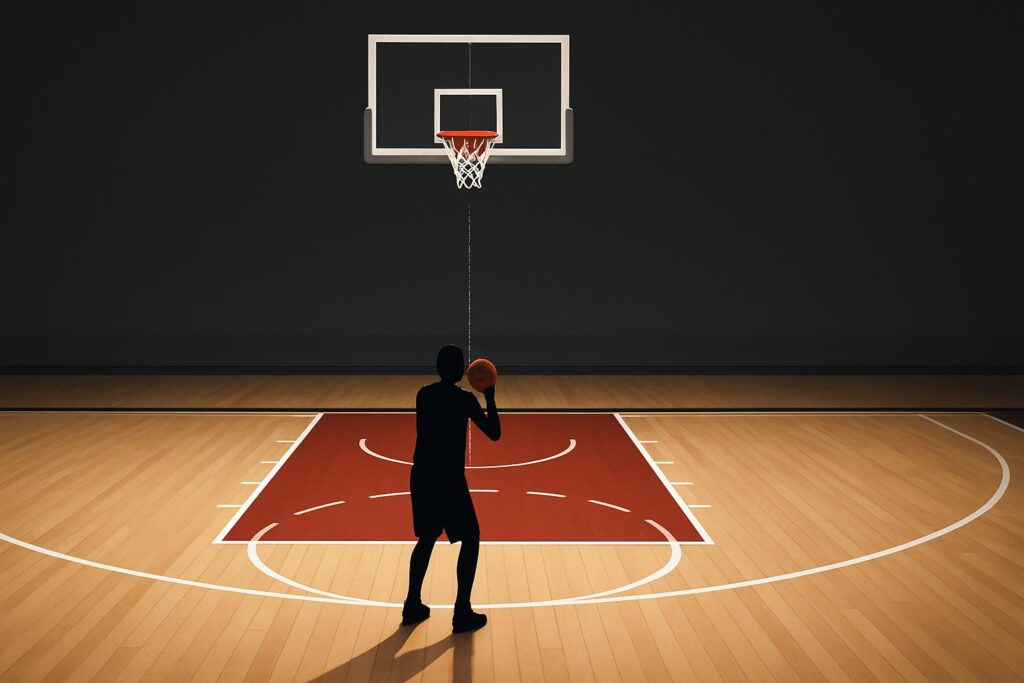
The free throw line is 15 feet from the plane of the backboard in the NBA, WNBA, NCAA, and NFHS high school rules. Under FIBA, it’s 4.6 meters (effectively the same). Because the center of the rim sits 15 inches in front of the backboard, the free throw is 13 feet 9 inches from the center of the basket. This article explains how that distance is measured, how officials judge free throws, what counts as a violation, and subtle differences across leagues.
Quick Answer
The free throw line is a fixed distance from the backboard: 15 feet (4.57 m) in U.S. rules and 4.6 m under FIBA. Measured to the center of the rim, that’s 13 feet 9 inches (4.19 m) everywhere. The height of the rim is always 10 feet. While the distance is universal, timing and lane-space rules differ slightly by league.
| League | Measured From | Distance (U.S.) | Distance to Rim Center | Metric |
|---|---|---|---|---|
| NBA | Plane of the backboard | 15 ft | 13 ft 9 in | 4.57 m (approx.) |
| WNBA | Plane of the backboard | 15 ft | 13 ft 9 in | 4.57 m (approx.) |
| NCAA (Men/Women) | Plane of the backboard | 15 ft | 13 ft 9 in | 4.57 m (approx.) |
| NFHS (High School) | Plane of the backboard | 15 ft | 13 ft 9 in | 4.57 m (approx.) |
| FIBA | Plane of the backboard | ~15.1 ft | ~13 ft 10 in | 4.6 m |
What the Free Throw Line Is and How It’s Measured
A free throw is an unopposed shot taken from the free throw line with the clock stopped. The line itself is drawn 15 feet from the plane of the backboard (not from the rim) in U.S. rules and 4.6 meters in FIBA. Because the rim’s nearest point is 6 inches in front of the backboard and the rim radius is 9 inches, the rim center sits 15 inches ahead of the backboard—so the shot is 13 feet 9 inches from the rim center.
The line is 12 feet wide, centered on the lane. The free-throw circle is 12 feet in diameter. Lane width varies by code (NBA/WNBA 16 feet; NCAA/NFHS 12 feet; FIBA ~16 feet), but the free-throw distance stays the same. All standard baskets are 10 feet high.
Free-Throw Procedure and Player Positioning
After the official places the ball at the shooter’s disposal, play is live. The shooter stands behind the free throw line within the semicircle. Teammates and opponents may occupy marked lane spaces; others must remain beyond the three-point line and the free-throw line extended.
Entering the Lane: When Is It Legal?
- NBA/WNBA/NCAA/NFHS: Players in marked lane spaces may enter the lane the moment the ball leaves the shooter’s hand (on the release). Players not in marked lane spaces must stay behind the three-point line and free-throw line extended until the ball touches the ring or backboard or the try ends.
- FIBA: Players in marked lane spaces may enter on the release. All other players must wait until the ball touches the ring. FIBA does not use “backboard contact” as the trigger for players outside the arc.
In practice, rebounders along the lane crash as soon as the ball leaves the hand. Wing players and guards outside the arc wait for rim contact before cutting in for rebounds or defensive box-outs.
Shooter Restrictions
- Feet and line: The shooter may not step on or over the free throw line until the ball touches the ring/backboard (NBA/WNBA/NCAA/NFHS) or the ring (FIBA). A toe on the line at release is a violation.
- Time limit: NBA/WNBA/NCAA/NFHS shooters have 10 seconds to release the ball after it’s at their disposal. FIBA allows 5 seconds.
- Faking: The shooter may not fake a try to cause opponents to violate. Deliberate deception is penalized as a violation; if it disconcerts the defense, officials may call defensive disconcertion instead (see below).
What Officials Watch and How They Penalize
Referees split responsibilities: one official tracks the shooter’s feet and release/clock count; partners watch lane spaces, players outside the arc, and potential disconcertion.
- Offensive violation (shooter or teammate): If the try is successful, the point is canceled; if unsuccessful, the ball becomes dead and, if it was the last free throw, the defense is awarded the ball for a throw-in (commonly at the free-throw line extended). If additional free throws remain, play proceeds to the next attempt.
- Defensive violation (opponent in lane early or disconcertion): If the try is successful, the point counts; if unsuccessful, the shooter is awarded a substitute free throw.
- Double violation (both teams): The throw is canceled. If more free throws remain, continue with the next; if it was the last/only free throw, resume by alternating possession (NCAA/NFHS/FIBA) or a jump ball by rule (NBA/WNBA).
“Disconcertion” includes yelling, clapping in the shooter’s line of sight, or abrupt movements meant to distract. Officials judge intent and immediacy; when called on the defense and the free throw misses, a replacement free throw is granted.
Key Differences Across Leagues Near the Free-Throw Line
- Distance: Functionally identical—15 feet (U.S.) vs 4.6 m (FIBA).
- Time to shoot: 10 seconds (NBA/WNBA/NCAA/NFHS) vs 5 seconds (FIBA).
- Lane entry timing: All codes allow lane-space players to enter on release; players outside the arc must wait until rim contact (FIBA doesn’t use “backboard contact”).
- Lane width: NBA/WNBA 16 ft; NCAA/NFHS 12 ft; FIBA ~4.9 m (16.08 ft). This changes angle/rebounding geometry but not the free-throw distance.
Real Game Situations and How Officials Rule Them
1) Shooter’s Toe on the Line
Situation: A college shooter’s front toe rests on the line at release and the shot goes in. Ruling: Offensive free-throw violation. The point is canceled. If it was the final free throw, the defense gets the ball for a throw-in at the free-throw line extended. Coaches should teach shooters to leave visible hardwood between the shoe and the line.
2) Early Lane Entry by a Rebounder
Situation: In a WNBA game, the defender in the first lane space steps into the lane before the ball leaves the shooter’s hand; the free throw misses. Ruling: Defensive lane violation; award a substitute free throw to the shooter. If the make had counted, no extra would be awarded.
3) Disconcertion by the Defense
Situation: During a high school game, a defender claps loudly and yells as the shooter begins the motion; the try misses. Ruling: Defensive disconcertion. Count a substitute free throw. Officials watch for abrupt, distracting actions timed with the shooter’s release.
4) Players Outside the Arc Crash Too Early
Situation: In an NCAA men’s game, a wing player beyond the three-point arc sprints toward the lane before the ball hits the rim; the try misses. Ruling: Offensive violation by a non-lane player; ball is dead. If this was the last free throw, the defense is awarded the throw-in.
How to Measure the Free-Throw Line Correctly
- Always measure from the plane of the backboard, not from the rim or stanchion padding.
- Confirm the rim’s projection is correct: the front of the rim’s center is 15 inches in front of the backboard; that’s why the shot is 13’9″ to the rim center.
- Verify the free-throw circle is centered and 12 feet in diameter; a skewed circle often signals a misdrawn line.
Similar Rules That Get Confused
- Three-second violation vs. lane violations: Three seconds is a team-control violation during live play. Lane violations are timing/placement infractions specific to free throws.
- Basket interference/goaltending on free throws: Touching a free throw in flight before it hits the rim is illegal. Touching the ball while it’s on the rim or in the cylinder is basket interference; if by the defense on a successful try, the point counts.
- Stepping on a line: On free throws, stepping on the free throw line early is a violation. On three-pointers, touching the line reduces it to a two. Don’t mix these contexts.
Practical Tips for Players, Coaches, and Officials
- Shooters: Set your lead toe 2–3 inches behind the line and hold your landing until you hear/see rim contact. Use a quick pre-shot routine to stay within the 10- or 5-second limit.
- Rebounders in lane spaces: Watch the ball, not the shooter’s feet. Move on the release, hands up, hips low, and avoid stepping into the semicircle too early.
- Players outside the arc: Don’t creep in. Wait for rim contact, then knife to long rebounds.
- Coaches: Rehearse free-throw lane assignments and timing in practice with a whistle and visible hand-count to hardwire legal habits.
- Officials: One official owns the shooter’s feet and count; partners own first lane-line spaces and players outside the arc. Communicate violations crisply and signal replacement throws or possession.
Common Mistakes and Misunderstandings
- Measuring from the rim instead of the backboard. The rule is based on the backboard plane.
- Assuming the distance changes by level or gender. It doesn’t; only timing and lane widths differ.
- Lane players waiting for rim contact. In every code, lane-space players may enter on the release.
- Ignoring the time limit. Ten seconds (U.S.) and five seconds (FIBA) come up in close games—officials will call it.
- Outside players creeping in early. They must wait for rim contact (backboard contact doesn’t help under FIBA).
Frequently Asked Questions
Is the free throw distance the same for men and women?
Yes. NBA, WNBA, NCAA women, NCAA men, NFHS, and FIBA all use the same distance to the backboard (15 ft in U.S. codes; 4.6 m in FIBA).
Why do some youth leagues look closer than 15 feet?
Local youth organizations sometimes adopt a 12-foot line for younger age groups to encourage proper shooting form. That’s a local modification, not an NFHS rule.
Can the shooter jump on a free throw?
Yes, the shooter may jump, but cannot land with any part of the foot on or over the line before the ball contacts the ring (or ring/backboard as specified). Many players prefer a set shot for consistency.
Do both feet have to stay on the floor?
No. The key requirement is remaining behind the line until the legal trigger (rim contact or the try ending) occurs. Lifting a pivot or both feet is fine as long as you don’t cross early.
What happens if the ball wedges between the rim and backboard on a free throw?
It’s a dead ball. If no violation occurred and it was the last free throw, resume with alternating possession (NCAA/NFHS/FIBA) or a jump ball by rule (NBA/WNBA). If a defensive violation preceded it, a substitute free throw is awarded.
What if both teams violate on the same free throw?
It’s a double violation. The attempt is canceled. If more free throws remain, continue with the next one; if it was the last/only attempt, use alternating possession (NCAA/NFHS/FIBA) or a jump ball (NBA/WNBA).
Does the free-throw distance change with a wider NBA lane?
No. Lane width affects rebounding angles and space, but the free-throw line remains 15 feet from the backboard in every code.
Why does FIBA list 4.6 m instead of 4.57 m?
FIBA uses metric standards. Its specification is 4.6 m from the backboard plane, which translates to about 15.09 feet. The practical on-court distance is effectively the same.
Final Thoughts
The free throw line is universally fixed—15 feet from the backboard in U.S. play and 4.6 meters in FIBA—yielding a 13’9″ shot to the rim’s center. What changes by league are timing (10 seconds vs. 5), when non-shooters may enter, and lane geometry. Players should keep toes comfortably behind the line, rebounders should move on the release from marked spaces, and everyone outside the arc should wait for rim contact. Mastering these small details turns free throws into free points—and keeps avoidable violations off the scoreboard.