
We are reader supported. When you purchase through links on our site, we may earn an affiliate commission. Also, as an Amazon affiliate, we earn from qualifying purchases.
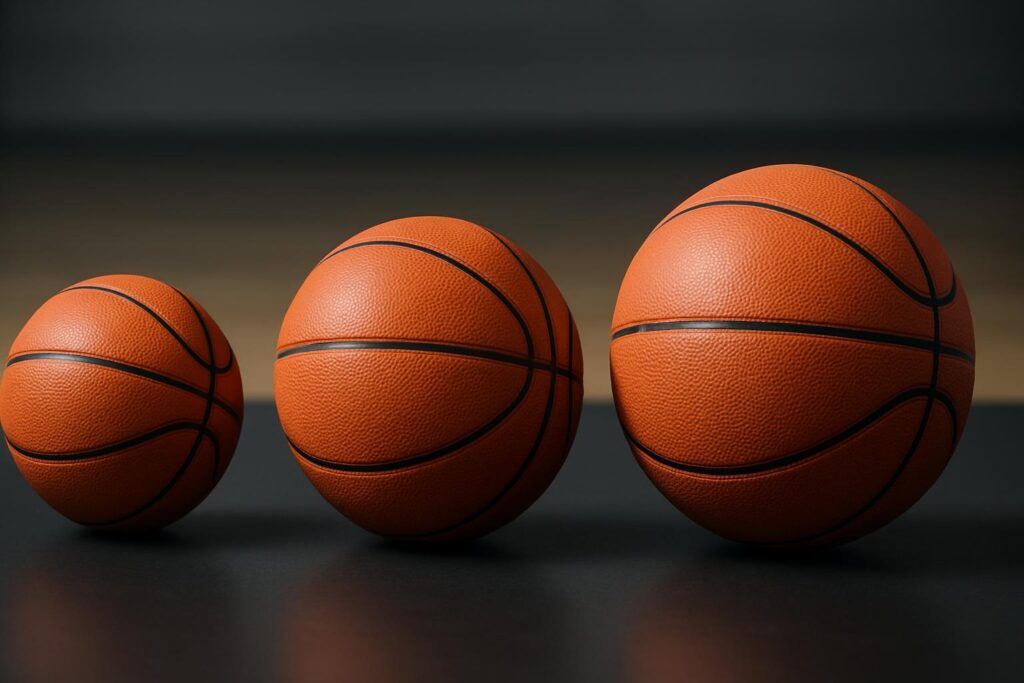
Size 7 is the official men’s game ball (29.5 in, about 22 oz) used by the NBA, NCAA Men’s and NFHS boys. Size 6 is the official women’s ball (28.5 in, about 20 oz) used by the WNBA, NCAA Women’s and NFHS girls. Size 5 (27.5 in, about 17 oz) is a youth training size commonly used in U11 and below. Below you’ll find a clear breakdown of what each size means, how leagues enforce ball specs, and which products fit each level.
Quick Answer
Use Size 7 for adult men’s play, Size 6 for women’s play and most middle school girls, and Size 5 for youth development. NBA/WNBA/NCAA/NFHS specify pressure at 7.5–8.5 psi (referees check this pregame), while FIBA uses size ranges and a rebound test for pressure.
| League/Level | Official Size | Circumference | Approx. Weight | Pressure/Check |
|---|---|---|---|---|
| NBA (Men) | Size 7 | 29.5 in | ~22 oz | 7.5–8.5 psi (pregame check) |
| WNBA (Women) | Size 6 | 28.5 in | ~20 oz | 7.5–8.5 psi (pregame check) |
| NCAA Men | Size 7 | 29.5 in | ~22 oz | 7.5–8.5 psi |
| NCAA Women | Size 6 | 28.5 in | ~20 oz | 7.5–8.5 psi |
| NFHS Boys (HS) | Size 7 | 29.5 in | ~22 oz | 7.5–8.5 psi |
| NFHS Girls (HS) | Size 6 | 28.5 in | ~20 oz | 7.5–8.5 psi |
| FIBA Men | Size 7 | 749–780 mm | per FIBA spec | Rebound test (no fixed psi) |
| FIBA Women | Size 6 | 724–737 mm | per FIBA spec | Rebound test (no fixed psi) |
| Youth (typical U11 and below) | Size 5 | 27.5 in | ~17 oz | League/coach discretion |
Basketball Sizes: What They Mean and Who Uses Them
Size 7 (Men’s Official)
Definition: Size 7 is the largest standard game ball. In U.S. play it measures 29.5 inches in circumference and weighs about 22 ounces.
Leagues: NBA, NCAA Men’s and NFHS boys all use size 7. FIBA designates size 7 for men with a metric circumference range.
Referee check: In NBA/NCAA/NFHS, officials ensure 7.5–8.5 psi and that the ball is legal at the pregame equipment inspection. FIBA officials verify the ball’s circumference range and use a rebound test (drop from a prescribed height; the ball must rebound within a set range) rather than a fixed psi number.
Game impact: A size 7 ball requires more hand strength to control. Players with big hands find it easier to palm on drives; others benefit from firm fingertip control and proper hand placement on the seams.
Size 6 (Women’s Official; also common in youth and middle school)
Definition: Size 6 measures 28.5 inches in circumference and weighs about 20 ounces.
Leagues: WNBA, NCAA Women’s and NFHS girls use size 6. Many U.S. youth leagues also use size 6 for players roughly 9–11, and for some middle school boys leagues before transitioning to size 7.
Referee check: Same pregame pressure check in U.S. rules (7.5–8.5 psi). FIBA women’s competitions use size 6 with the same rebound-based pressure check.
Game impact: The slightly smaller diameter and lighter weight promote better shooting mechanics and ball control for developing players and for the women’s game.
Size 5 (Youth)
Definition: Size 5 typically measures 27.5 inches in circumference and weighs around 17 ounces in U.S. youth products. FIBA’s youth size 5 range is slightly different in metric terms.
Leagues: Widely used in U11 and below. Programs that follow age-based progression often recommend size 5 for players around ages 7–8 to build confidence and proper form.
Referee check: Local leagues or tournaments set the standard. Officials still inspect pressure, grip and condition to ensure safe play.
Game impact: Smaller hands can reach correct shooting pockets and develop wrist snap with a shallower release angle. Dribbling control and passing accuracy improve with fewer compensations.
How Rules Enforce Ball Specs
Pregame equipment inspection is where enforcement happens. The referee crew or game operations staff confirms the ball’s size, condition, inflation, and legality for that competition.
- NBA/WNBA/NCAA/NFHS: Ball must be the correct size and inflated to 7.5–8.5 psi. If a game begins with an illegal ball, officials replace it at the next dead ball; prior play stands. No free throws are awarded simply for an illegal ball.
- FIBA: Uses circumference/weight ranges and a bounce (rebound) test to verify proper internal pressure. If out of spec, the ball is replaced before play.
Common game situation example: In a high school girls game (NFHS), if a 29.5 ball mistakenly enters the game, the crew switches to a legal 28.5 at the earliest dead ball. In youth tournaments, if a court is using size 5 for all divisions by mistake, the site director and referees standardize sizes for each bracket before continuing.
Age and Level Recommendations at a Glance
- Size 5 (27.5 in): Common for ages 7–8 and U11-and-under leagues.
- Size 6 (28.5 in): Women and girls from middle school through pro; many boys 9–11 divisions.
- Size 7 (29.5 in): High school boys, college men, pro men.
Coaches should follow their governing body’s handbook for official competition. For practice, using a developmentally appropriate size helps clean shooting form, passing accuracy, and dribble control.
How We Chose (Product Selection Criteria)
We selected balls that match league specs and are widely trusted in U.S. gyms and parks. We prioritized:
- League alignment: Official or widely used in NBA/WNBA/NCAA/NFHS/FIBA contexts.
- Court surface: Indoor-only game balls vs. durable indoor/outdoor options.
- Grip and channels: Reliable composite or leather cover and consistent channel feel.
- Durability: Retains grip and roundness over a season of realistic use.
- Sizes offered: Availability in size 5, 6 or 7.
- Price level: Budget, Mid-range or Premium.
Product Comparison Table
| Product | Best For | Key Features | Main Limitation | Price Level |
|---|---|---|---|---|
| Wilson NBA Authentic Series Indoor/Outdoor | Recreation and pickup (Size 7/6) | Durable composite cover; NBA branding; all-surface use | Not a pure indoor game ball feel | Mid-range |
| Wilson WNBA Official Game Ball | Women’s official play (Size 6) | Official WNBA spec; indoor composite cover | Indoor use recommended | Premium |
| Wilson Evolution | High school gyms; skill work (Size 7/6) | NFHS approved; soft composite; consistent grip | Not built for rough outdoor courts | Mid-range |
| Wilson EVO NXT NCAA Official Game Ball | College-level indoor feel (Size 7/6) | Official NCAA game ball line; indoor composite | Premium pricing; indoor only | Premium |
| Molten BG5000 (FIBA Official Game Ball) | FIBA-spec indoor play (Size 7/6) | FIBA official; premium leather; distinct panel design | Requires break-in; indoor use | Premium |
| Spalding Rookie Gear Youth (Size 5) | Early youth development | Light youth construction; easy control | Not for advanced competitive play | Budget |
Individual Product Reviews
Wilson NBA Authentic Series Indoor/Outdoor
Best for: Players who split time between the gym and the park and want an NBA-branded ball in size 7 or 6.
Main specs: Composite leather cover suited for both indoor wood and outdoor asphalt; deep channels; official size options.
Pros: Versatile surface performance, durable outer cover, familiar NBA look. Good value for teams needing a reliable practice ball that can go outside.
Cons: Touch is firmer than pure indoor game balls; channels and tack can vary as the cover wears on rough surfaces.
Who it’s for: Rec leagues, pickup players, and coaches who run mixed-surface practices.
Who it’s not for: College or pro indoor purists seeking top-tier game-ball softness.
Buying notes: Choose size 7 for men’s play or size 6 for women’s play. Inflate to 7.5–8.5 psi for organized U.S. rules.
Wilson WNBA Official Game Ball
Best for: Women’s competition that wants the official 28.5-inch feel.
Main specs: Official WNBA size 6 ball; indoor composite cover tuned for control and consistent bounce.
Pros: Matches the women’s pro game spec; reliable grip and channel feel; great for game-speed shooting practice.
Cons: Designed for indoor courts; outdoor use will accelerate wear.
Who it’s for: High school and college women’s teams; serious training sessions that mirror WNBA specs.
Who it’s not for: Outdoor-only players or youth who need a more rugged cover.
Buying notes: Keep a quality pump/needle handy to maintain pressure within 7.5–8.5 psi for NFHS/NCAA play feel.
Wilson Evolution
Best for: High school gyms, club practices, and skills work where NFHS approval matters.
Main specs: NFHS-approved indoor composite; soft, tacky feel; available in size 7 and size 6.
Pros: One of the most popular U.S. high school balls; consistent grip and cushion help shooters and ball handlers.
Cons: Not meant for outdoor courts; cover will scuff quickly on asphalt.
Who it’s for: Coaches stocking a practice rack; players honing touch and form indoors.
Who it’s not for: Park hoopers who need an outdoor-specific cover.
Buying notes: Match size 7 to boys/men’s teams and size 6 to girls/women’s teams to mirror NFHS standards.
Wilson EVO NXT NCAA Official Game Ball
Best for: Players and programs aiming for a true NCAA-style indoor game feel.
Main specs: Official NCAA game ball line; indoor composite engineered for consistent grip and visibility; sizes 7 and 6.
Pros: Game-ball touch; reliable bounce; excellent shooting feedback at college-level standards.
Cons: Premium cost; requires proper care and indoor play only.
Who it’s for: College programs, elite high school teams, and serious trainers.
Who it’s not for: Budget-conscious buyers or anyone needing outdoor durability.
Buying notes: Keep to 7.5–8.5 psi to emulate NCAA conditions; store away from heat/humidity.
Molten BG5000 (FIBA Official Game Ball)
Best for: Players and international programs that want FIBA’s official indoor leather feel.
Main specs: Premium leather cover; FIBA official; available in size 7 and 6; distinct 12-panel design for rotational feedback.
Pros: Elite grip after break-in; clear rotation read on shots and passes.
Cons: Needs break-in time; indoor-only; premium pricing.
Who it’s for: International play, pro-level training, and collectors who value FIBA spec.
Who it’s not for: Outdoor rec players; youth who won’t benefit from a long break-in period.
Buying notes: FIBA checks pressure with a rebound test, but for U.S. practice 7.5–8.5 psi is a solid reference.
Spalding Rookie Gear Youth (Size 5)
Best for: Young beginners who need a manageable size and weight.
Main specs: Youth size 5 circumference; lighter construction for easier handling and shooting; composite cover.
Pros: Encourages correct mechanics; boosts confidence; durable enough for school gyms and light outdoor use.
Cons: Too light for advanced youth or older players; will not replicate regulation weight progression.
Who it’s for: Coaches and parents introducing fundamentals to new players.
Who it’s not for: Competitive middle school teams that have moved to size 6 or 7.
Buying notes: Prioritize comfort and control over lifespan; graduate to size 6 as skills and strength improve.
Basketball Buying Guide: Pick the Right Size and Build
1) Match the Size to the Player and League
- Men’s high school, college and pro: Size 7.
- Women’s high school, college and pro: Size 6.
- Youth: Size 5 is common for beginners; many leagues use Size 6 around ages 9–11 before moving to Size 7 for boys.
2) Choose the Right Cover for Your Court
- Indoor-only composite or leather: Best grip and soft touch; preserve for hardwood.
- Indoor/Outdoor composite: More durable; good for parks and school blacktops.
3) Understand Inflation and Checks
- NBA/WNBA/NCAA/NFHS: 7.5–8.5 psi is the standard range used by officials.
- FIBA: Uses a rebound test, not a fixed psi, to confirm correct internal pressure.
- Practical tip: Use a needle gauge. Too soft hurts shooting range; too hard reduces control and increases rim outs.
4) Safety and Durability
- Inspect for cuts, lumps, or out-of-round shape. Replace if bounce becomes irregular.
- Keep balls out of extreme heat and off abrasive surfaces to extend life.
5) Budget
- Budget: Good for youth rec or outdoor-only play.
- Mid-range: Balanced durability and touch, popular for high school practices.
- Premium: True game feel for varsity, college and pro-style training.
Common Mistakes and Misunderstandings
- Using the wrong size in tryouts: High school girls should not use 29.5. Coaches should label racks and confirm sizes pre-session.
- Assuming FIBA uses the same psi rule: FIBA uses a rebound test. Don’t force a fixed psi for international play.
- Practicing outdoors with an indoor game ball: The cover will wear prematurely and lose tack quickly.
- Overinflation to “improve bounce”: Excess psi causes harder caroms and less control, and can fail pregame checks.
- Skipping the pregame ball check: Officials should confirm size and pressure before the opening tip to avoid midgame switches.
Frequently Asked Questions
Can men’s leagues use a 28.5-inch ball?
Not in NBA, NCAA Men’s or NFHS boys games. Those competitions require size 7 (29.5 in). A 28.5 ball is the women’s standard in the U.S.
What if the wrong ball is discovered during play?
Officials replace it at the next dead ball. Past play stands unless another rule applies. There’s no automatic free throw or technical for using the wrong legal-size ball by mistake.
How do I measure a ball at home?
Wrap a flexible tape around the widest part to get circumference. Compare to 27.5 (size 5), 28.5 (size 6), or 29.5 (size 7). Also check firmness with a gauge for consistent feel.
Why does FIBA use a rebound test?
It standardizes playing characteristics across different environments and manufacturing by focusing on actual bounce performance rather than a single internal pressure number.
Is there a size 4 or 8?
Manufacturers make smaller sizes (e.g., size 4) for skill development and mini basketball, but organized competition in the U.S. typically centers on sizes 5, 6 and 7. Size 8 is not a standard game size.
Does a smaller ball help shooting form?
Yes for younger players. A ball matched to hand size and strength enables correct elbow alignment, wrist snap and arc without overcompensating.
Should teams practice with the same make as their game ball?
It helps. Consistency in grip, channel width, and cover tack can smooth the transition from practice to games, especially for shooters.
How often should we replace balls?
When the cover loses tack significantly, the ball won’t hold pressure, or the bounce becomes uneven. Competitive teams usually rotate fresh game balls each season and relegate older balls to practice.
Final Thoughts
Pick size 7 for men, size 6 for women, and size 5 for youth development. For NBA/WNBA/NCAA/NFHS play, keep pressure at 7.5–8.5 psi; FIBA uses a rebound test. Coaches and referees should confirm ball size and inflation before tipoff, and players should train with the ball that matches their competition. Once you lock in the correct size and cover for your court, everything from shooting touch to passing accuracy feels more natural—and your game benefits immediately.