
We are reader supported. When you purchase through links on our site, we may earn an affiliate commission. Also, as an Amazon affiliate, we earn from qualifying purchases.
Double dribble means a player ends their dribble and then starts dribbling again (or dribbles with both hands at once). Carrying, often called palming, means the dribbler lets the ball come to rest in one hand—usually with the hand sliding under the ball—and then continues dribbling. In every major rule set (NBA, WNBA, NCAA, NFHS, FIBA) both are violations, not fouls: the whistle stops play and the other team gets the ball for a throw-in. This guide explains the exact definitions, how officials judge them, the key exceptions, and how players can avoid both calls.
Quick Answer
Double dribble is about restarting a dribble after it legally ended or using two hands to dribble. Carrying is about letting the ball momentarily come to rest—often with the hand under the ball—during a dribble. Both result in a turnover and a throw-in for the opponent; no free throws are awarded. Across NBA, WNBA, NCAA, NFHS, and FIBA, the concepts and penalties match, though terminology can vary.
| League | Double Dribble (Core) | Carrying/Palming (Core) | Penalty |
|---|---|---|---|
| NBA | Dribble ends (both hands/ball at rest/catch), then dribble again without a legal exception | Hand under ball or ball comes to rest, then dribble continues | Opponent throw-in at nearest spot; no free throws |
| WNBA | Same as NBA | Same as NBA | Opponent throw-in; no free throws |
| NCAA (Men/Women) | Illegal dribble/double dribble: dribble ends then starts again without exception | Discontinued dribble/palming: ball comes to rest in hand and dribble continues | Opponent throw-in; no free throws |
| NFHS (High School) | Double/illegal dribble: dribble ends then dribble again without exception | Carrying/palming: ball comes to rest in the hand then dribble continues | Opponent throw-in; no free throws |
| FIBA | Second dribble after first has ended without a legal exception | Illegal dribble when ball comes to rest in dribbler’s hand | Opponent throw-in; no free throws |
Double Dribble: What It Is and How It’s Called
Plain-language definition
- Ending your dribble by catching the ball, touching it with both hands at the same time, or letting it come to rest—then starting to dribble again.
- Dribbling the ball with both hands simultaneously.
When does a dribble “end”?
Across NBA, WNBA, NCAA, NFHS, and FIBA, a dribble ends when the player:
- Touches the ball with both hands at the same time, or
- Holds or causes the ball to come to rest, or
- Catches the ball.
If the dribble ended and the player starts another dribble, that’s a double dribble—unless a specific exception applies.
Allowed exceptions to start a new dribble
- The player shot the ball (a try for goal), the try touched the backboard/rim, and the player regained the ball.
- An opponent legally touched the ball (e.g., a deflection) during or after the first dribble.
- A pass or a fumble was touched by another player before the original player began dribbling again.
These exceptions exist in NBA, WNBA, NCAA, NFHS, and FIBA, with minor wording differences but the same effect: the player’s control ended or was interrupted legally, so a new dribble is permitted.
How referees judge double dribble
- Officials watch for a clear end to the dribble (two hands, catch, or ball at rest) followed by a new dribble without an intervening legal touch or try.
- Signal: “Illegal/Double Dribble.” In most rule sets, the official uses both hands in an alternating dribbling motion to indicate the violation.
- Timing: The violation occurs the moment the player begins the second, illegal dribble.
Game situations and concrete examples
- Point guard drives, picks the ball up with both hands to pump fake, then puts it back on the floor: double dribble.
- Wing dribbles once, stops to look for a pass (ball at rest in both hands), then dribbles again to escape pressure: double dribble.
- Guard bounces a pass that is deflected by a defender back to the guard, who then dribbles: legal because the opponent touched it.
- Shooter drives, gathers, tosses the ball toward the rim (a try) that hits the backboard, rebounds to the same player, who dribbles: legal—control ended with the shot.
Carrying/Palming: What It Is and How It’s Called
Plain-language definition
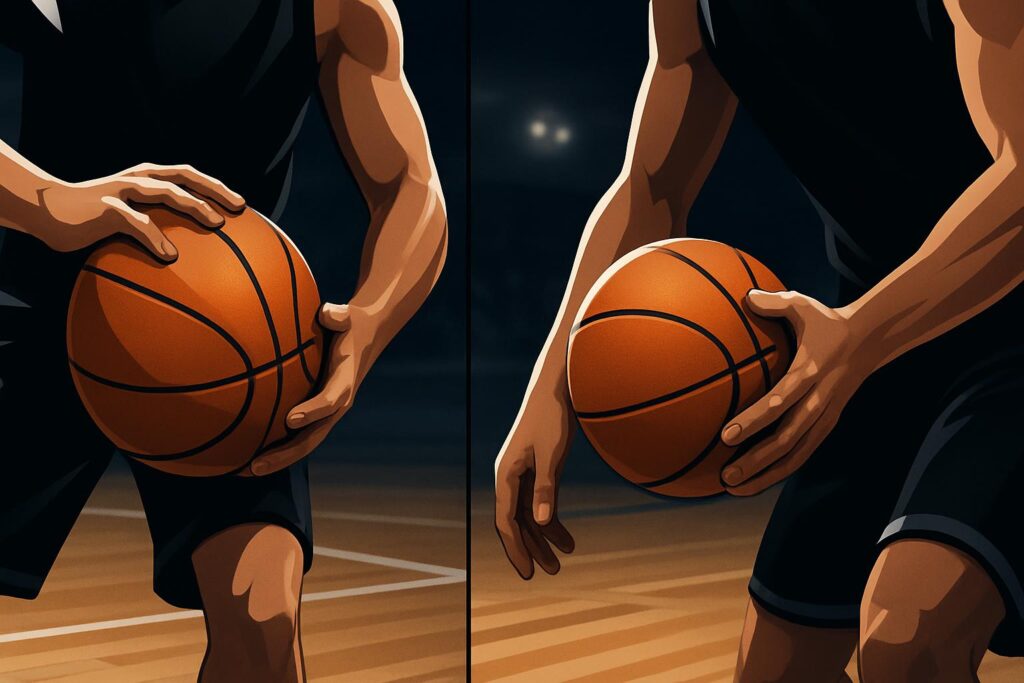
- During a dribble, the ball comes to rest in the dribbler’s hand, usually because the hand slides under the ball’s midline (“equator”) and briefly holds it.
- The dribbler then continues bouncing the ball after that pause, often using the pause to change speed or direction.
Key referee cues
- Hand position: If the hand clearly gets under the ball and the ball stops or changes direction unnaturally, officials read that as a carry.
- Ball behavior: A legal dribble has rhythmic up-down bounces; a carry shows a “pause” or “lift” with the ball traveling with the hand before being pushed down.
- Advantage gained: If the pause creates an unfair change of pace or allows extra steps to set up a move, it will draw a whistle.
- Signal: Many rule sets use a “palming” motion—official’s hand turned up then rolled over—followed by the direction of the turnover.
Game situations and concrete examples
- High in-and-out dribble: The guard cups the ball from underneath on the outside of the hip, momentarily carrying it before bouncing—carrying.
- Hesitation cross: The ball comes to a visible stop with the palm facing up during the pause, then the dribbler explodes—carrying.
- Legal hesitation: The ball stays on top/side of the ball (fingers above the equator) and keeps bouncing without resting—legal.
- Spin move: If the hand slides under the ball to “hold” it while turning, that’s carrying; if the ball stays live with hand on top/side and keeps bouncing, it’s legal.
Penalty and Game Administration
- Type: Both double dribble and carrying are violations (not personal or technical fouls).
- When it’s called: The instant the illegal act occurs (second dribble starts; ball comes to rest and dribble continues).
- How play resumes: Opponent is awarded a throw-in at the spot nearest to where the violation occurred, in NBA, WNBA, NCAA, NFHS, and FIBA.
- Free throws: None. These violations never result in free throws by themselves.
- Team control: The ball is awarded to the opponent; team possession changes on the throw-in.
Double Dribble vs Carrying: A Quick On-Court Checklist
- Did the dribbler clearly end the dribble (two hands/catch/rest) and then bounce again? Think double dribble.
- Did the dribbler keep bouncing but let the ball pause or ride in the hand with the palm under the ball? Think carrying.
- Was there an opponent touch or a shot attempt that interrupted control? If yes, a new dribble is often legal.
- Did the player just fumble a live ball before ever dribbling? Regaining and starting a first dribble is legal.
League-by-League Nuances (Without Mixing Rules)
NBA and WNBA
- Double dribble includes starting a second dribble after the first ends unless it was interrupted by a shot, pass/fumble that touches another player, or opponent touch.
- Carrying: The dribbler may not place a hand under the ball and bring it to a pause or carry it from one point to another, then continue.
- Penalty: Opponent throw-in at nearest spot; no free throws.
NCAA (Men and Women)
- Terminology often uses “illegal dribble” or “double dribble” for the restart, and “discontinued dribble” or “palming” for carrying.
- Same core exceptions: opponent touch, shot attempt, or pass/fumble touched by another player.
- Penalty: Opponent throw-in; no free throws.
NFHS (High School)
- Double dribble when a dribble ends and another begins without a legal interruption.
- Carrying/palming when the hand is under the ball and the dribble is momentarily discontinued.
- Penalty: Opponent throw-in; no free throws.
FIBA
- Illegal to dribble a second time after the first has ended, except after a shot, an opponent’s touch, or a pass/fumble touched by another player.
- Carrying is treated as an illegal dribble when the ball comes to rest in the dribbler’s hand.
- Penalty: Opponent throw-in; no free throws.
Similar Rules That Often Get Confused
- Traveling vs Carrying: Traveling is about illegal steps while holding the ball; carrying is about the ball coming to rest during a dribble. A carry can precede a travel, but they are distinct calls.
- Fumble vs Double Dribble: If a player fumbles a live ball before starting a dribble, they may recover and begin their first dribble. If they already dribbled, ended it, and then bounce again without a legal touch, that’s double dribble.
- Gather vs Carry: “Gather” is the moment a player secures the ball to shoot or pass. If during the gather the hand slides under and the ball rests while still “dribbling,” that can be a carry.
How Players and Coaches Can Avoid These Violations
- Keep your hand above or on the side of the ball. Use fingers to control, not the palm under the ball.
- Maintain dribble rhythm. If you need to stop, transition directly into a pass, jump stop, or shot—do not resume dribbling.
- Sell legal hesitations. Slow your body and lower your center of gravity without letting the ball pause in your hand.
- Teach live-ball reads. If a defender tips the ball, you’re free to regather and dribble; if not, don’t start a second dribble.
- Practice with constraints. Use cones and metronome/coach clap counts to keep dribble cadence; video your crossover angle to ensure fingers don’t slip under the ball.
Common Mistakes and Misunderstandings
- “Touching with two hands is always double dribble.” Not until you dribble again. Two hands ends the dribble; the violation occurs if you bounce the ball after that.
- “Every hesitation dribble is a carry.” Legal hesitations keep the hand on top/side and the ball bouncing without coming to rest.
- “You can’t dribble again after your shot.” You can, if your try touches the rim/backboard and you regain; control ended with the try.
- “A self-fumble lets you dribble again anytime.” Only if it occurs before you started a dribble or if another player touches the ball in between once you have ended a dribble.
- “Referees ignore palming in the pros.” The rule exists in every league; application can vary by level and emphasis, but obvious carries are still violations.
Frequently Asked Questions
Is a hesitation dribble legal if the ball briefly pauses?
Yes—if your hand stays on top/side and the ball’s bounce is continuous. If the ball comes to rest or your hand slips under it, it becomes a carry.
Can I dribble, hold the ball to fake, then dribble again?
No. Holding the ball ends the dribble. Starting another dribble without an intervening shot or opponent touch is a double dribble in all major rule sets.
If I lose the ball off my knee and get it back, can I dribble again?
If you had not ended a prior dribble, you may recover and continue. If you had ended your dribble first, you need an opponent touch (or a shot attempt or pass/fumble touched by another player) before starting a new dribble.
Does carrying require the hand to be fully underneath the ball?
No. Officials look for the ball coming to rest and the hand noticeably below the ball’s midline or turning palm-up to “hold” the ball before continuing.
Is a two-handed start to a dribble legal?
No. Starting or continuing a dribble with two hands simultaneously is illegal and leads to a double-dribble/illegal-dribble call.
Can carrying be called on a post player backing down?
Yes. If the post player cups the ball on the bounce (hand under the ball causing a pause) and then continues dribbling, it’s a carry regardless of position.
Do these violations ever lead to free throws?
No. They are violations, not fouls. The penalty is a turnover with a throw-in for the opponent at the nearest spot.
Can backcourt or frontcourt status affect these calls?
No. Double dribble and carrying can occur anywhere on the court; location affects only where the throw-in occurs.
Final Thoughts
Keep the difference simple: double dribble is about restarting after you’ve legally ended the dribble; carrying is about letting the ball come to rest during the dribble. Officials across NBA, WNBA, NCAA, NFHS, and FIBA use the same core cues—two hands/catch/rest for double dribble; hand under the ball or a noticeable pause for carrying. Players should protect their handle by keeping fingers on top/side of the ball, maintaining bounce rhythm, and transitioning cleanly into a pass or shot once the dribble ends. Coaches who teach these checkpoints dramatically cut down turnovers from both violations.