
We are reader supported. When you purchase through links on our site, we may earn an affiliate commission. Also, as an Amazon affiliate, we earn from qualifying purchases.
Here are the essentials up front: NBA, WNBA, and NCAA games use a 94 ft by 50 ft court. FIBA uses 28 m by 15 m (about 91 ft 10 in by 49 ft 2.6 in). Most U.S. high schools play on 84 ft by 50 ft courts (some have 94 ft). The three-point arc is 23 ft 9 in in the NBA (22 ft in the corners), 22 ft 1.75 in in the WNBA and NCAA, and 6.75 m in FIBA (corners 6.60 m). Below is the complete guide—dimensions, how officials judge the lines, and what coaches and players should adjust by level and age group.
Quick Answer
Across leagues, the basket is always 10 ft high, the backboard is 6 ft by 42 in, and the free-throw line is 15 ft from the backboard plane. Court size and the three-point line are where the big differences live: NBA/WNBA/NCAA play on 94×50; FIBA is slightly smaller; most high schools use 84×50. The NBA three-point line is the deepest; NCAA/WWNBA and FIBA match at the arc but handle the corners differently.
| League | Court Size | Lane Width | Free-Throw Line | 3PT Arc (Apex) | Restricted Area |
|---|---|---|---|---|---|
| NBA | 94 ft x 50 ft | 16 ft | 15 ft (from backboard plane) | 23 ft 9 in (22 ft corners) | 4 ft radius |
| WNBA | 94 ft x 50 ft | 16 ft | 15 ft | 22 ft 1.75 in | 4 ft radius |
| NCAA (Men & Women) | 94 ft x 50 ft | 12 ft | 15 ft | 22 ft 1.75 in | 4 ft radius |
| NFHS (High School) | 84 ft x 50 ft (many); 94×50 in some gyms | 12 ft | 15 ft | Varies by state/facility | Varies by state |
| FIBA | 28 m x 15 m (≈ 91’10” x 49’3″) | 4.9 m (≈ 16.1 ft) | 4.6 m (≈ 15.1 ft) | 6.75 m (corners 6.60 m) | 1.25 m (≈ 4’1″) radius |
What “Court Dimensions” Mean in Practice
Core Markings and How They’re Used
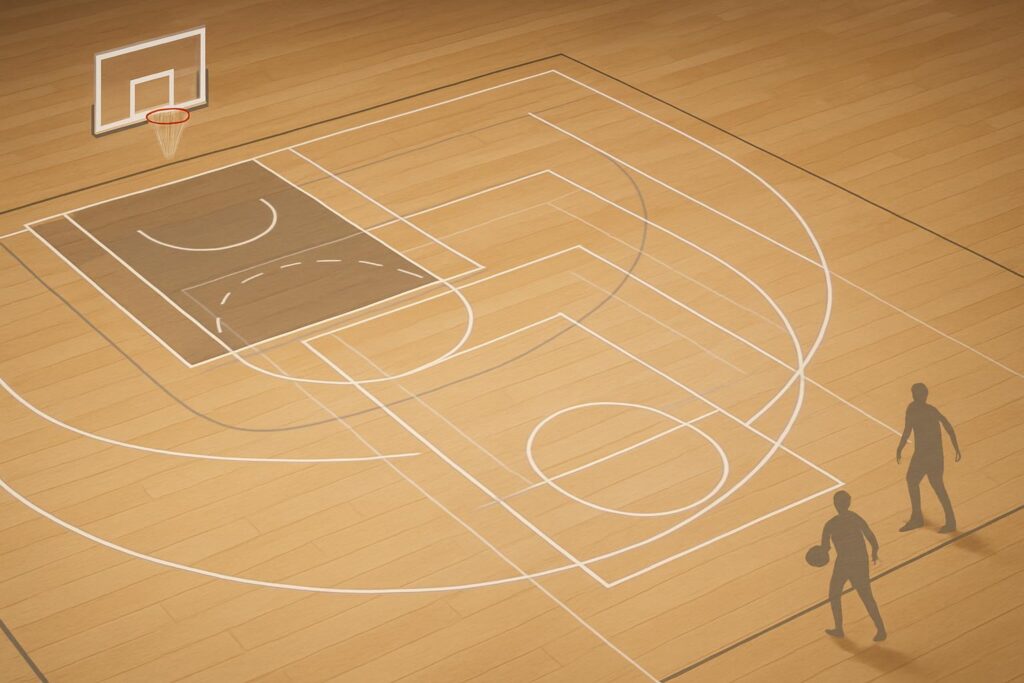
Court dimensions define playable space and the reference lines officials use to judge scoring and violations. The boundary lines (sidelines and endlines) are out of bounds. The center line splits backcourt and frontcourt. The free-throw line and lane (key) define the three-second area. The three-point line defines whether a made shot is worth two or three points. The restricted area semicircle affects charge/block decisions near the rim.
Officials use these markings to rule on: out-of-bounds, frontcourt/backcourt status, three-second violations, whether a try is for two or three points, and restricted-area charge/block decisions.
League-by-League Dimensions and Officiating Notes
NBA (United States)
- Court size: 94 ft x 50 ft.
- Three-point line: 23 ft 9 in at the arc; 22 ft in the corners (line runs parallel to the sideline).
- Lane (key): 16 ft wide; free-throw circle radius 6 ft.
- Free-throw line: 15 ft from the backboard plane.
- Restricted-area semicircle: 4 ft radius from the basket center.
- Backboard: 6 ft x 42 in; inner rectangle 24 in x 18 in; basket ring 18 in diameter; backboard plane is 4 ft from the endline.
Officiating impact: NBA officials judge three-point attempts by the shooter’s feet at release—any part on the line is two points. Corner threes are tight due to the 22 ft distance and proximity to the sideline; stepping on or outside the sideline is out of bounds. The offensive three-second count applies to players in the lane while their team controls the ball in the frontcourt. Defensive three seconds (NBA-specific) results in a technical free throw plus retained possession.
Common scenarios:
- Toe-on-the-line wing jumper: Scored as two points; baseline official or center official tracks the shooter’s feet at release.
- Drive and charge near the rim: If the defender’s feet are inside the 4-ft restricted area and he’s a help defender, it’s generally a blocking foul (with specific exceptions in the rulebook). Lead official locates the defender’s feet relative to the arc.
- Corner three with a side step: If the outside foot touches the sideline prior to release, it’s out of bounds; ball awarded to the defense at the nearest spot.
WNBA (United States)
- Court size: 94 ft x 50 ft.
- Three-point line: 22 ft 1.75 in at the arc.
- Lane: 16 ft wide; free-throw circle radius 6 ft.
- Free-throw line: 15 ft from the backboard plane.
- Restricted-area semicircle: 4 ft radius.
- Backboard and rim: Same as NBA.
Officiating impact: The arc is shorter than the NBA, affecting spacing and shot selection. Officials use the same foot-placement standard on threes and the same boundary rules. Offensive three seconds is enforced in the lane; restricted-area judgments mirror the geometry above.
NCAA (Men and Women, United States)
- Court size: 94 ft x 50 ft.
- Three-point line: 22 ft 1.75 in at the arc for both men and women.
- Lane: 12 ft wide; free-throw circle radius 6 ft.
- Free-throw line: 15 ft from the backboard plane.
- Restricted-area semicircle: 4 ft radius.
- Backboard and rim: Same as NBA.
Officiating impact: With a 12-ft key, post positioning and three-second calls happen in a narrower space than the NBA. Review protocols allow officials to confirm two vs. three on made shots in certain situations; regardless, the live call relies on where the shooter’s feet are at release.
Examples:
- Transition pull-up behind the arc: Trail official checks the lead foot on lift-off; if a heel is on the line, it’s two points.
- Post player camps with one foot in the paint: The count continues—exiting the lane with both feet (or a try contacting the ring) resets the count.
- Charge/block near rim: If the help defender’s feet are inside the 4-ft arc at contact, it is typically a block. Crew communicates arc status early on drives.
NFHS (High School, United States)
- Court size: Commonly 84 ft x 50 ft; some schools use 94 ft x 50 ft.
- Three-point line: Implemented nationwide; exact distance and arc style can vary by state or facility. Verify with your state association and host site.
- Lane: 12 ft wide.
- Free-throw line: 15 ft from the backboard plane.
- Restricted-area semicircle: Use varies by state; many courts have none or use a state-adopted arc.
- Backboard and rim: Same dimensions as above.
Officiating impact: The shorter court quickens backcourt counts and compresses spacing. Coaches should confirm home and away floor markings in pregame, especially the three-point arc and whether a no-charge semicircle is present. Officials brief captains if unique markings are in play.
FIBA (International)
- Court size: 28 m x 15 m (≈ 91 ft 10 in x 49 ft 2.6 in).
- Three-point line: 6.75 m at the arc; 6.60 m in the corners.
- Lane: 4.9 m (≈ 16.1 ft) wide.
- Free-throw line: 4.6 m (≈ 15.1 ft) from the backboard plane.
- Restricted-area semicircle: 1.25 m (≈ 4 ft 1 in) radius.
- Backboard and rim: Same size and height.
Officiating impact: The slightly smaller court tightens space and changes angles for help defense and spacing. FIBA’s corner distance is shorter than the arc apex, creating a different value proposition for corner threes compared to the NCAA/WNBA arc on a 94-ft court.
How Officials Judge the Lines: What Counts and When
Out-of-Bounds
- Definition: Sidelines and endlines are out of bounds. A player or the ball touching any boundary surface (including the line) is out of bounds.
- When it occurs: At the moment the ball or the player in control contacts the boundary or beyond.
- Ruling and penalty: Ball awarded to the opponents for a throw-in at the nearest spot (no free throws). Shot clocks reset per league rules.
Example: A shooter’s heel hits the sideline before releasing a corner three—officials rule out of bounds, no try, throw-in to the defense at the nearest spot.
Two vs. Three Points
- Definition: A try is three points if the shooter has both feet completely behind the three-point line at the time of release; the line itself does not count as “behind.”
- When it’s decided: At the instant the ball leaves the shooter’s hand.
- Ruling: Any part of either foot on or above the line at release makes it a two-point try. Officials focus on the shooter’s feet, not where the ball is released.
Example: A player lands on the line after release—still three points if both feet were behind at the moment of release.
Three-Seconds in the Lane (Offense)
- Definition: An offensive player may not remain in the lane (the painted key) for more than three consecutive seconds while his/her team controls the ball in the frontcourt.
- When it occurs: Count starts when the offensive team gains frontcourt control and the player has any part in the lane; it ends when the player fully exits, a try is released and touches the ring/backboard (league-dependent), or control ends.
- Ruling and penalty: Violation; team loses the ball on a throw-in. (NBA also has defensive three seconds with a different penalty.)
Example: A post player with one foot in the paint who never fully clears before re-entering can be called; officials watch both feet, advantage gained, and resets on shots.
Restricted Area (No-Charge Semicircle)
- Definition: Secondary defenders cannot draw a player-control foul if their feet are on or inside the restricted-area arc under the basket (with specific rulebook exceptions).
- When it applies: On drives to the basket with a help defender arriving near the rim.
- Ruling and penalty: Block if the help defender is inside/on the arc and no exception applies; otherwise standard charge/block criteria. Fouls result in throw-ins or free throws based on team foul counts and try status.
Example: Help defender arrives with heels on the arc as the dribbler rises: officials signal a block. Lead official locates the feet relative to the arc before judging legal guarding position.
Why the Differences Matter for Coaches and Players
- Spacing and shot value: Deeper NBA arc stretches defenses; FIBA corners are notably shorter than the top of the arc, encouraging corner threes. NCAA/WWNBA distance compresses closeouts and affects pick-and-roll spacing.
- Lane width: A 12-ft college/high school lane provides more post congestion and quicker three-second decisions than the 16-ft pro/international lanes.
- Court length: High school’s 84-ft floor rewards conditioning and early offense differently than 94 ft; teams should adjust press breaks and timing of entries.
- Practice transfer: High school shooters moving to college should train one to two feet behind the current arc to build range margin; similarly, pros prepare for the deeper 23’9″ line.
Youth and Age-Group Considerations
There is no single national youth-court size. Community leagues often scale courts and equipment to age: smaller courts, no three-point line for the youngest divisions, lowered rims, and shorter free-throw distances. If you organize or coach youth teams:
- Prioritize development: Use smaller playing areas and lowered rims for younger ages to promote proper shooting form and decision-making.
- Match dimensions to players: For elementary ages, many leagues use shortened courts or half-court games; the three-point line is often omitted.
- Verify local standards: Ask your league coordinator for the exact court dimensions and line markings before the season. Plan practice spacing and shooting drills accordingly.
Common Mistakes and Misunderstandings
- Thinking the line is “in”: The boundary line is out of bounds, but the three-point line is not “behind the arc.” Standing on the three-point line makes a try worth two, even though standing on the sideline makes you out.
- Assuming all U.S. courts are 94×50: Many high schools use 84×50. Adjust press and substitution patterns to the floor you’re playing on.
- Confusing arc distances: NBA is not the same as NCAA/WWNBA/FIBA. Players training for different levels should shoot from the correct distance.
- Forgetting corner geometry: Corner threes are the shortest in NBA and FIBA due to parallel lines; footwork must be precise to avoid out-of-bounds or a two-point ruling.
- Overlooking lane width: Post-spacing and paint touches feel different in a 12-ft key versus a 16-ft key—tweak play calls and timing accordingly.
- Assuming a restricted area exists at every high school: Many states do not use it or use different markings. Coaches should confirm before tip-off.
Frequently Asked Questions
Do all NCAA courts have the same three-point line?
Yes. Both NCAA men and women use a 22 ft 1.75 in arc at the top. Facility layouts can affect where the arc transitions to straight lines near the corners, but the apex distance is standard.
Why is the NBA corner three shorter?
The NBA uses straight lines parallel to the sideline in the corners (22 ft), creating a shorter distance than the 23 ft 9 in arc at the top. This is a design compromise to keep playable space along the baseline and sideline.
Is the free-throw line always 15 feet?
Functionally, yes across NBA, WNBA, NCAA, and NFHS—it’s measured 15 ft from the plane of the backboard. FIBA’s specification is 4.6 m, which is essentially the same.
Can a high school game be played on a 94×50 court?
Yes. While many high schools use 84×50, some gyms have 94×50 floors. Confirm dimensions during scheduling and adjust conditioning and tempo plans.
How do officials decide two vs. three when a shooter is fading or jumping sideways?
They track the shooter’s feet at the moment of release. Where the shooter lands does not matter. If any foot is on the line at release, it’s two points.
What happens after an out-of-bounds call?
The opponents receive the ball for a throw-in at the nearest spot to where it went out (some leagues specify hash marks). No free throws are awarded for an out-of-bounds violation.
Why does lane width change between college and the pros?
A wider lane at the pro/international level opens driving lanes and discourages paint camping, while the college 12-ft key tightens post play and help defense. Each code balances spacing and physicality differently.
How should youth teams handle three-point lines?
Many youth divisions don’t use a three-point line at all, emphasizing layups, free throws, and midrange form first. Follow your league’s age-specific guidelines and court markings.
Final Thoughts
Get the big four right for your level: floor size, three-point distance, lane width, and the restricted area. Players should train footwork and shooting to the exact arc they’ll face, coaches should tailor spacing and sets to the lane and court length, and officials and team staff should confirm the venue’s markings pregame—especially in high school and youth gyms where dimensions vary. When in doubt, remember: the boundary line is out, the three-point line is not “behind,” and the call is made at the instant of release.