
We are reader supported. When you purchase through links on our site, we may earn an affiliate commission. Also, as an Amazon affiliate, we earn from qualifying purchases.
Fans often accuse referees of favoring the home team.
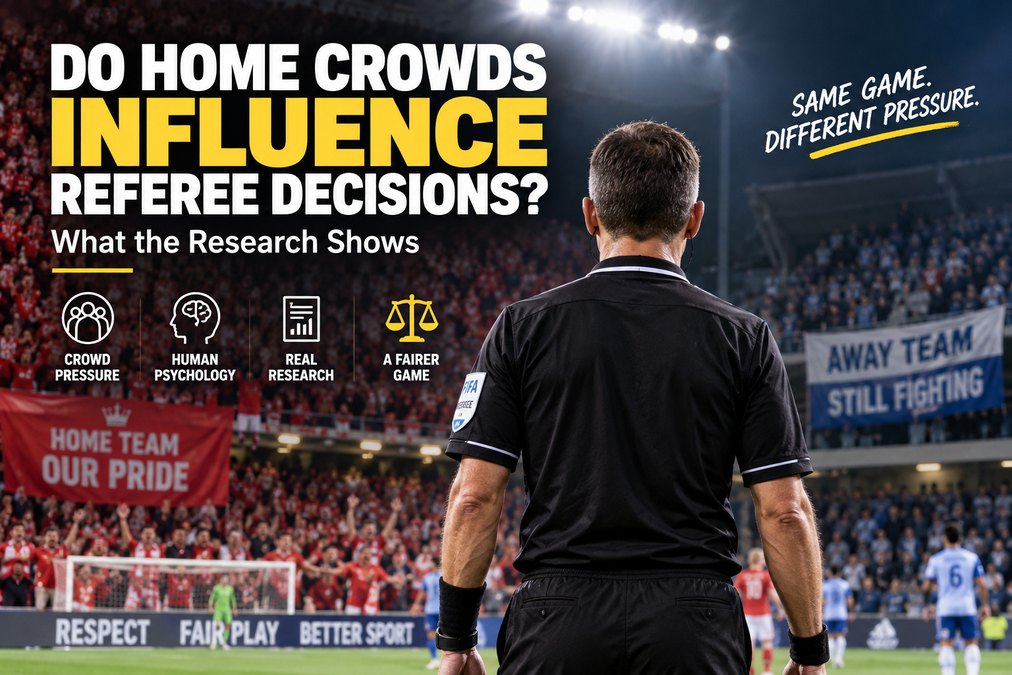
But does crowd pressure actually change officiating decisions?
Research suggests that it can—but the effect is more subtle than simply saying referees “favor” the home team.
Laboratory experiments, match data, and especially the unusual period of games played without spectators during the COVID-19 pandemic provide evidence that crowd presence can influence some judgment-based referee decisions.
At the same time, refereeing is only one part of home advantage.
Here is what the evidence actually shows.
What Is Home Advantage?
Home advantage describes the tendency for teams to perform better at home than away.
Several factors can contribute:
- familiar surroundings
- travel demands on the visiting team
- tactical differences
- player confidence
- crowd support
- possible effects on officiating
That last factor is particularly difficult to measure.
If an away team receives more fouls or cards, it does not automatically mean the referee was biased. The away team may simply have defended more, had less possession, or committed more genuine fouls.
Researchers therefore need better evidence than simply comparing raw home and away penalty totals.
An Experiment Found Crowd Noise Changed Referee Decisions
One of the most influential experiments was published in Psychology of Sport and Exercise in 2002.
Researchers Alan Nevill, Nigel Balmer, and A. Mark Williams showed recorded football challenges to qualified referees.
Some referees watched the incidents with crowd noise.
Others evaluated them without the crowd soundtrack.
The result was striking.
Referees exposed to crowd noise awarded 15.5% fewer fouls against the home team than referees watching the same incidents in silence.
Because the actual video incidents were the same, the experiment isolated crowd noise as an important variable.
The researchers concluded that crowd noise influenced decisions in favor of the home side.
This does not mean referees consciously decided to help the home team.
Instead, the experiment suggests that the environment surrounding a judgment can affect how the same incident is interpreted.
Added Time Provides Another Clue
Another influential line of research examined something referees historically had considerable discretion over: added time.
Researchers Luis Garicano, Ignacio Palacios-Huerta, and Canice Prendergast studied professional football in Spain.
They found that referees systematically gave different amounts of additional time depending on the match situation.
When the home team was narrowly behind, referees tended to allow more additional time.
When the home team was narrowly ahead, matches tended to end sooner.
Importantly, the effect appeared in close games where additional time could matter most.
The researchers also found evidence connecting the size and composition of the crowd with referee behavior.
That supported the idea that social pressure, rather than a deliberate desire to favor a particular club, could influence discretionary decisions.
COVID Created a Huge Natural Experiment
For decades, researchers had a major problem:
Almost every professional match had spectators.
Then COVID-19 temporarily removed them.
Professional leagues around the world suddenly played matches in largely empty stadiums.
That created an unusual natural experiment.
Researchers could compare:
football with crowds
against
football without crowds.
The results produced some of the strongest evidence yet that spectators can influence officiating.
Study: More Than 40,000 Matches
A 2021 study published in PLOS ONE examined more than 40,000 football matches, including more than 1,000 professional matches played without spectators.
The researchers found that the usual tendency for away teams to receive more sanctions changed when spectators disappeared.
Without crowds, the increased sanctioning of away teams disappeared for:
- fouls
- yellow cards
- red cards
The differences were statistically significant.
However, the researchers also found something important:
Home advantage itself did not disappear completely.
Home teams also showed changes in playing performance, including fewer shots and shots on target.
That means referees cannot explain the entire home-field advantage.
Crowds appear to influence both players and officials.
Another Study Looked at 1,498 Empty-Stadium Matches
A separate study published in Economics Letters examined 1,498 matches played without crowds across 23 leagues in 17 countries during the 2019/20 season.
It found significantly fewer yellow cards being issued to away teams when spectators were absent.
In other words, one of the normal home-team advantages in disciplinary decisions became smaller without a crowd.
Again, this is stronger evidence than simply observing that home teams receive favorable calls.
The same competitions suddenly removed one major environmental variable: spectators.
Referee behavior changed with it.
A Study of More Than 4,000 Matches Reached a Similar Conclusion
Another analysis used more than 4,000 matches from 12 European leagues, comparing games played with spectators and games played in empty stadiums.
The researchers estimated that removing fans reduced home advantage by roughly one-third.
Their model attributed the reduction to two broad effects:
- home-team performance declined
- referee bias disappeared
This again suggests that officiating contributes to home advantage but is not its only cause.
Newer Research Still Finds an Effect
The empty-stadium period also allowed researchers to study specific decisions more carefully.
A 2025 study in Sports Economics Review compared actual added time with expected added time calculated using ball-in-play data.
The study found evidence of home-team favoritism in additional-time decisions when spectators were present, but not when matches were played behind closed doors.
It also found that the magnitude of the effect increased with crowd size.
When spectators returned after the pandemic, the tendency toward home-favoring additional time also returned.
That strengthens the social-pressure explanation.
So Are Referees Biased?
The word bias needs to be used carefully.
The evidence does not show that professional referees deliberately decide:
“I want the home team to win.”
A more plausible interpretation is unconscious social influence.
Referees make rapid decisions while processing:
- player movement
- contact
- position
- game state
- communication
- crowd reactions
For an obvious decision, crowd noise may make little difference.
For an ambiguous challenge, however, thousands of people reacting simultaneously can become another signal entering the decision-making environment.
That is where small biases are most likely to appear.
Which Calls Are Most Vulnerable?
Research is strongest for decisions containing some degree of discretion.
Examples include:
Fouls
Contact can sit between clearly legal and clearly illegal.
That creates room for interpretation.
Yellow and Red Cards
The referee must evaluate not only whether an offence occurred but also its severity and disciplinary consequence.
Empty-stadium studies found measurable changes in card patterns.
Added Time
Historically, deciding exactly how much time to add involved referee judgment.
Research has repeatedly found home-favoring patterns in close matches.
More objective decisions should theoretically be less vulnerable to crowd pressure.
Whether the ball completely crossed a line, for example, can now be resolved through goal-line technology in competitions that use it.
Does Crowd Size Matter?
There is evidence that it can.
The 2025 additional-time study found that referee bias increased with crowd size.
Earlier research into social pressure also linked crowd characteristics with referee decisions.
This makes intuitive sense, but it should not be simplified into:
bigger stadium = more biased referee.
Crowd size interacts with stadium design, match importance, supporter behavior, referee experience, and the specific decision being made.
Researchers observe statistical patterns across many games, not a guaranteed effect in every match.
Does This Explain All of Home Advantage?
No.
This is one of the most important conclusions from the research.
The PLOS ONE study found that even though crowd-related differences in referee sanctions changed during empty-stadium games, home advantage did not simply vanish.
Home teams also performed differently without supporters.
Other factors can include:
- familiarity with the venue
- travel
- tactical behavior
- psychological effects on players
- routines
- game state
Referee decision-making is therefore one component of a much larger home-advantage system.
Why Empty Stadiums Were So Important to Researchers
Ordinary match statistics have a causality problem.
Suppose away teams receive more yellow cards.
Possible explanation A:
The referee favors the home team.
Possible explanation B:
The away team actually commits more card-worthy fouls.
Both can produce the same box-score pattern.
Empty-stadium games gave researchers something closer to a natural experiment because crowd presence changed dramatically while the fundamental rules of the sport remained largely the same.
When officiating patterns changed alongside crowd removal, the argument for social pressure became substantially stronger.
It still does not prove that every individual decision is influenced by spectators.
But it provides much better evidence than raw home-versus-away statistics alone.
Can Technology Reduce Crowd Influence?
Potentially.
Technology is most effective when it converts a judgment into a more objective measurement.
Goal-line technology is a good example.
If sensors determine that the entire ball crossed the line, crowd reaction becomes largely irrelevant to that decision.
Video review can also provide additional angles for important incidents.
However, technology cannot eliminate judgment from sport.
A referee reviewing contact may still need to decide:
- Was the contact careless?
- Was it reckless?
- Was the player impeded?
- Was the contact sufficient for a foul?
Technology provides more evidence.
It does not automatically remove interpretation.
What the Research Does Not Prove
The evidence should not be stretched beyond what the studies actually show.
It does not prove:
- every referee favors home teams
- every league has the same effect
- every controversial home decision resulted from crowd pressure
- referees intentionally favor home teams
- crowd influence explains all home advantage
The studies identify patterns across groups of decisions and matches.
They cannot tell us that a particular penalty in a particular game occurred because 50,000 people were shouting.
That distinction matters.
What Leagues Can Do
The research suggests several reasonable approaches.
Referee training can include high-pressure environments and crowd noise.
Performance analysis can examine whether individual officials develop unusual home-away decision patterns.
Replay and objective officiating technology can reduce uncertainty in appropriate situations.
Strong enforcement against abuse can also help distinguish passionate support from direct intimidation of officials.
The objective should not be to remove atmosphere from sport.
Crowds are part of what makes live competition compelling.
The challenge is helping officials make consistent decisions inside that atmosphere.
Bottom Line
Yes, there is credible evidence that home crowds can influence referee decisions.
A controlled experiment found referees exposed to crowd noise awarded 15.5% fewer fouls against the home team.
COVID-era natural experiments involving thousands of professional football matches found that some home-favoring differences in fouls and disciplinary cards became smaller or disappeared when spectators were removed.
Research on added time has also found patterns favoring home teams in close games, with newer evidence indicating stronger effects when crowds are larger.
But the conclusion requires nuance.
Crowd influence appears to be one contributor to home advantage, not the entire explanation, and the evidence describes statistical tendencies rather than intentional misconduct by referees.
The most accurate conclusion is therefore not:
“Referees help the home team.”
It is:
Under pressure and uncertainty, the presence of a home crowd can subtly shift some human officiating decisions.