
We are reader supported. When you purchase through links on our site, we may earn an affiliate commission. Also, as an Amazon affiliate, we earn from qualifying purchases.
Technology has changed how baseball is officiated, analyzed, coached, and watched.
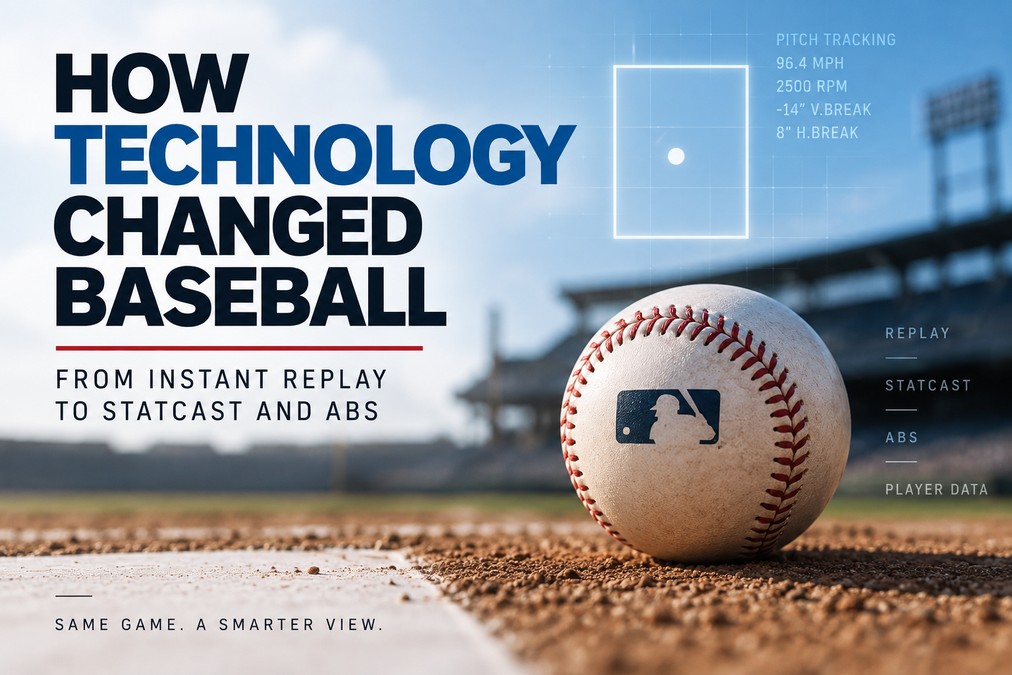
Instant replay can reverse certain calls on the field. Statcast tracks pitches, batted balls, and player movement. PitchCom allows pitchers and catchers to communicate electronically. And beginning with the 2026 MLB season, players can challenge ball-and-strike calls using the Automated Ball-Strike (ABS) Challenge System.
The important change is not simply that baseball has “more data.” Technology now affects decisions that happen during Major League games.
Here are the technologies that have had the biggest impact.
Instant Replay: From Home Runs to Full Replay Review
MLB introduced replay review on August 28, 2008.
At first, its use was narrow. Umpires could review disputed home-run boundary calls, including whether a ball was fair or foul, whether it left the ballpark, and possible fan interference.
That changed substantially in 2014.
MLB expanded replay review to a much wider range of situations and introduced manager challenges.
Reviewable plays now include specific situations involving tags, force plays, catches, boundaries, base touches, hit-by-pitches, runner placement, and other defined rulings.
The important limitation is that replay does not make every disputed decision reviewable.
MLB defines which types of calls can be reviewed.
How Replay Changed Baseball
Replay added a second layer to umpiring.
Instead of relying entirely on what an umpiring crew sees at full speed, certain calls can be examined using video from multiple angles.
That can produce three basic outcomes:
Confirmed: replay clearly supports the original ruling.
Stands: available evidence is not sufficient to change the ruling.
Overturned: replay provides sufficient evidence to change the call.
Technology therefore does not eliminate judgment. It provides additional evidence within a defined review system.
From PITCHf/x to Statcast
Pitch tracking developed separately from replay.
Earlier systems such as PITCHf/x helped measure pitch velocity, location, and movement.
MLB introduced Statcast league-wide in 2015, greatly expanding the amount of information available about pitches, batted balls, running, and defense.
The technology changed again in 2020 when MLB moved Statcast to a Hawk-Eye-based optical tracking system.
According to MLB, the Hawk-Eye Statcast setup uses 12 cameras around each ballpark.
Five cameras operating at 100 frames per second primarily track pitches, while seven additional cameras operating at 50 frames per second track players and batted balls.
That allows the system to measure events that are difficult to evaluate accurately with the human eye alone.
What Does Statcast Measure?
Statcast data include metrics such as:
- pitch velocity
- spin rate
- pitch movement
- release characteristics
- exit velocity
- launch angle
- sprint speed
- player positioning
- batted-ball trajectory
These measurements give teams and fans a more detailed picture of what happened on a play.
For example, two fastballs thrown at the same velocity may behave differently because of their movement and release characteristics.
Likewise, two balls hit at similar speeds can produce very different outcomes depending on launch angle and direction.
Exit Velocity and Launch Angle
Two of the most familiar Statcast metrics are exit velocity and launch angle.
Exit velocity measures how fast the baseball leaves the bat.
Launch angle describes the vertical angle at which the ball leaves the bat.
Neither metric determines the outcome by itself.
A very hard-hit ball can still become an out, while a softer hit can fall safely between defenders.
The value of these measurements is that they describe the quality and shape of contact more precisely than traditional box-score statistics alone.
Pitch Tracking and Pitch Design
Pitch tracking has also changed player development.
Modern tracking systems can measure how a pitch moves, how quickly it travels, where it is released, and how it spins.
Pitchers and coaches can use those measurements during training to compare different grips and release patterns.
Instead of relying only on whether a pitch “looks better,” a pitcher can see whether a mechanical or grip adjustment actually changed measurable characteristics.
That does not mean data automatically create a better pitch.
The measurements provide feedback. Players and coaches still have to decide how to use it.
ABS Arrived in MLB in 2026
One of the biggest recent changes is the Automated Ball-Strike Challenge System, commonly called ABS.
After years of testing in the Minor Leagues, MLB Spring Training, and the 2025 All-Star Game, MLB introduced the ABS Challenge System for the 2026 Major League season.
Importantly, MLB did not replace home-plate umpires with a fully automated strike zone.
The umpire still makes the initial ball-or-strike call.
A batter, pitcher, or catcher who believes the call was wrong can immediately challenge it.
How the ABS Challenge System Works
Each team begins a standard game with two challenges.
Only the:
- batter
- pitcher
- catcher
can initiate a challenge.
Managers cannot initiate an ABS challenge.
The player signals immediately after the call by tapping their cap or helmet.
If the challenge is successful, the team keeps it.
If the challenge is unsuccessful, the team loses one.
MLB uses Hawk-Eye cameras to determine where the pitch crossed the defined ABS strike zone.
How Accurate and Fast Are ABS Challenges?
MLB’s testing provides useful real-world data.
During 2025 Spring Training testing, players challenged approximately 2.6% of called pitches.
The overturn rate was 52.2%.
MLB also reported that challenges during its 288-game Spring Training experiment took an average of approximately 13.8 seconds.
Those numbers help explain why MLB selected a challenge system rather than automatically allowing technology to call every pitch.
Human umpires continue making the normal calls, while technology is available for a relatively small number of disputed pitches.
Statcast Technology Powers ABS
The connection between Statcast and ABS illustrates how baseball technology has evolved.
The Hawk-Eye infrastructure used for modern tracking can determine pitch location with very high precision.
For ABS, MLB uses 12 Hawk-Eye cameras in each equipped ballpark.
The 2026 ABS strike zone is defined as a two-dimensional plane over the middle of home plate.
Its vertical limits are based on the individual player’s measured height, with the top at 53.5% of height and the bottom at 27%.
Any part of the ball touching the defined zone results in a strike under the ABS system.
PitchCom Changed Pitch Calling
Technology has also changed communication between pitchers and catchers.
PitchCom allows pitch information to be transmitted electronically rather than relying entirely on traditional hand signals.
That became particularly important after concerns about electronic sign stealing.
The system can also reduce the need for complicated sign sequences when runners are on base.
PitchCom is a good example of technology solving a communication problem without fundamentally changing what pitchers and catchers are trying to accomplish.
Technology and the Pace of Baseball
Not every important baseball technology is designed to measure performance.
The pitch timer is primarily a game-management tool.
When MLB introduced the modern pitch timer in 2023, the effect on game length was measurable.
MLB reported that the average nine-inning game in 2023 was about 24 minutes shorter than in 2022.
The 2022 average was 3 hours and 4 minutes, while the 2023 average fell to under 2 hours and 40 minutes.
This is a useful reminder that technology can change not only how baseball is measured, but also how quickly the game itself is played.
Has Technology Replaced Umpires?
No.
Replay and ABS illustrate a different model: technology supplements human officiating in specific situations.
Replay can correct certain reviewable calls.
ABS can correct challenged ball-and-strike calls.
But umpires still make the initial calls, manage the game, enforce rules, judge many plays that technology does not decide, and handle situations that require context and interpretation.
The trend has been toward technology-assisted officiating, not fully automated baseball.
A Short Timeline of Baseball Technology
2008: MLB introduces replay review for disputed home-run boundary calls.
2014: Replay review expands significantly and manager challenges become part of MLB games.
2015: Statcast begins its league-wide tracking era.
2020: Statcast moves to a 12-camera Hawk-Eye tracking system.
2022: ABS Challenge System testing begins in affiliated Minor League Baseball.
2023: MLB introduces the pitch timer and other pace-of-play changes.
2025: Major League players use ABS challenges during Spring Training and the All-Star Game.
2026: ABS Challenge System becomes part of Major League regular-season and postseason play.
Bottom Line
Baseball technology has moved far beyond radar guns and television replays.
Instant replay can correct defined on-field rulings. Statcast records the movement of pitches, batted balls, and players. Hawk-Eye provides detailed optical tracking. PitchCom changed pitcher-catcher communication. The pitch timer changed game pace.
And in 2026, ABS brought pitch-tracking technology directly into Major League ball-and-strike decisions.
The result is not a game run entirely by computers.
Instead, modern baseball increasingly combines human decisions with technological evidence—using machines to measure what happened while leaving players, coaches, and umpires responsible for what happens next.