
We are reader supported. When you purchase through links on our site, we may earn an affiliate commission. Also, as an Amazon affiliate, we earn from qualifying purchases.
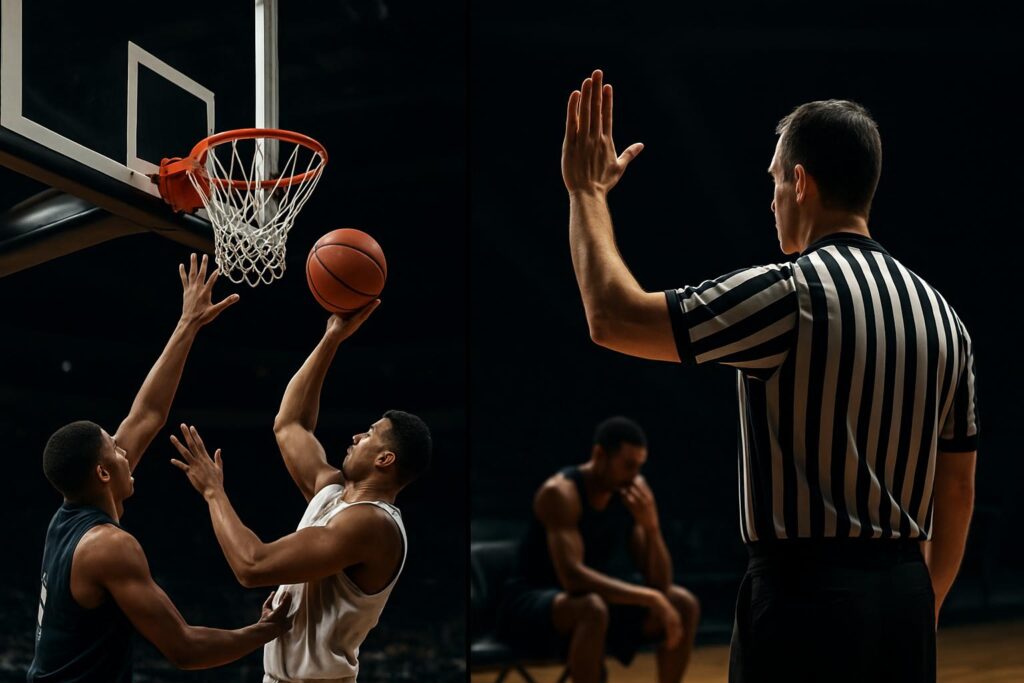
Technical vs personal foul, in one line: a personal foul penalizes illegal physical contact during play, while a technical foul penalizes unsportsmanlike or administrative behavior (often without contact) that can occur during a live or dead ball. Personal fouls usually lead to free throws only if a shot is affected or a team is in the bonus; technical fouls always award free throws and often carry additional discipline. This guide explains the exact penalties, how referees judge each call, and the differences across NBA, WNBA, NCAA, NFHS, and FIBA.
Quick Answer
Personal foul: illegal physical contact (hit on the shooter, push on a rebound, moving screen). Penalty depends on whether the player was shooting and the team-foul bonus for that league. Technical foul: unsportsmanlike conduct, delay/administrative issues, or certain defensive violations. Always results in free throws; possession may or may not change based on the code.
| League | Personal Foul (non-shooting) | Shooting Foul | Team-Foul Bonus | Technical Foul | Possession After Tech |
|---|---|---|---|---|---|
| NBA | Throw-in, unless in team penalty | 2 or 3 FTs (1 if made) | Penalty on 5th team foul in a period | 1 FT | Point of interruption (POI); defensive 3-sec: 1 FT + offense keeps ball |
| WNBA | Throw-in, unless in team penalty | 2 or 3 FTs (1 if made) | Penalty on 5th team foul in a period | 1 FT | POI; defensive 3-sec: 1 FT + offense keeps ball |
| NCAA Men | Throw-in, unless in bonus | 2 or 3 FTs (1 if made) | 7th–9th: 1-and-1; 10th+: 2 FTs (per half) | Class A: 2 FTs; Class B/administrative: 1 FT | POI |
| NCAA Women | Throw-in, unless in bonus | 2 or 3 FTs (1 if made) | 5th team foul per quarter: 2 FTs (no 1-and-1) | Unsporting: 2 FTs; administrative: 1 FT | POI |
| NFHS (HS) | Throw-in, unless in bonus | 2 or 3 FTs (1 if made) | 7th–9th: 1-and-1; 10th+: 2 FTs (per half) | 2 FTs | Opponent gets throw-in at division line |
| FIBA | Throw-in, unless in penalty | 2 or 3 FTs (1 if made) | 5th team foul per quarter: 2 FTs | 1 FT | POI |
Core Concepts and Definitions
What is a Personal Foul?
A personal foul is illegal physical contact that affects an opponent’s rhythm, speed, balance, or quickness. Examples include hitting the shooter’s arm, pushing a rebounder, using a forearm to dislodge a post player, or setting a moving screen. It is judged during live-ball play and, by rule, is contact-based.
Referees evaluate legal guarding position, verticality, displacement, advantage/disadvantage, and point of contact (e.g., head/neck is often judged more severely). If contact is marginal and does not confer an advantage, it is usually passed on.
What is a Technical Foul?
A technical foul penalizes unsportsmanlike conduct or administrative/delay violations. It can be called during a live ball or dead ball and may or may not involve contact (e.g., taunting, abusive language, bench decorum, hanging on the rim, calling an excessive timeout, illegal participation/equipment). In the NBA/WNBA, defensive three seconds is also penalized as a team technical.
Officials look for behavior that disrespects the game (profane language, overt gestures), delays play (repeated delay-of-game after a warning), or violates procedures (scorebook errors, illegal substitutes). The signal is the “T” formed with the hands; personal fouls are indicated with a closed fist.
When the Foul Occurs and How Play Resumes
Personal Foul Timing and Restart
- Timing: Live ball only.
- If shooting: Shooter gets 2 or 3 free throws if the shot misses; 1 free throw if the shot is made (all codes).
- If not shooting: Ball out-of-bounds to the offended team unless the defense is in the bonus/penalty (then free throws per code).
- Offensive (player/team control) foul: No free throws in NCAA/NFHS/FIBA; in NBA/WNBA, offensive fouls also do not award free throws. Ball awarded to the defense at the spot.
Technical Foul Timing and Restart
- Timing: Live or dead ball.
- Free throws: Always awarded (number depends on the code and class of technical).
- Possession: Resumes at the point of interruption in NBA/WNBA/NCAA/FIBA unless specified otherwise; NFHS awards two free throws and the ball at the division line to the opponents. NBA/WNBA defensive three seconds: one free throw plus the offense keeps the ball.
League-by-League: How Officials Administer Each Call
NBA
- Personal foul: Common contact foul. In the act of shooting: 2 or 3 FTs; if not shooting: throw-in unless the defense is in the team-penalty (then 2 FTs). A player fouls out at six personals.
- Technical foul: 1 FT to the opponents; play resumes at POI. Defensive three seconds: 1 FT plus the offense retains possession. Two unsportsmanlike technicals on the same person result in ejection.
WNBA
- Personal foul: Same framework as NBA. Team-penalty begins with the 5th defensive team foul of a period (2 FTs). Six personals to foul out.
- Technical foul: 1 FT to opponents; POI. Defensive three seconds: 1 FT and offense retains the ball. Two unsportsmanlike technicals lead to ejection.
NCAA (Men’s and Women’s)
- Personal foul (Men): 7th–9th team foul in a half triggers a 1-and-1; 10th+ triggers two free throws. Five personals to disqualify. Offensive/team-control fouls never shoot free throws.
- Personal foul (Women): Four quarters; on the 5th team foul of a quarter, all subsequent non-shooting defensive fouls are two free throws; five personals to disqualify. Offensive/team-control fouls do not shoot.
- Technical foul (Men): Class A (unsporting) = 2 FTs; Class B/administrative = 1 FT. Resume at POI.
- Technical foul (Women): Unsporting = 2 FTs; administrative = 1 FT. Resume at POI. Two technicals on the same person = ejection.
NFHS (U.S. High School)
- Personal foul: Bonus at 7th team foul per half (1-and-1); double bonus at 10th+ (two shots). Five personals to disqualify. Offensive/player-control fouls never shoot.
- Technical foul: Two free throws for the opponents, then the opponents receive the ball for a division-line throw-in opposite the table. Two technicals = disqualification.
FIBA
- Personal foul: Team penalty at 5th defensive team foul in a quarter; subsequent defensive non-shooting fouls are two free throws. Five personals to disqualify. Offensive/team-control fouls do not shoot.
- Technical foul: One free throw; resume at POI. Two technicals on the same person = disqualification. Unsportsmanlike fouls (separate from technicals) are two free throws plus possession.
Real-Game Situations and How They’re Ruled
1) Block/Charge on a Layup
A guard drives, a help defender slides late and makes hip-to-hip contact. If the defender was not in legal guarding position or moved into the path late, it’s a personal foul on the defender. NBA/WNBA: 2 FTs if the shot misses; NCAA/NFHS/FIBA: same. If the ball goes in, count it and award 1 FT.
2) Moving Screen at the Top
The screener shuffles into the defender after the ball-handler uses the pick. That’s a personal offensive (team-control) foul. In all codes, there are no free throws for the offense; the defense gets the ball at the spot of the foul.
3) Taunting After a Dunk
A player stands over an opponent and barks after a dunk. That’s an unsportsmanlike technical foul. NBA/WNBA: 1 FT to the opponents, ball at POI. NCAA Women/Men: 2 FTs for Class A; resume at POI. NFHS: 2 FTs and the ball at midcourt for the opponents. Repeat behavior risks ejection.
4) Defensive Three Seconds (NBA/WNBA)
A defender camps in the lane without actively guarding an opponent. The official counts to three and whistles a team technical. Penalty: any offensive player shoots 1 FT, and the offense retains the ball at the free-throw line extended.
5) Delay of Game After a Warning
An inbounder taps the ball away to slow a quick throw-in after already receiving a delay-of-game warning. That’s a technical foul. NBA/WNBA: 1 FT, POI. NCAA/NFHS/FIBA: administrative technical (penalty per code), typically resumed at POI (NFHS gives the ball at the division line).
6) Excessive Timeout
A coach requests and is granted a timeout with none remaining. This is a technical foul. NBA/WNBA: 1 FT to opponents; resume at POI. NCAA/NFHS/FIBA: administrative technical; opponents shoot (shots per code) and resume at POI (NFHS: plus the ball at the division line).
Referee Judgment: What Officials Look For
On Personal Fouls
- Legal guarding position: Established with both feet on the floor, facing the opponent; then verticality applies.
- Verticality and cylinder: Did the defender leave their vertical space? Did the contact displace the offensive player?
- Advantage/disadvantage: Was the contact marginal or did it affect the play outcome?
- Point of contact: High/above-shoulders contact is judged more severely; hits to the head/neck can escalate to flagrant/unsportsmanlike in all codes.
On Technical Fouls
- Behavioral thresholds: Profanity, personal insults, aggressive gestures, or prolonged taunting draw technicals.
- Delay/admin: Repeated delays after a warning, illegal jerseys/equipment, scorebook errors, illegal participation.
- Bench decorum: Assistant coaches standing/arguing, players leaving the bench area, crowd incitement.
- Game control: A first tech may be preventive; a second unsportsmanlike tech on the same person results in ejection (all codes).
Edge Cases, Exceptions, and Look-Alikes
- Dead-ball contact: Contact after the whistle is not a common personal; it’s penalized as a technical/unsportsmanlike-type foul depending on severity (shots and, in some codes, possession).
- Unsportsmanlike/Flagrant vs Technical: Flagrant (NBA/WNBA) and unsportsmanlike (FIBA) are severe contact fouls (2 FTs + possession). Technicals cover non-contact or minor contact without a play on the ball.
- Player-control fouls in the bonus: In NCAA/NFHS/FIBA, offensive fouls never award free throws even when the defense is in the bonus; the ball goes to the defense.
- Point of interruption (POI): After technical free throws, most codes resume where the game left off. NFHS is the key exception: opponents also get the ball at midcourt.
- Delay-of-game sequence: First delay is a warning (recorded); subsequent delays are technicals.
Practical Impact for Players, Coaches, and Officials
- Players: Control emotions—react, don’t overreact. Avoid hand-checks, body displacements, and illegal screens. Know your league’s bonus, so you understand when a bump becomes two free throws.
- Coaches: Teach verticality and legal screens. Establish bench decorum standards. Use timeouts and substitution procedures correctly to avoid administrative technicals.
- Officials: Communicate early (quick warnings on delays/bench behavior). Be consistent with advantage/disadvantage on contact, and clear about POI vs awarded possession based on the code.
Common Mistakes and Misunderstandings
- “Technical fouls always change possession.” Not in NBA/WNBA/NCAA/FIBA—those resume at POI. NFHS is the major exception (2 FTs + ball).
- “Any foul on a made basket is an and-1.” Only if the foul is on the shooter and the try is successful. Off-ball contact is a common personal; count the basket and administer the foul per bonus rules.
- “Offensive fouls shoot in the bonus.” In all codes noted here, offensive/team-control fouls do not award free throws.
- “Defensive three seconds exists everywhere.” It’s specific to NBA/WNBA. NCAA/NFHS/FIBA do not have a defensive three-second rule.
- “Technical = ejection.” One tech is a warning with penalty. Ejection generally comes with two unsportsmanlike technicals or a severe contact foul (flagrant/unsportsmanlike).
Frequently Asked Questions
Does a technical foul count as a personal foul?
In NBA/WNBA/FIBA, a technical does not count as a personal foul. In NCAA/NFHS, unsporting technicals are recorded as technicals, not personal fouls, but they do count toward ejection thresholds; the team foul count is affected per that code’s rules for technicals.
Can you have a technical and a personal on the same play?
Yes. Example: a defender commits a shooting foul, then argues with profanity. Administer the shooting free throws for the personal, then the technical free throw(s), and resume play per the code (POI for most; division-line throw-in for NFHS).
What’s the penalty for a bench technical?
NBA/WNBA: 1 FT, POI. NCAA Men: 2 FTs if Class A; 1 FT if Class B/administrative; POI. NCAA Women: 2 FTs for unsporting; 1 FT for administrative; POI. NFHS: 2 FTs plus the ball at the division line.
How many personal fouls before disqualification?
NBA/WNBA: Six. NCAA/NFHS/FIBA: Five.
Is hanging on the rim always a technical?
No. If a player briefly hangs to prevent injury (e.g., traffic under the basket), it’s legal. Prolonged or showboating hangs are a technical (all codes empower officials to use safety judgment).
What’s the difference between a flagrant (NBA/WNBA) and a technical?
A flagrant involves severe or unnecessary/excessive contact (penalty: two free throws and the ball; ejection for the most severe). A technical penalizes conduct or administrative issues and typically carries free throws but not automatic possession except where specified (e.g., NFHS, NBA/WNBA defensive 3 seconds).
Do team fouls reset by quarter or half?
NBA/WNBA/FIBA: by quarter. NCAA Men: by half. NCAA Women: by quarter. NFHS: by half.
Who shoots the technical free throws?
Any eligible opponent on the floor may shoot in most codes; teams typically choose their best free throw shooter. For NBA/WNBA defensive three seconds, the offensive team chooses any player on the floor.
How to Avoid Each Type of Foul
Avoiding Personal Fouls
- Defend with chest, not hands—show verticality at the rim.
- Set screens stationary and square; give time and distance on moving defenders.
- Beat drives with early help, not late body checks.
Avoiding Technical Fouls
- Use calm, brief communication with officials; avoid demonstrative reactions.
- Know administrative details: correct jerseys, legal substitutions, timeout count.
- After whistles, hand the ball to the nearest official—don’t delay restarts.
Final Thoughts
Think of personal vs technical this way: contact vs conduct. Personal fouls manage physical play; technical fouls manage sportsmanship and administration. The penalty details vary by league—especially bonus rules and what happens after a technical—so players and coaches should know their code. Master legal guarding and verticality to avoid personals, and maintain composure and clean game operations to avoid technicals. That awareness saves possessions, free throws, and sometimes the game.