
We are reader supported. When you purchase through links on our site, we may earn an affiliate commission. Also, as an Amazon affiliate, we earn from qualifying purchases.
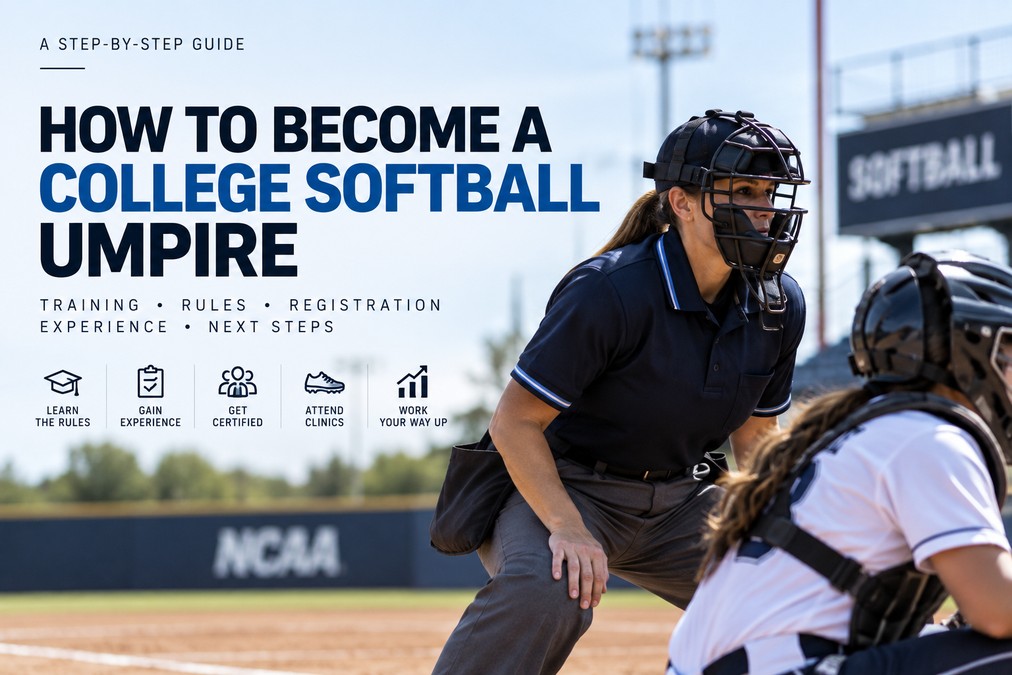
How to Become a College Softball Umpire
Becoming a college softball umpire usually does not start with an NCAA game.
Most officials first learn the job at the high school, recreational, travel-ball, or other amateur level. They build experience behind the plate and on the bases, attend clinics, learn college mechanics and rules, and gradually develop relationships with assignors who hire officials for collegiate games.
There is also an important distinction to understand:
The NCAA writes rules and provides national officiating resources, but simply registering with the NCAA does not automatically give you college game assignments.
Assignments are handled through conferences, coordinators, assignors, and officiating organizations.
Here is a practical path from beginner to college softball umpire.
1. Start Officiating Softball Locally
If you have never umpired before, jumping directly into college softball is unrealistic.
Start where you can develop the fundamental skills of officiating:
- positioning
- safe/out mechanics
- balls and strikes
- foul-ball decisions
- interference and obstruction
- substitutions
- communication
- game management
High school softball is one common entry point.
The NCAA itself directs prospective officials toward resources including the National Federation of State High School Associations (NFHS) and the National Association of Sports Officials (NASO) when explaining where new officials can begin.
Local umpire associations can also provide training and game assignments.
The goal at this stage is not simply to accumulate games. It is to develop consistent mechanics and judgment.
2. Learn the NCAA Softball Rulebook
College softball has its own rules and interpretations.
The NCAA publishes the official NCAA Softball Playing Rules, along with a softball case book containing game situations that help officials apply the written rules.
For 2026–27, NCAA resources include:
- the NCAA Softball Rules Book
- the 2026–27 Softball Case Book
- rules interpretations and clarifications
- major rules changes
- umpiring resources
An official moving from high school or another softball code should not assume every rule transfers directly.
Differences in areas such as substitutions, equipment, obstruction, pitching, video review, and game administration can matter.
Studying the rulebook is therefore part of moving up—not something to do only after receiving a college assignment.
3. Register Through the NCAA Officiating System When Appropriate
The NCAA maintains national officiating resources through its officiating program.
Its current officiating resources include RefQuest+ (RQ+), registration information, background-check resources, and sport-specific education.
The NCAA’s broader officiating reform initiative has expanded the number of NCAA-registered officials and standardized parts of education and compliance across conferences.
Registration, however, should not be confused with hiring.
Being registered makes you part of the relevant officiating infrastructure. It does not guarantee that a conference will assign you games.
4. Complete Required Education and Compliance Steps
College officials may need to complete requirements associated with their conference, officiating organization, or NCAA program.
These can include:
- rules education
- rules examinations
- background-check consent
- sport-specific training
- officiating compliance requirements
- required meetings or clinics
Exact requirements can change, so use current NCAA and conference information rather than relying on an old checklist from another umpire.
The NCAA’s current officiating resources specifically include registration information, a registration fee chart, background-check program information, and education tools.
5. Attend Softball Umpire Clinics and Camps
Knowing the rulebook is only part of collegiate officiating.
Evaluators also need to see whether you can apply those rules while working a real game.
Clinics and camps can help develop:
- plate mechanics
- base positioning
- rotations
- crew communication
- timing
- judgment
- handling coaches
- game awareness
They can also put officials in front of assignors and experienced collegiate umpires.
That networking matters because college games are assignments, not simply jobs that anyone with a registration can claim.
The NCAA’s own softball officiating structure includes national coordinators and sport-specific umpiring resources intended to improve consistency in rule application and mechanics. (NCAA.org)
6. Build a Strong Record at Lower Levels
Assignors need evidence that an umpire can handle faster games and more difficult situations.
That reputation develops through actual work.
An umpire who consistently demonstrates good positioning, rules knowledge, communication, professionalism, and composure becomes easier to recommend for higher-level assignments.
Do not treat lower-level games as merely a waiting room for college softball.
Those games are where you develop the habits that assignors eventually evaluate.
7. Connect With College Softball Assignors
This is one of the most important parts of the process.
College softball assignments are generally managed through conferences and officiating coordinators or assignors.
That means aspiring collegiate umpires need to determine who assigns games in their region.
Useful questions include:
- Which conferences operate near me?
- Who coordinates softball officials for those conferences?
- Which camps or clinics do they evaluate?
- What experience do they expect?
- Which registration or testing requirements apply?
- Are they currently accepting new officials?
The NCAA directory and conference websites can help identify relevant organizations and officiating contacts.
A professional introduction accompanied by your officiating history is much more useful than simply asking, “How do I get NCAA games?”
8. Be Ready for Evaluation
Moving into college softball means more than knowing whether a runner is safe or out.
Officials are evaluated on the entire performance.
That can include:
Rules knowledge
Do you understand the current college rulebook and interpretations?
Mechanics
Are you in the correct position to make the call?
Timing
Do you allow the play to develop before making the ruling?
Communication
Can you explain a ruling without escalating a disagreement?
Crew work
Can you rotate and communicate effectively with other umpires?
Game management
Can you keep control of a competitive game while remaining professional?
Those skills become increasingly important as the level of competition rises.
9. Keep Up With Rule Changes Every Season
College softball rules do change.
For example, recent NCAA changes have included the implementation of the double first base and modifications to video-review procedures.
In August 2025, the NCAA Playing Rules Oversight Panel approved a double first base requirement for Division I beginning with the 2025–26 academic year, with Divisions II and III following in 2026–27.
The same rules action also changed video review so that a team retains its challenge when the on-field call is overturned. (NCAA.org)
That is exactly why an umpire cannot rely on what they learned several seasons earlier.
Current rules, interpretations, case plays, and mechanics should be part of preseason preparation every year.
Do You Need Previous Umpiring Experience?
There is no single universal number of games or years that automatically qualifies someone to umpire college softball.
That is why claims such as “you need exactly three years of high school experience” should be treated cautiously unless a specific conference or assignor states that requirement.
In practice, previous experience matters because collegiate games demand strong mechanics, rules knowledge, and game management.
The better question is not:
“How many years do I need?”
It is:
“Can I demonstrate that I am ready for the level I want to work?”
Individual assignors and conferences may have their own expectations.
Do You Have to Be an NCAA Employee?
No.
College officials should not be assumed to be NCAA employees simply because they work NCAA contests.
The officiating ecosystem involves conferences, schools, coordinators, assignors, and officiating platforms.
The NCAA provides rules, education, national officiating infrastructure, championship policies, and other resources, while regular-season assignments are managed within the broader collegiate officiating structure.
How Long Does It Take to Reach College Softball?
There is no responsible universal answer.
Someone who already has substantial high-level softball umpiring experience may progress much faster than a complete beginner.
Geography also matters.
An area with many college programs and an active officiating network may offer a different path from a region with fewer collegiate games.
Rather than targeting an arbitrary number of years, focus on progression:
Learn → work games → receive feedback → improve → attend clinics → meet assignors → earn higher-level assignments.
What Equipment Do College Softball Umpires Need?
Exact uniform and equipment requirements depend on the organization assigning the game.
Plate umpires typically need appropriate protective equipment, while all officials need approved uniforms and footwear.
Before purchasing expensive gear specifically for college softball, check the standards of the conferences or associations you expect to work.
Uniform requirements can vary, and buying first and asking later can waste money.
A Practical Path to College Softball
For a new umpire, the process can be simplified to:
Step 1: Find a local softball officiating association.
Step 2: Learn basic mechanics and begin working games.
Step 3: Build experience at the high school, travel, or comparable amateur level.
Step 4: Study the current NCAA Softball Rules Book and Case Book.
Step 5: Complete the appropriate NCAA/conference registration, education, and compliance requirements.
Step 6: Attend collegiate softball clinics or camps.
Step 7: Identify the assignors and conferences operating in your region.
Step 8: Seek evaluation and feedback.
Step 9: Earn college assignments based on demonstrated readiness.
Step 10: Continue studying and being evaluated as you move toward higher-level games.
Where Should You Start?
If you are completely new to officiating, start with the NCAA’s Officiating and Referee Opportunities resources.
The NCAA specifically provides an officiating interest form and directs new officials toward organizations that can help them enter the profession. (NCAA.org)
If you already umpire softball and want to move into college games, your next priorities should be different:
study the current NCAA softball rules, identify collegiate assignors in your region, and find camps or clinics where your mechanics can be evaluated.
Bottom Line
Becoming a college softball umpire is not a matter of filling out one NCAA application and immediately receiving games.
It is a progression.
You first need to learn how to officiate, build a record of reliable work, understand NCAA softball rules and mechanics, satisfy applicable registration and compliance requirements, and become visible to the people who assign college games.
The NCAA provides official rules and national officiating resources, but assignments are earned through the collegiate officiating network.
If you are starting from zero, begin locally.
If you are already an experienced softball umpire, begin studying the NCAA rulebook and connecting with college assignors.
In both cases, the path is the same at its core:
learn the rules, work games, seek feedback, and earn the next level.