
We are reader supported. When you purchase through links on our site, we may earn an affiliate commission. Also, as an Amazon affiliate, we earn from qualifying purchases.
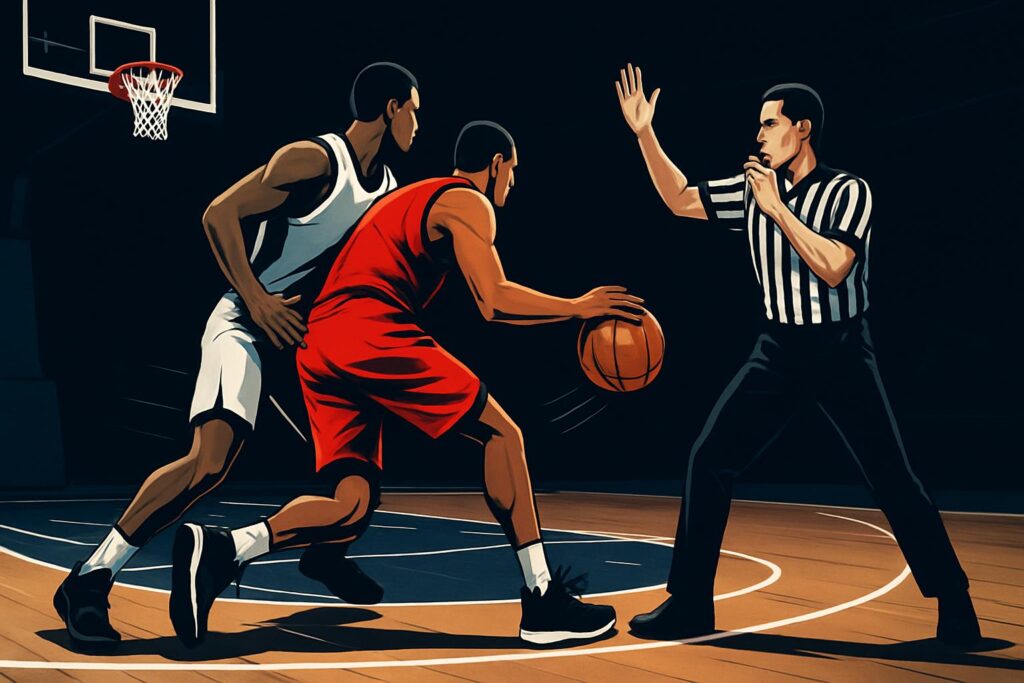
Blocking vs Charging Foul: How Referees Make the Call
Quick Answer
A charging foul is an offensive foul when a ballhandler or shooter runs into a defender who has established legal guarding position; a blocking foul is on the defender when that position or timing is illegal. Referees primarily judge (1) legal guarding position, (2) when contact occurs relative to the shooter leaving the floor, and (3) whether the defender is inside a restricted-area arc near the basket. Across all major rule sets, offensive fouls do not result in free throws; blocking fouls may lead to free throws based on the league’s penalty rules.
Summary at a glance (restricted-area arc radius)
– NBA: 4 feet
– WNBA: 4 feet
– NCAA: 4 feet
– NFHS: Arc use and specifications vary by state adoption; check your state association
– FIBA: 1.25 m (about 4.1 feet)
What We’ll Cover
– Clear definitions of blocking vs charging
– Exactly what referees watch: position, timing, contact, restricted area
– How NBA, WNBA, NCAA, NFHS, and FIBA differ
– Common in-game situations and exceptions
– How play resumes and when free throws apply
– Practical tips for players and coaches to avoid whistles
Definitions and Core Concepts
What is a charging foul?
– Plain definition: An offensive (player-control) foul when a dribbler or shooter makes significant contact with a defender who has established and maintains legal guarding position (LGP).
– Key traits: The defender’s torso is contacted; the defender arrived legally (on time and in position); and the defender isn’t in a restricted area where charges by secondary defenders are not allowed.
What is a blocking foul?
– Plain definition: A defensive foul when a defender does not establish or maintain LGP, moves into the path late, slides under an airborne player, or otherwise initiates illegal contact.
– Key traits: The defender is late, moving forward into contact, inside the restricted area as a help defender, or contacts the dribbler without having established LGP.
Legal Guarding Position (LGP)—the bedrock of the call
– Establishing LGP: Defender faces the opponent with both feet on the floor. After that, the defender may move laterally or backward to maintain the position.
– Timing: The defender must achieve LGP before the offensive player leaves the floor for a shot or pass (all major rule sets use this timing concept).
– Verticality: With LGP, the defender may jump straight up within their vertical cylinder; contact caused by the offense jumping into that space is generally offensive, contact caused by the defender going forward is defensive.
Restricted-Area Arc—where secondary charges die
– Purpose: To prevent help defenders from sliding under drivers at the rim.
– Basic effect: A secondary defender standing with feet inside or touching the arc cannot draw a charge on a drive to the basket. A primary defender guarding the ball from the start of the play is generally not protected by the arc (league language varies but the spirit is consistent).
– Radius: NBA/WNBA/NCAA use 4 feet; FIBA uses 1.25 m; NFHS adoption and markings vary by state.
How Referees Make the Call: The Checklist
Referees read the play in this order:
1) Who is the defender—primary or secondary?
– Primary: Guarding the ballhandler from the initial move. May draw a charge at the rim even near/inside the arc (league language varies).
– Secondary: Help defender rotating to take a hit. Must be outside the restricted area to draw a charge on a drive.
2) Where is the defender’s body?
– LGP established? Two feet down, torso facing. After that, lateral/backward movement is OK; lunging forward is not.
3) When does the contact occur?
– Did the defender legally arrive before the offensive player left the floor for a shot or pass?
4) Where did contact occur relative to the arc?
– If the secondary defender’s foot is on/inside the arc, it’s usually a blocking foul on a driving play to the rim.
5) What kind of contact?
– Torso-to-torso favors charge if LGP and timing are met. If the defender clips the side/hip or slides under airborne player, it’s a block.
6) Was there displacement, extension, or a push-off by the ballhandler?
– Clear-off with the forearm or shoulder can be an offensive foul, arc or not.
League-by-League: Key Differences and What Stays the Same
Common ground across NBA, WNBA, NCAA, NFHS, FIBA
– LGP standard and timing relative to airborne status are very similar.
– Secondary defenders cannot draw charges inside the restricted area on drives to the basket.
– Offensive fouls (player control) do not result in free throws; the ball is awarded to the defense.
Restricted-area specifics
– NBA and WNBA: 4-foot arc. Secondary defenders in/over the arc generally cannot draw a charge on a drive. Replay and Coach’s Challenge may be used to confirm whether the defender’s feet were inside the arc on close calls.
– NCAA (Men’s and Women’s): 4-foot arc. Secondary defenders must be outside the arc to draw a charge on a drive. The airborne timing standard applies (defender must be there before the shooter leaves the floor).
– NFHS (U.S. High School): Use of a restricted-area arc is determined by state adoption. Where present, the practical application mirrors the “secondary defender must be outside the arc” concept. Coaches and officials should confirm their state’s policy and gym markings.
– FIBA: 1.25 m arc. A secondary defender in the no-charge semicircle cannot draw a charge on a player driving to the basket.
Penalty and resumption of play
– Charging (offense):
– NBA/WNBA/NCAA/NFHS/FIBA: Offensive foul; no free throws; ball awarded to the defensive team at the spot or nearest designated spot.
– Blocking (defense), non-shooting:
– NBA/WNBA: Side out unless in the penalty; in penalty, two free throws.
– NCAA Men: Bonus free throws begin at seven team fouls per half (1-and-1), and two free throws at 10+ (double bonus).
– NCAA Women: Two free throws beginning with the fifth team foul each quarter; no 1-and-1.
– NFHS: 1-and-1 at seven, two free throws at ten per half.
– FIBA: Two free throws on the fifth team foul in a quarter.
– Blocking on a shooter:
– All: Free throws awarded based on the shot (two or three) unless the basket is made (and-1).
On-Court Situations and How They’re Judged
1) Help defender slides under late in the paint
– Situation: Wing drive; big rotates from weak side, feet on/inside the arc; contact at the chest, driver airborne.
– Ruling: Blocking foul. Secondary defender is in the restricted area and arrived late. Same outcome NBA/WNBA/NCAA/FIBA; at high school, same if arc is adopted.
2) Defender beats the driver to the spot, outside the arc
– Situation: Point guard drives; on-ball defender shuffles, squares chest just outside the arc; torso-to-torso contact; shooter still on the ground when contact starts.
– Ruling: Charging foul on the offense. LGP and timing established; outside the arc.
3) Defender moving forward into contact
– Situation: Help defender sets up just outside arc but lunges forward at the last step as the driver gathers.
– Ruling: Blocking foul. Even outside the arc, lunging forward or not having LGP at contact makes it a block.
4) Eurostep around a stationary defender
– Situation: Driver steps around a stationary help defender outside the arc but clips the defender’s shoulder with hip contact.
– Ruling: Usually a no-call or a block if the defender moved into the path late and didn’t get chest contact. Mere contact isn’t automatically a charge; it’s about legal position and who created the disadvantage.
5) Offensive push-off on the perimeter
– Situation: Ballhandler uses off arm to create space versus a set defender 25 feet from the rim.
– Ruling: Offensive foul (player-control). Restricted area is irrelevant away from the basket.
6) Primary defender under the rim
– Situation: The same defender who guarded the ball from the top stays with the driver into the lane; both reach the restricted area; chest-to-chest contact occurs.
– Ruling: Often a charge if LGP/timing are met. Primary defenders generally are not subject to the no-charge semicircle protection that applies to secondary help.
What Officials Look For in Real Time
– Feet and torso first: Did the defender establish with two feet down, facing the opponent?
– The gather and upward motion: Was LGP in place before the offense left the floor?
– Angle of contact: Chest (charge) vs. side/hip (often block).
– Defender’s movement: Lateral/backward acceptable; forward lunge is illegal.
– Restricted area awareness: Are one or both heels on/inside the arc line?
– Displacement: Did someone get knocked off their path by illegal contact?
– Arms and hands: Vertical hands are legal; reaching or extending forward suggests a block.
Exceptions and Nuances
– Verticality: A defender who goes straight up after establishing LGP is typically legal. If the shooter initiates contact into the defender’s chest, it often favors the defense.
– Lower-body displacement: Knees/hips jutting out by the defender to cause contact is a block.
– Flops: Simulated fouls are subject to penalties in some leagues (e.g., NBA has an in-game penalty). The underlying call still relies on LGP and real contact.
– Screens vs. charges: Illegal screens involve the screener not giving required time/distance; a dribbler charging into a legal screener can be an offensive foul.
– No restricted-area relevance: On perimeter plays or post-ups away from the arc, the arc has no bearing.
Common Mistakes and Misunderstandings
– “Feet must be set.” Not exactly. The defender must establish LGP but may move laterally or backward. “Set” doesn’t mean frozen.
– “Any contact equals a charge if the defender falls.” No. Officials judge who created the illegal contact and whether LGP and timing were met.
– “Arc always protects the offense.” Only versus secondary defenders on drives. Primary defenders can still draw charges near the rim.
– “If the offense is airborne, it’s always a block.” Not if the defender legally obtained LGP before the player left the floor.
– “Hands straight up means no foul either way.” Verticality protects space, but if the defender is moving forward or arrived late, it can still be a block.
– “High school has the same arc everywhere.” Arc rules and markings vary by state association; verify your local adoption.
How Players and Coaches Can Avoid the Whistle
For defenders
– Be early, be square: Get outside the arc when rotating. Show chest and establish LGP before upward motion.
– Don’t lunge forward: Slide laterally or retreat; avoid stepping into the path late.
– Know roles: Primary defenders can stand their ground; secondary defenders must clear the arc.
For ballhandlers
– Read the help: Use jump stops, Eurosteps, or floaters to avoid square chests.
– Change speeds and angles: Make defenders adjust; don’t drive through stationary torsos.
– Control the off-arm: Don’t push off to create separation.
For coaches
– Teach the arc and timing: Practice closeout angles and early help outside the arc.
– Film review: Pause at the gather to see if the defender had LGP; train recognition.
– Drill verticality: Bigs must go straight up; guards must finish around chests, not through them.
Frequently Asked Questions
1) Does a defender need both feet down at the moment of contact?
– The defender must have established LGP with two feet down initially. At contact, they may be moving laterally/backward and may even have a foot up, provided they are maintaining LGP and not moving forward into contact.
2) Is hip-to-hip contact ever a charge?
– Rarely. Torso-to-torso is a strong indicator of a charge. Glancing or hip contact often signals a late slide by the defender, leading to a block or no-call.
3) What if the offensive player goes airborne first?
– If the defender had not established LGP before the offense left the floor for a shot or pass, it’s usually a block. If the defender already had LGP, a charge is possible.
4) Does the restricted area matter on post-ups?
– Generally no. The arc applies to drives to the basket and secondary defenders. Back-to-the-basket contact away from the rim is judged by LGP, displacement, and verticality—not the arc.
5) Can you take a charge on a pass, not a shot?
– Yes. The timing standard (before the passer leaves the floor) still applies; the arc still limits secondary defenders on drives that lead to passes at the rim.
6) How do free throws work after an offensive foul?
– Offensive fouls do not result in free throws in NBA, WNBA, NCAA, NFHS, or FIBA (unless there’s an additional technical/unsportsmanlike). The ball is awarded to the defense.
7) Are block/charge calls reviewable?
– NBA games can use replay/Coach’s Challenge to check elements such as restricted-area position on close block/charge plays. Other levels have limited or no video review in-game.
8) Does flopping change the block/charge result?
– The underlying judgment remains the same. If officials deem the contact simulated, leagues with flopping penalties may add a separate sanction.
Similar Rules That Get Confused
– Illegal screen vs. charge: A moving screener is a defensive or offensive team-control issue depending on possession and contact; a dribbler who plows into a legal screener is an offensive foul.
– Player-control foul vs. team-control foul: “Charging” is a type of player-control foul. In college and high school, all team-control fouls (including player-control) do not result in bonus free throws.
– Verticality vs. block: Straight up with LGP is legal. Leaning forward or bodying through the shooter is a block regardless of hand position.
When Exactly the Foul Occurs
– The violation happens at the moment of illegal contact. For charges, officials confirm that LGP existed before the airborne phase. For blocks, they often see late movement into the path, forward lunge, or contact by a secondary defender inside the arc.
How Play Resumes After the Whistle
– Charging (offense): Ball awarded to the defensive team for a throw-in at the nearest spot; no free throws.
– Blocking (defense): If the foul is on a shooter, free throws are awarded; if not a shooting foul, resume per league penalty (side out or bonus).
Practical Film-Study Triggers for Referees, Players, and Coaches
– Freeze at the gather: Was the defender already legal?
– Check the feet: Outside or on the arc? Are they sliding forward?
– Identify chest: Is it torso-to-torso or a side clip?
– Note roles: Primary vs. secondary defender changes the arc equation.
– Track momentum: Who created displacement?
Final Thoughts
Block/charge decisions hinge on three pillars: legal guarding position, timing relative to the airborne phase, and restricted-area status for secondary defenders. If a defender legally gets there early, shows chest, and is outside the arc on a drive, a charge is likely; if they’re late, inside the arc, or lunge forward, expect a block. Players should attack at angles and avoid push-offs; defenders should rotate early and slide, not lunge; coaches should teach arc awareness and verticality. Master these cues, and you’ll read—and influence—this pivotal call with confidence at any level.