
We are reader supported. When you purchase through links on our site, we may earn an affiliate commission. Also, as an Amazon affiliate, we earn from qualifying purchases.
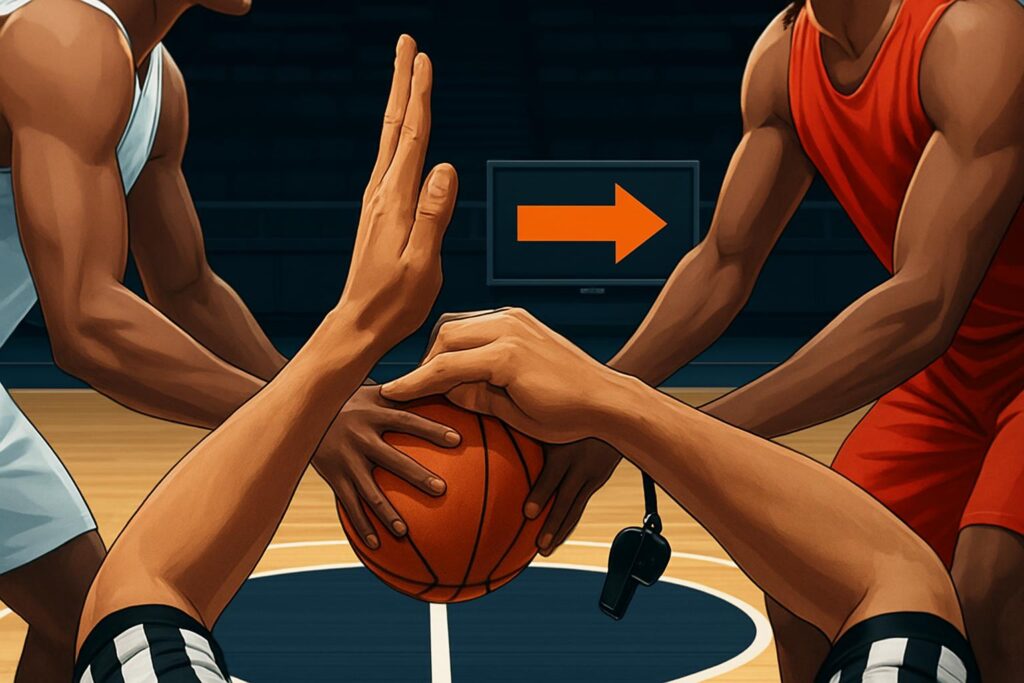
The possession arrow is the rule most U.S. levels (college, high school) and FIBA use to decide who gets the ball on “jump ball” situations like a held ball or a lodged ball, without re-jumping. It alternates between teams after each alternating-possession (AP) throw-in ends. The NBA and WNBA do not use a possession arrow—those leagues resolve held balls and similar situations with an actual jump ball. Below is a complete, practical guide to how alternating possession works, what referees look for, and how rules differ by league.
Quick Answer
In NCAA, NFHS (high school), and FIBA play, the possession arrow points to the team that will receive the next alternating-possession throw-in. The arrow is set after the opening jump when a team first gains control, and it flips after each AP throw-in ends (or if the AP throw-in team commits a throw-in violation). The NBA and WNBA do not use an arrow; they administer a jump ball for held balls and similar “simultaneous” situations.
| League | Possession Arrow Used? | Held Ball | Wedgie (ball wedges between rim/backboard) | Start of Overtime |
|---|---|---|---|---|
| NBA | No | Jump ball | Jump ball | Jump ball |
| WNBA | No | Jump ball | Jump ball | Jump ball |
| NCAA (Men/Women) | Yes | Alternating-possession throw-in | Alternating-possession throw-in | Jump ball |
| NFHS (High School) | Yes | Alternating-possession throw-in | Alternating-possession throw-in | Jump ball |
| FIBA | Yes | Alternating-possession throw-in | Alternating-possession throw-in | Jump ball |
What Is the Possession Arrow?
The possession arrow is a display at the scorer’s table that indicates which team is entitled to the next alternating-possession throw-in. It is used instead of a jump ball for most “simultaneous” scenarios—most commonly a held ball, where two opponents firmly hold the ball so neither can gain control without undue roughness.
In NCAA, NFHS, and FIBA games, the arrow is established after the opening tip when a team first gains control. The arrow then points to the other team. Whenever an AP throw-in is administered, the arrow flips when the throw-in ends (ball legally touched inbounds) or if the AP throw-in team violates (e.g., 5 seconds, stepping on the court) before the throw-in ends.
How Alternating Possession Works
Step-by-Step
- Game starts with a jump ball (all codes).
- Once a team gains control from the opening jump, the arrow is set to point to the opponent (NCAA/NFHS/FIBA).
- When a “jump ball situation” occurs (e.g., held ball, simultaneous out of bounds, wedgie), the team indicated by the arrow gets a throw-in at the nearest spot (not under the backboard in some codes).
- The official signals the direction, places the thrower-in, and starts the 5-second count.
- When the AP throw-in ends (the ball is legally touched on the court), the arrow flips to the other team. If the AP throw-in team violates before the ball is touched inbounds, the opponent gets the ball and the arrow flips (NCAA/NFHS/FIBA).
When Officials Use the Arrow
- Held ball (tie-up) – two opponents each have firm control at the same time.
- Simultaneous out of bounds – last touched simultaneously by opponents.
- Ball lodged between the ring and backboard (“wedgie”) during a live ball.
- Certain simultaneous or offsetting situations with no team control (varies slightly by code); when penalties cancel and no team clearly earned the ball, AP can be used (NCAA/NFHS/FIBA).
Referee Judgment and Administration
How Referees Judge a Held Ball
- Visual: Two opponents each grasp the ball with one or both hands.
- Criteria: Neither player can gain control without excessive force or roughness.
- Signal: Official blows the whistle and gives the “held ball” signal (both thumbs up), then clearly indicates the AP direction.
Spot of the Throw-In
- Generally the nearest spot to where play stopped, outside the boundary line.
- If the stoppage is under/behind the backboard, the spot may be adjusted to a designated throw-in location (depends on code and local mechanics).
When the Arrow Flips
- After the AP throw-in legally ends (touch inbounds) – arrow flips.
- If the AP throw-in team violates before the throw-in ends (5 seconds, stepping on court, illegal movement) – opponent gets the ball and the arrow flips immediately.
- If the defense violates during the AP throw-in (e.g., kicking the ball, reaching across the boundary and contacting the ball) – same AP team keeps the ball for a new throw-in and the arrow does not flip.
Fouls During an AP Throw-In
- No free throws are awarded simply because of AP. Free throws only occur if a foul merits them by rule (e.g., bonus, flagrant, or shooting once the ball is on the court).
- If the defense commits a common foul during the AP throw-in, administer by rule for that code; the arrow flips only when the AP throw-in ends or the throw-in team violates.
League-by-League: Where the Arrow Applies
NCAA (Men and Women)
- Uses possession arrow for held balls, simultaneous out of bounds, and lodged balls.
- Game starts with a jump ball; the arrow is set to the opponent of the team that first gains control.
- Start of period: Men (two halves) – the second half begins by the arrow. Women (four quarters) – quarters 2, 3, and 4 begin by the arrow.
- Overtime starts with a jump ball (no arrow at OT start).
NFHS (High School)
- Uses possession arrow for held balls and similar simultaneous situations.
- Game starts with a jump ball; arrow is set toward the team that did not gain initial control.
- Quarters 2, 3, and 4 begin by the arrow.
- Overtime starts with a jump ball.
FIBA
- Uses possession arrow for held balls and other “jump ball situations,” including wedgies.
- Game starts with a jump ball; the arrow is set once a team gains control.
- Periods 2, 3, and 4 begin by the arrow.
- Overtime starts with a jump ball.
NBA and WNBA
- No possession arrow. All held balls and wedgies are resolved with a jump ball.
- Game and overtime periods begin with a jump ball.
- Strategy note: Because jump balls decide these situations, matchups at the circle (height, timing, and positioning) matter more than in arrow-based codes.
Common Game Situations and Rulings
1) Low-post tie-up
Scenario: A center drop-steps and a help defender clamps the ball; both players have firm control.
- NCAA/NFHS/FIBA: Held ball – alternating-possession throw-in to the team indicated by the arrow, at the nearest spot. Arrow then flips after the throw-in ends.
- NBA/WNBA: Held ball – jump ball between any two opponents per the rules (often the two players involved) at the nearest circle.
2) Rebound knocked out by both players simultaneously
Scenario: Two players battle for a rebound and the ball goes out with simultaneous last touch.
- NCAA/NFHS/FIBA: Alternating-possession throw-in to the arrow team.
- NBA/WNBA: Jump ball between any two opponents at the nearest circle.
3) “Wedgie” on a jumper
Scenario: A corner three lodges between the rim and backboard.
- NCAA/NFHS/FIBA: Alternating-possession throw-in to the arrow team (not considered a try that changes possession automatically).
- NBA/WNBA: Jump ball at the nearest circle.
4) AP throw-in violation by the thrower
Scenario: After a held ball, the arrow points to Team A. The inbounder for Team A steps onto the court before releasing the ball.
- NCAA/NFHS/FIBA: Throw-in violation by the AP team. Team B is awarded the ball, and the arrow flips to Team B immediately.
5) Defensive boundary violation during AP throw-in
Scenario: During an AP throw-in for Team A, a defender reaches across the boundary and contacts the ball.
- NCAA/NFHS/FIBA: Defensive throw-in violation. Team A retains the ball for a new throw-in; the arrow does not flip because the AP throw-in did not end.
Exceptions, Edge Cases, and What Officials Watch
- Simultaneous personal/technical fouls: If penalties cancel and no team control exists, many codes resume with AP (check your code’s specific language).
- Timeouts do not change the arrow. The arrow changes only when the AP throw-in ends or the AP throw-in team violates.
- If the arrow is displayed incorrectly and an error is discovered, officials correct it at the first dead ball, based on the last completed AP opportunity.
Similar Rules That Are Easy to Confuse
- Held ball vs. traveling: If a defender legally ties the ball before a ball handler falls or shuffles, it’s a held ball (AP or jump ball by league), not traveling.
- AP throw-in vs. team-control foul: AP doesn’t create or remove bonus; a foul still follows each code’s penalty rules. AP only determines which team gets the ball on certain simultaneous situations.
- Replay reviews: Correcting who last touched the ball out of bounds is different from AP. The arrow is used only if the officials rule simultaneous touches.
Practical Impact and Strategy
For Players
- Secure the ball with two hands and pivot strong to avoid tie-ups that may give it away via the arrow.
- Know the arrow late in close games; it can dictate whether to fight a tie-up or call a timeout.
For Coaches
- Track the arrow possession-by-possession. Use it to inform ATO (after-timeout) plays and endgame decisions.
- On defense, if the arrow favors you, scrapping for a tie-up can be as valuable as a steal.
For Referees and Table Personnel
- Signal direction clearly after a held ball and confirm with the table.
- Flip the arrow only when the AP throw-in ends or the AP throw-in team violates.
- If there’s an arrow-display error, fix it at the next dead ball using the last completed AP event.
Common Mistakes and Misunderstandings
- Thinking the NBA or WNBA use an arrow. They do not—those leagues use jump balls.
- Assuming the arrow flips after any stoppage. It flips only after an AP throw-in ends or the AP throw-in team violates.
- Believing a timeout changes the arrow. It does not.
- Confusing a wedgie with a missed shot out of bounds. A wedgie is a “jump ball situation” (AP in NCAA/NFHS/FIBA; jump ball in NBA/WNBA).
- Forgetting period starts: At many levels that use the arrow, later periods (not the first) begin by the arrow, while overtime begins with a jump ball.
Frequently Asked Questions
Does the possession arrow ever award free throws?
No. The arrow only decides which team gets the ball for a throw-in on designated “jump ball situations.” Free throws occur only if a foul warrants them under that league’s penalty rules.
When exactly does the arrow change?
In NCAA, NFHS, and FIBA, the arrow flips when the AP throw-in ends (a legal touch inbounds) or immediately if the AP throw-in team commits a throw-in violation. Defensive throw-in violations do not flip the arrow.
Does the arrow apply to overtime?
Overtime begins with a jump ball in all major codes (NBA, WNBA, NCAA, NFHS, FIBA). After that opening OT jump, NCAA/NFHS/FIBA continue using the arrow for subsequent “jump ball situations.”
What happens if there’s a foul during an AP throw-in?
Administer the foul by rule for that code (e.g., common foul, bonus, technical). The arrow changes only when the AP throw-in ends or the AP throw-in team violates.
Who is responsible for flipping the arrow?
The official scorer or table personnel manage the visible arrow at the scorer’s table, under the crew chief/referee’s supervision. Officials confirm the direction on the floor.
Does a made basket or turnover affect the arrow?
No. Ordinary changes of possession during play do not affect the arrow. Only an AP opportunity (and its completion or a throw-in violation by the AP team) changes it.
Can the same team get consecutive APs?
Yes, if the defense violates during the AP throw-in and the throw-in is replayed, the arrow does not flip. The same team retains the AP until a legal inbounds touch ends the throw-in.
If the arrow device is wrong, is the play reversed?
If an error is discovered, officials correct the arrow at the next dead ball based on the last completed AP event. Completed plays stand; the display is corrected moving forward.
Final Thoughts
The possession arrow is a simple, fair way to handle simultaneous situations without constant re-jumps. Remember these essentials: NCAA/NFHS/FIBA use the arrow; NBA/WNBA do not. The arrow flips only once an AP throw-in legally ends or if the AP throw-in team violates. Officials judge held balls by firm, simultaneous control; wedgies and simultaneous out-of-bounds also trigger AP (or a jump ball in pro leagues). Track it, coach to it, and manage it cleanly at the table—it can decide a close game.