
We are reader supported. When you purchase through links on our site, we may earn an affiliate commission. Also, as an Amazon affiliate, we earn from qualifying purchases.
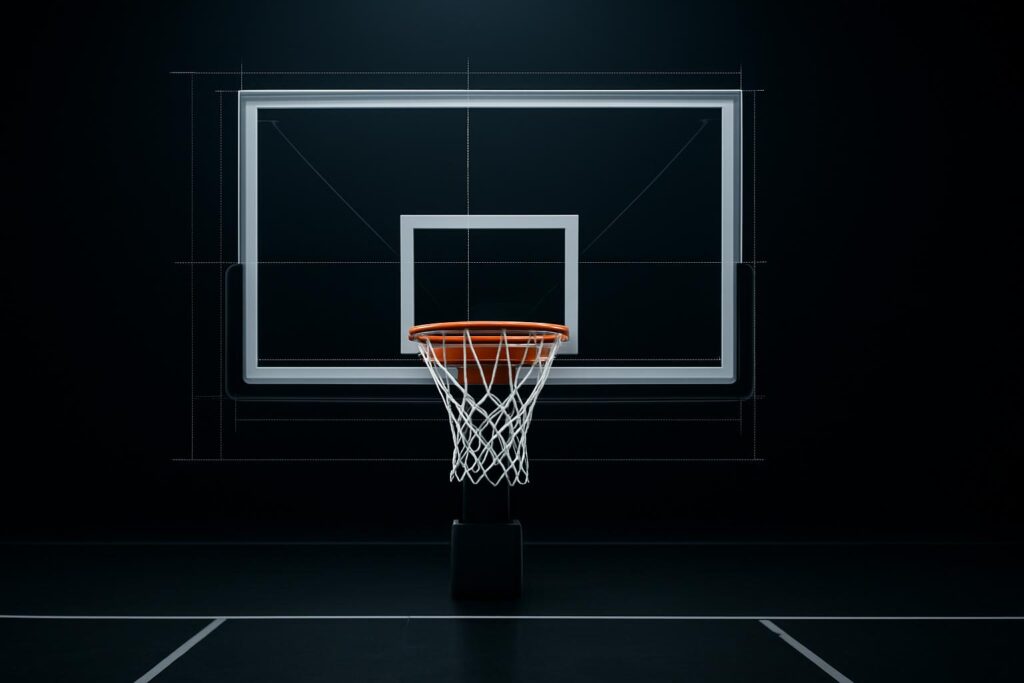
The regulation basketball backboard is a 72-by-42-inch (6′ x 3’6″) rectangle in the NBA, WNBA, NCAA, and NFHS; FIBA uses virtually the same size at 1.80 m by 1.05 m. The inner “shooter’s square” is 24 by 18 inches (NBA/WNBA/NCAA/NFHS) and 59 by 45 cm (FIBA), with 2-inch (5 cm) lines. The face of the backboard sits 4 feet (NBA/WNBA/NCAA/NFHS) or 1.2 m (FIBA) inside the endline, the ring is 18 inches in diameter, 10 feet high, and 6 inches in front of the board. Below, you’ll find a complete breakdown of dimensions, markings, referee rulings, and how players and coaches should use them.
Quick Answer
Across major rule sets, a regulation rectangular backboard is 72″ x 42″ (1.80 m x 1.05 m) with a 24″ x 18″ (59 cm x 45 cm) shooter’s square centered behind the rim. The board’s plane is 4 ft (1.2 m) from the endline, and the rim is 18″ in diameter, 10 ft high, with 6″ clearance from the board. Strikes on the top or sides of the backboard keep the ball live; contact with supports or the back of the board is out of bounds; the ball may not pass over the top of the board.
| League | Backboard Size | Shooter’s Square | Board-to-Endline | Top/Back/Over Ruling (Short) |
|---|---|---|---|---|
| NBA | 72″ x 42″ | 24″ x 18″ (2″ lines) | 4 ft | Top/sides live; back/supports or over = OOB |
| WNBA | 72″ x 42″ | 24″ x 18″ (2″ lines) | 4 ft | Top/sides live; back/supports or over = OOB |
| NCAA | 72″ x 42″ | 24″ x 18″ (2″ lines) | 4 ft | Top/sides live; back/supports or over = OOB |
| NFHS (HS) | 72″ x 42″ (fan boards allowed locally) | 24″ x 18″ (2″ lines) | 4 ft | Top/sides live; back/supports or over = OOB |
| FIBA | 1.80 m x 1.05 m | 59 cm x 45 cm (5 cm lines) | 1.2 m | Top/sides live; back/supports or over = OOB |
Backboard Basics: What It Is and Why It’s Marked
A basketball backboard is the flat surface behind the rim that allows legal rebounds and bank shots. In all top competitions (NBA, WNBA, NCAA, FIBA), it must be a transparent rectangular board, mounted rigidly and padded for safety. The “shooter’s square” is a visual target that helps players bank the ball at angles—think wing bank shots and layups that kiss the glass.
Officials use the board’s edges and markings to judge out-of-bounds, basket interference, and goaltending. For players, those same lines are aiming references. For coaches and facility managers, dimensions and placement guarantee consistency from court to court.
Official Dimensions and Markings by League
NBA and WNBA
- Backboard: 72″ wide x 42″ high, transparent and rectangular.
- Shooter’s square: 24″ wide x 18″ high, with 2″ line width, centered vertically and horizontally behind the ring.
- Rim: 18″ inner diameter; front of rim is 6″ in front of the backboard plane; rim height is 10′ from the playing surface; white net 15–18″ long.
- Placement: The backboard plane is 4′ inside the endline; supports, shot clock, and any structure behind the backboard are out of bounds if touched by the ball.
- Padding: Required on the bottom and sides of the backboard and on the ring assembly for player safety.
NCAA (Men’s and Women’s)
- Backboard: 72″ x 42″, transparent rectangular board required for competition-level play.
- Shooter’s square: 24″ x 18″ with 2″-wide lines; commonly white for visibility through the glass.
- Rim: 18″ diameter; 10′ rim height; 6″ clearance in front of the backboard; net 15–18″.
- Placement: Backboard plane 4′ inside endline; ball contacting the back or supports is out of bounds; it may not pass over the top of the board.
- Padding: Mandatory on the lower edges and ring assembly per safety standards.
NFHS (U.S. High School)
- Backboard: Regulation rectangular board is 72″ x 42″; fan-shaped boards are permitted in some gyms but not used in higher levels.
- Shooter’s square: 24″ x 18″ with 2″-wide lines; border markings on transparent boards improve visibility.
- Rim and placement: Same core specs as NCAA—18″ rim, 10′ height, 6″ clearance, backboard 4′ inside the endline.
- Padding: Required for safety on the board and ring assembly.
FIBA
- Backboard: 1.80 m x 1.05 m (approx. 72″ x 41.3″), transparent rectangular board.
- Shooter’s square: 59 cm x 45 cm with 5 cm line width, centered behind the ring.
- Rim: 45 cm (17.72″) inner diameter; 3.05 m (10′) rim height; 15 cm (approx. 6″) clearance from the backboard.
- Placement: Backboard plane is 1.2 m inside the endline; ball may not pass over the board and is out if it hits supports or the back.
- Padding: Required on lower edges and ring assembly.
How Officials Judge Backboard-Related Plays
1) Ball hits the top, sides, back, or supports
- Live ball off top or sides: In NBA, WNBA, NCAA, NFHS, and FIBA, a ball that hits the top or side of the backboard and rebounds back into the court is still live.
- Out of bounds (OOB): The ball is out if it hits the back of the backboard, any support structure, the shot clock (where present), or passes over the top of the board from any direction. Officials look for the ball’s path and the exact surface it contacted.
2) Bank shots and the shooter’s square
- Purpose: The 24″ x 18″ (or 59 x 45 cm) rectangle is centered on the rim and used as a visual target. On layups, aim for the upper inside corner; on wing banks, aim slightly higher on the square depending on distance and angle.
- Referee note: The square itself is only a marking; it does not define a cylinder or plane for interference. Officials rule interference/goaltending based on ball location relative to the ring and cylinder, not the square lines.
3) Slapping or vibrating the backboard
- Legal play vs. violation: Simply touching or even slapping the backboard while trying to block a shot is not automatically a violation.
- Basket interference: If a defender’s action causes the ring or backboard to vibrate and it affects the ball while it is on or within the basket cylinder, officials can rule basket interference and award the score.
- Unsporting conduct: In NCAA and NFHS, deliberately striking the backboard to disconcert an opponent can be ruled a technical foul. Officials judge intent and effect.
4) Shots from behind or around the backboard
- Not over the top: Across leagues, the ball may not pass over the top of the backboard. If it does, it’s out of bounds.
- Around the side is legal: A “circus” shot that travels around the side of the backboard (without touching the back or supports) and into the basket is legal. Officials track the ball’s path and any illegal contact with structures.
5) When play stops and how it resumes
- OOB due to back/support/over-top: The offending team loses the ball. Officials award a throw-in at the nearest spot (or designated spot per rule set).
- Basket interference/goaltending: If ruled on the defense, the basket counts and play resumes with a standard throw-in by the non-scoring team. If ruled on the offense, the basket is canceled and the defense gets the ball for a throw-in.
Three Real-Game Examples
- Example 1—Wing bank at the horn: A guard uses the top inside corner of the square for a banked buzzer-beater. The ball hits the square and drops in. Legal in all leagues. If a defender slapped the board after the ball hit the rim and obviously jarred it off, officials may rule defensive basket interference and count the basket.
- Example 2—Rebound off the top: A deep three bounces straight up, grazes the top edge of the backboard, and falls back into play. Officials keep the ball live. If it had struck the back of the backboard or shot clock, it would be out of bounds.
- Example 3—Behind-the-backboard runner: A player near the baseline floats a shot that arcs around the side of the backboard and in, without touching supports. Legal score. If the ball had gone over the top or brushed the support, it would be out of bounds.
Exceptions and Lesser-Seen Boards
- Fan-shaped boards: Permitted at some NFHS venues and in recreational settings, but not used in NBA, WNBA, NCAA, or FIBA competition. Dimensions and sightlines differ, which can change bank-shot aiming cues.
- Youth/backyard systems: Common widths include 54″ and 60″. They are not regulation, so the shooter’s square and bank angles won’t perfectly mirror competition courts. Coaches should note this when evaluating finishing drills at non-regulation baskets.
Player and Coach Implications
- Finishing angles: Teach athletes to use the upper inside corner of the square for layups and high off-glass touch from the wing. Emphasize consistent footwork so the square remains a reliable visual target.
- Rebound reads: Shots that hit the square often rebound softly near the lane line; shots that miss the square come off harder. Diagram likely rebound lanes during scouting.
- Defensive discipline: Contest shots without grabbing the rim or violently shaking the structure. Time blocks before the ball touches the glass if it’s on a downward path to avoid goaltending or interference calls.
- Facility checks: Ensure the backboard is the correct distance from the endline and padding is intact. A misaligned unit changes angles and can create safety and officiating issues.
Common Mistakes and Misunderstandings
- “Top of the board is out of bounds.” Incorrect. The top and sides are in-bounds surfaces; the back and supports are out.
- “Any backboard slap is a technical.” Not by default. It’s only a technical if it’s unsporting or intended to disconcert; otherwise, it’s legal unless it causes basket interference.
- “The ball can’t go behind the board at all.” It can travel around the side legally; it just can’t pass over the top or touch the back/supports.
- “All shooter’s squares are the same globally.” FIBA’s square is slightly narrower (59 cm vs. 24″ ≈ 61 cm), which can subtly change visual aiming at international events.
- “Fan boards are fine for high-level games.” They’re not used in NBA, WNBA, NCAA, or FIBA and alter bank angles and player perception.
- “Padding is cosmetic.” It’s mandatory safety equipment and can affect calls if contact moves the ring/backboard while the ball is on or in the cylinder.
Frequently Asked Questions
Is the 72″ x 42″ backboard size the same for men’s and women’s games?
Yes. NBA and WNBA share the same backboard size; NCAA men’s and women’s also use the same. FIBA uses the comparable metric size (1.80 m x 1.05 m).
How wide are the lines on the shooter’s square?
They are 2 inches (about 5 cm) wide across NBA, WNBA, NCAA, and NFHS. FIBA specifies 5 cm. The lines must be solid and clearly visible on transparent glass.
Does the square’s bottom edge line up with the rim?
Rules specify the square’s size and centering behind the ring; exact offsets are standardized by equipment diagrams. For players, the coaching cue is to use the inside upper corner for layups and adjust height for distance and angle.
Is it legal to bank a free throw off the backboard?
Yes. A free throw may legally be banked off the backboard in all major rule sets. It must still enter the basket cleanly without basket interference or goaltending.
Can a made shot count if it bounces on top of the backboard first?
Yes, provided the ball does not pass over the backboard and does not touch the back or any support. If it caroms off the top or sides and drops in, the basket counts.
Are there color or material requirements for the backboard markings?
On transparent boards, the square and required border markings must be a solid, high-contrast color (commonly white). The board itself must be a transparent, rigid material suitable for competition, with protective padding where required.
Do youth leagues use the same backboard size?
Not always. Many youth and recreational systems use 54″ or 60″ boards. For training consistency, teams preparing for regulation play should practice on 72″ x 42″ boards when possible.
How far from the baseline is the rim?
The backboard plane is 4 feet (1.2 m) from the endline. The rim’s front edge sits 6 inches in front of the backboard plane, centered on the lane midline.
Final Thoughts
Backboard dimensions and markings are among the most consistent elements in basketball: a 72″ x 42″ board, a 24″ x 18″ (or 59 x 45 cm) square with 2″ (5 cm) lines, the rim 10′ high and 6″ in front of the glass, and the board set 4′ (1.2 m) inside the endline. For referees, the key judgments are whether the ball hit live surfaces (top/sides) versus out-of-bounds structures (back/supports) and whether any vibration created basket interference. For players and coaches, the square is a practical aiming tool for banks and finishes. Get the markings right, teach the angles, and you’ll remove ambiguity from both the rulebook and your late-game possessions.