
We are reader supported. When you purchase through links on our site, we may earn an affiliate commission. Also, as an Amazon affiliate, we earn from qualifying purchases.
A yakker is one of the most talked about breaking balls in baseball, yet many fans and new players are not sure what it really is. If you have heard a broadcaster rave about a big-breaking pitch that drops hard at the plate, that is a yakker. In simple terms, a yakker is a curveball with strong downward break. This guide explains what a yakker is, how it works, why it is effective, how pitchers throw it, how hitters should approach it, and how modern data evaluates it. You will understand the language, the science, and the on-field tactics without needing advanced background.
Quick definition
A yakker is baseball slang for a curveball, usually one with big, late downward movement. It is thrown slower than a fastball, with heavy top-spin that forces the ball to drop and often move slightly toward the pitcher’s glove side. For a right-handed pitcher, the typical movement looks like 1-to-7 on a clock. For a left-handed pitcher, it looks like 11-to-5.
When people use the word yakker, they often want to highlight the shape and depth of the curveball rather than only the speed. A true yakker bites late, finishes below barrels, and tempts hitters to chase out of the zone.
Where the word came from
Yakker grew out of clubhouse and broadcast slang to describe a hammer curve with big action. Old-school baseball talk used many short, punchy words to label pitch types. Over time, yakker stuck as a colorful way to single out curves that really bend. Today broadcasters use it for drama when a pitcher drops a heavy curve that freezes a hitter or gets a swing over the top.
The science behind a yakker
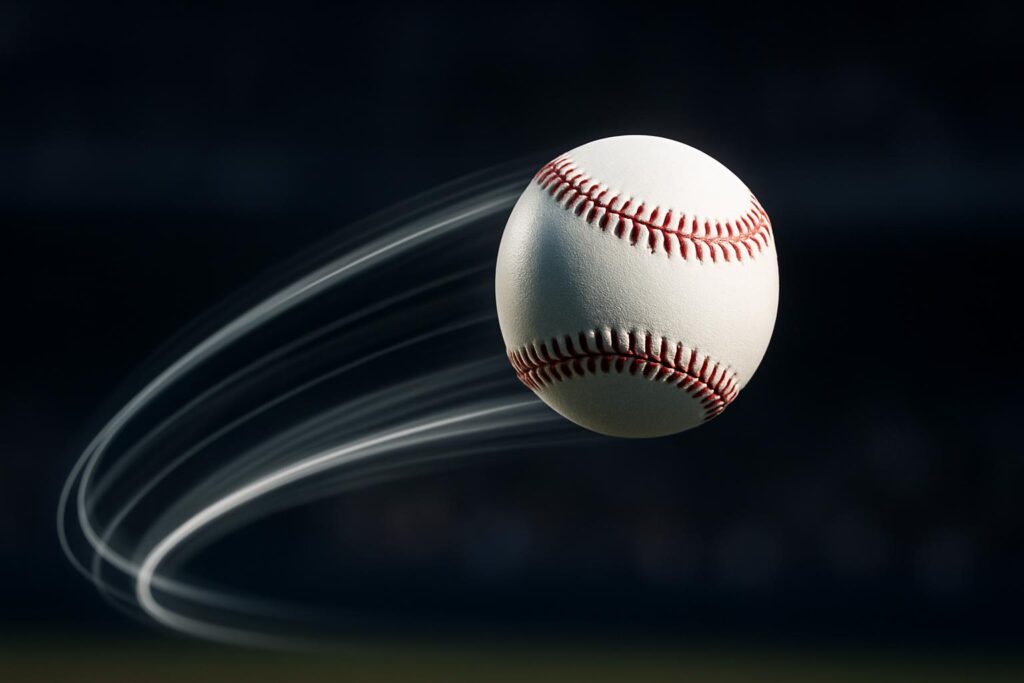
The yakker works because of spin. When a pitcher imparts strong top-spin, aerodynamic forces push the ball downward. This is the Magnus effect. The faster and cleaner the top-spin, the more the ball breaks down as it travels to the plate. That break not only misses barrels but also changes a hitter’s timing window.
Key components behind the movement:
Velocity: Most yakkers sit roughly 72 to 83 mph. Power curves can reach the low to mid 80s. Lower speed is not the main goal. What matters is the right balance of speed and spin that produces consistent shape.
Spin rate: Strong yakkers in pro ball commonly range from about 2400 to 3000 rpm, and elite ones can go even higher. Higher spin alone does not guarantee results. Spin needs to be on the right axis and used at effective speeds.
Shape: In pitch-tracking terms, a yakker shows significant negative induced vertical break. Many strong curves land around minus 10 to minus 20 inches of vertical break, with some even more. Horizontal break tends to be modest and toward the glove side.
Spin axis and clock face
Think of the ball like a spinning top. For a right-handed pitcher, a classic yakker often shows a 1-to-7 spin axis. For a left-handed pitcher, it often shows 11-to-5. The closer the axis is to pure top-spin, the truer and deeper the drop. A 12-to-6 curve is the purest top-spin version, with little to no horizontal movement, only hard downward action.
Spin efficiency
Spin efficiency is the share of total spin that actually moves the ball. A yakker thrives on high spin efficiency, because more of the spin is working to bend the ball down. If the spin tilts toward bullet spin or side spin, the pitch loses depth and can morph toward a slurve or a softer slider shape. That can still work, but it is no longer a classic yakker.
Grips and releases
You do not need a complex grip to throw a yakker. What matters is a secure feel, clean seam contact, and a repeatable release.
Standard curve grip: Most pitchers place the middle finger along or just inside a seam on the horseshoe with the index finger close by for support. The thumb finds a seam underneath. Pressure often sits on the middle finger.
Knuckle-curve variation: Some pitchers dig the index fingernail or knuckle into the ball. This can help tighten spin for certain hands and add power while keeping depth.
Power curve feel: The same general grip, thrown with more arm speed, a firmer wrist, and tighter spin. This version often runs 80 to 85 mph, trading a bit of drop for later, tighter bite.
Release cues:
Maintain fastball intent with full arm speed. Finish strong with the middle finger pulling over the front of the ball. Allow natural forearm supination at release so the fingers work on top and create top-spin. Keep the head quiet and the glove side firm so the arm can work on time. Do not float the hand early or slow the body down. The pitch should look like a fastball until late.
How pitchers use a yakker
A yakker helps a pitcher change plane, steal strikes, and get whiffs. Its main strengths are depth and deception.
Steal a strike: Many pitchers drop a first-pitch yakker at the top of the zone or a get-me-over version across the plate to get ahead of guessing hitters.
Expand for chase: Once a hitter respects the strike version, the pitcher can bounce it below the zone to get swing-and-miss.
Backdoor and back foot: Against opposite-handed hitters, a curve can sweep across the outer edge for a called strike. Against same-handed hitters, a curve can dive under the back foot for chase. Even a yakker with modest horizontal break can use this aim if the catcher sets late and the tunnel is strong.
Kill lift: Hitters who lift the ball often struggle with hard vertical drops. A yakker that finishes below the barrel can neutralize pull-side power.
Tunneling with the fastball
A yakker plays best when it shares the early flight path of a fastball. If the release height, extension, and line match the fastball for the first two-thirds of flight, the hitter reads fastball and commits. The curve then peels off late and escapes the barrel. Tunneling improves when the pitcher repeats release timing and arm speed, keeps posture steady, and uses consistent intent.
Simple sequences that work
Elevated fastball, then a yakker starting in the same tunnel and finishing below the zone. Backdoor yakker to steal a strike, then a fastball up and in. Fastball away, yakker back foot for chase. Keep the hitter unsure about planes and end points.
How hitters should read a yakker
Hitters do not win by reacting to break. They win by reading spin early, knowing plan, and committing to a zone.
Early tell signs: A yakker shows top-spin. Many hitters describe a top-down spin blur and a hump out of the hand on big 12-to-6 shapes. The ball might start higher than a fastball and then fall into the zone. Good pitchers reduce these tells with tight tunnels, but trained hitters can still pick up cues.
Plan by count: In fastball counts, sit fastball and force the pitcher to land a yakker in the zone. In two-strike counts, protect low. Many yakkers aim below the zone for chase. If the ball starts low, it likely ends lower. If it starts high and looks like a strike halfway, it can finish on the black.
Swing path: A steep downward break punishes uppercut swings that start too soon. Hitters can adjust with a shorter move, later commit, and a flatter path through the bottom of the zone. The goal is not to lift the yakker. The goal is to match depth long enough to square it or take it.
Variations and related pitches
12-to-6 curve: Pure top-spin, strong vertical drop, minimal horizontal break. Classic yakker look.
Power curve: Faster, tighter version, often 80 to 85 mph. Trades some drop for later bite.
Knuckle-curve: Uses an index knuckle or nail for extra grip and spin. Shape can range from classic drop to power-curve bite.
Slurve: Sits between a curve and a slider. More horizontal movement and a bit less pure vertical drop. It can be effective but is not a classic yakker shape.
Slider and sweeper versus yakker: A slider rides more on gyro or tilted spin and breaks more sideways with less depth. A sweeper maximizes horizontal break with a flatter plane. A yakker is defined by top-spin and vertical drop first. The hand action, axis, and finish separate them.
How data evaluates a yakker
Modern tools let coaches and players measure the parts that make a yakker work. A simple checklist helps:
Velocity: Typically 72 to 83 mph for a standard yakker. Power versions can run faster.
Spin rate: Often 2400 to 3000 rpm or more at the pro level. Combine this with good efficiency.
Spin axis: Clock-face targets around 12-to-6, 1-to-7 for right-handed, or 11-to-5 for left-handed. Closer to pure top-spin gives truer drop.
Vertical break: Large negative induced vertical break signals strong downward action. Deeper values generally mean more drop.
Horizontal break: Usually modest and toward the glove side.
Release traits: Stable release height, consistent extension, and minimal release variability improve tunneling.
Results: Whiff rate, chase rate, and called-strike-plus-whiff rate show how well the pitch wins at the plate. Contact quality against the yakker also matters. Weak groundballs or topspin contact suggest the pitch is finishing below barrels.
Drills and development
Grip reps: Sit with a ball and practice setting the fingers, feeling seam pressure, and rolling the ball with the middle finger. Build a consistent hand feel.
Spin axis practice: Light catch or short-box work with a focus on clean top-spin. Watch the spin blur and try to reproduce it on every throw. If the blur leans too much sideways, adjust the finger pressure and wrist finish.
Plyo or flat-ground spins: Use soft tosses at reduced effort to find the release cue. The goal is to create top-spin without muscling the wrist. Keep the arm path like the fastball until the last moment.
Intent and tunneling: Pair fastballs and yakkers in bullpen sets. Aim to match release height and early line. Throw both with the same arm speed. Ask a catcher or coach to confirm early flight similarity.
Strength and care: Build forearm, shoulder, and scap stability. Warm up well. Do not spam breaking balls when fatigued. Yakkers can be safe with sound mechanics, but fatigue and poor load management create risk. Keep workloads in line with age and season.
Famous yakkers
Clayton Kershaw: Signature 12-to-6 curve with sharp depth. A model for classic shape and tunneling with a high fastball.
Adam Wainwright: Elite command of a deep curve that he used to both steal strikes and finish hitters.
Barry Zito: Big, loopy curve with heavy drop that changed eye levels and drew chases.
Rich Hill: Slower but huge-breaking curves with multiple shapes, using speed separation and command.
Sandy Koufax: Historical benchmark for a dominant curve that fell off the table late in the zone.
Charlie Morton: Hard power curve with tight, late action that plays off his fastball mix.
Common mistakes and quick fixes
Hanging the curve: The hand gets under the ball too soon or spin efficiency drops. Fix by keeping the hand on top longer and finishing with the middle finger pulling over the front of the ball. Match fastball intent so the arm does not slow.
Bouncing every curve: The release is too late or the target is too low. Aim higher and throw through the glove. Trust the drop. Many curves need to start at the belt or even higher to finish at the knees.
Telegraphing: Slowing the arm or opening the front side early tells the hitter. Keep the same delivery and timing as the fastball. Let the grip and finish create spin, not a slower motion.
Inconsistent shape: Finger pressure shifting around the ball causes wobble. Set the middle finger on a seam and keep a firm, repeatable thumb spot. Practice short-box spins to calibrate axis.
No plan: Throwing a yakker without a count plan reduces its edge. Use it to steal a strike early, then expand late. Backdoor in even counts, back foot with two strikes.
Strategy by level
Youth: Limit total breaking ball volume and focus on sound mechanics. Learn a simple curve grip and a clean, gentle spin at lower effort first. Build a fastball foundation and command zones. Use the yakker as a surprise pitch rather than a crutch.
High school: Add intent and shape goals. Track velocity ranges and spin cues. Use the yakker to change planes against power bats, and as a chase pitch with two strikes. Work on tunneling with a four-seam up.
College and pro: Optimize shape and usage with data. Attack swing paths. Versus steep uppercut hitters, land the curve for strike one and drop it below later. Versus flat-bat hitters who stay on top, use backdoor or back-foot versions to disrupt timing.
Yakkers in the analytics era
Pitch design tools have made the yakker more precise. Pitchers now aim for exact spin axes, targeted vertical break windows, and repeatable tunnels with their fastballs. Some match a high four-seam with a deep yakker to create a vertical gap that forces hitters to defend two levels. Others prefer a harder power curve that plays off sinkers and cutters. The principle is the same. Show the hitter the same early picture, then finish in a different place.
Umpire and catcher factors
Catching a yakker is a skill. The catcher must present the top of the zone on steal strikes and stick the bottom edge without dragging the glove down. On chase calls, set late and hold firm. Blocking is part of the plan, since many two-strike yakkers are meant to hit the dirt. Umpires respond well to stable targets and clean catches. Pitch-calling needs a catcher ready to frame depth and live with the occasional block.
Weather and park effects
Grip changes with humidity, temperature, and ball texture. Dry air can demand a different feel or rosin use for a secure seam hold. Cold can numb the feel. Hot and humid can make the ball slick. Altitude reduces air density, which can shrink movement. Many pitchers see less break at high elevation and must aim higher or throw a firmer version to keep shape. Domes and climate-controlled parks are more stable, which makes fine-tuning easier.
How broadcasters use the term
In broadcasts, yakker signals a curve with eye-catching drop that beats the hitter. Analysts use it to highlight the pitch’s shape, timing of the drop, or a perfect location like a back-foot strikeout. When you hear the word, expect a replay of a ball that started on a fastball line and then fell under the bat late.
Conclusion
A yakker is a curveball built on top-spin, depth, and timing disruption. It wins by changing planes and finishing below the barrel. With a sound grip, clean release, and true spin, it becomes a reliable weapon in any arsenal. Data makes it easier to shape, tunneling adds deception, and good game plans turn it into strike one, chase, and soft contact. Whether you are a new fan, an aspiring pitcher, or a hitter learning to recognize spin, understanding the yakker will sharpen your feel for how at-bats are won.
FAQ
Q: What is a yakker in baseball?
A: A yakker is slang for a curveball with strong downward break created by heavy top-spin.
Q: How fast is a typical yakker?
A: Most yakkers sit roughly 72 to 83 mph, while power curves can reach the low to mid 80s.
Q: How does a yakker differ from a slider or sweeper?
A: A yakker is defined by top-spin and vertical drop, while sliders and sweepers break more sideways with less pure depth due to different spin types.
Q: What metrics indicate a good yakker?
A: Useful signs include spin rate around 2400 to 3000 rpm or more, large negative induced vertical break, a spin axis near 12-to-6 or 1-to-7 for right-handed and 11-to-5 for left-handed, and consistent arm speed and release.
Q: Who are some pitchers known for great yakkers?
A: Notable examples include Clayton Kershaw, Adam Wainwright, Barry Zito, Rich Hill, Sandy Koufax, and Charlie Morton.