
We are reader supported. When you purchase through links on our site, we may earn an affiliate commission. Also, as an Amazon affiliate, we earn from qualifying purchases.
Baseball talks about heat for a reason. Speed shapes at bats, defines pitcher identity, and forces decisions in the dugout. To capture that speed with precision, teams and players rely on a radar gun. This guide breaks down what a radar gun is, how it works, how to use it correctly, how to read the numbers, and how to pick the right model. By the end, you will know how to track velocity with confidence and use it to improve performance.
Introduction
A radar gun in baseball measures how fast a baseball travels. Coaches use it to evaluate pitchers. Players use it to train and track progress. Scouts use it to compare arms. Broadcasters use it to frame the story of a game. The tool is common, but the details behind it are often misunderstood. Accuracy depends on setup. Readings can differ across devices. Numbers mean little without context. Clarity on these points turns a simple reading into a reliable decision tool.
What Is a Radar Gun in Baseball
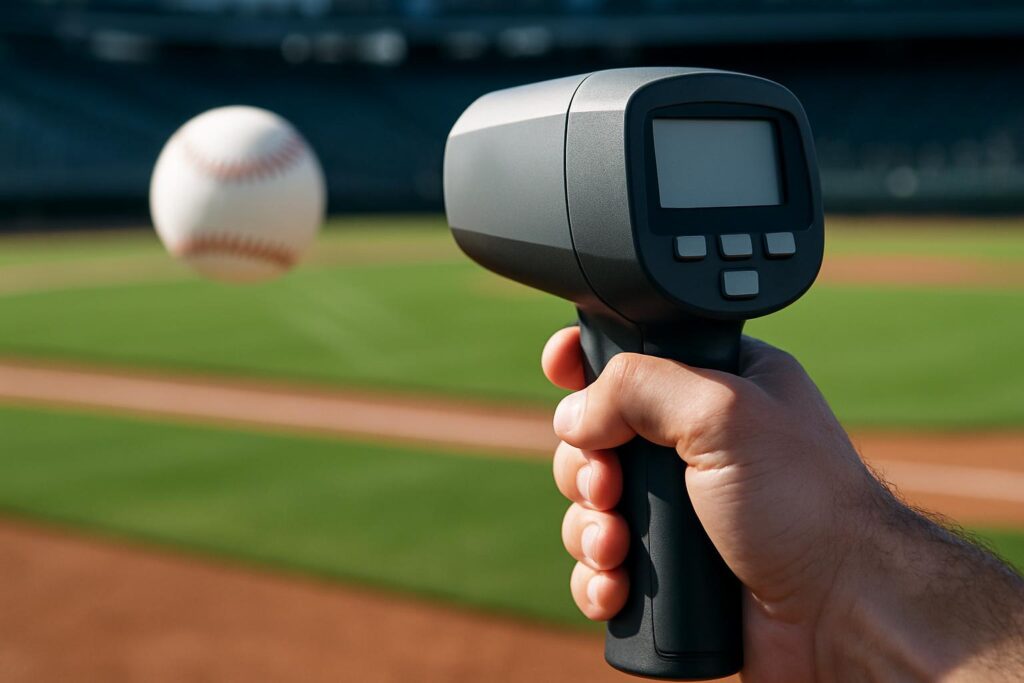
A radar gun is a handheld or mounted device that uses Doppler radar to measure speed. In baseball, it records how fast a pitch travels. Many models can also capture the speed of a batted ball, known as exit velocity. The display shows the value in miles per hour or kilometers per hour. A radar gun cannot tell you movement, spin, or location on its own. It specializes in one job, and it does that job fast, usually in real time.
How a Radar Gun Works
A radar gun sends radio waves toward a moving baseball. Those waves reflect off the ball and return to the device. Because the ball is moving, the frequency of the reflected waves shifts. The device calculates speed from that shift. The concept is called the Doppler effect. The ball does not need to be close for the device to read it, but range and aim affect the quality of the signal.
Continuous Read vs. Triggered Read
Most baseball radar guns can take continuous readings as long as the ball is moving in their aim. Some allow triggered reads, where the device starts measuring when you press a button. Continuous read is helpful for bullpens and practice. Triggered read can save battery and reduce stray readings in busy environments.
What the Gun Locks Onto
Radar guns prefer targets moving directly toward or away from them. The stronger and cleaner the return signal, the better the read. The ball is small and fast, so guns with better antennas, filtering, and processing tend to be more consistent in baseball settings.
Where the Speed Comes From Along the Flight
A baseball slows down due to air resistance from release to home plate. Devices differ in how they capture speed along that path. Some prioritize the speed near release. Others report a later portion of the flight. Even when two devices agree on the physics, their internal filters and timing can select slightly different slices of the flight. This is one common reason two guns can show different values on the same pitch.
Modern broadcast and pro systems often display speed measured near release. Many traditional handheld guns have historically emphasized readings closer to the plate. Both are valid, but they describe different moments of the same pitch. That is why comparing numbers works best when you use the same device in the same spot across sessions.
Key Numbers a Radar Gun Provides
Pitch velocity is the headline number. It tells you how hard a pitcher throws a specific pitch type. Pitchers and coaches track peak velocity, average velocity, and variability across sessions. Some radar guns can also measure exit velocity. That helps hitters see how hard they impact the ball. Exit velocity reads are sensitive to aim and angle, so consistent setup is important here too.
Miles per Hour and Kilometers per Hour
Most baseball contexts use miles per hour. Some devices can switch to kilometers per hour. If you change units, keep track across sessions. Mixing units can confuse trends.
Why Velocity Matters
Velocity influences the time a hitter has to swing. It shapes how much margin a pitcher has for mistakes over the plate. It can help set up offspeed pitches by increasing separation between pitch types. It is not the only factor in performance. Command, movement, deception, sequencing, and health matter too. Still, velocity is a core indicator of arm strength and helps guide training and scouting.
Types of Radar Guns Used in Baseball
Handheld Pistols
These are the classic devices you see behind the backstop. They are easy to aim and quick to deploy. Quality varies in range, accuracy, and features. They are common in high school, college, and amateur scouting.
Pocket-Sized Units
Compact devices are lighter and often more affordable. Some need to be set on a tripod or held steady to reduce shake. Many pair with a phone app for data logging and remote display. They are popular for training and travel.
Plate or Backstop Mounted Units
Mounted units aim through a net or fence. They provide stable readings across many pitches without manual aiming. This setup is useful for bullpens and cages where the angle to the ball is consistent.
Integrated Ball-Tracking Systems
Advanced systems in pro and college stadiums track the full flight of the ball. Radar is part of these systems, and they provide detailed data, including release velocity. These systems are not handheld, but they produce the speed numbers seen on broadcasts and scoreboards.
Accuracy, Consistency, and Calibration
Accuracy is how close a reading is to the true speed. Consistency is how repeatable the device is across pitches and days. In baseball, consistency often matters more day to day. If the same device in the same spot shows stable values across sessions, you can trust trends even if another device reads a little higher or lower.
Calibration Basics
Follow the manufacturer guide for calibration. Some units include a check method or built-in self test. Calibrate on a routine schedule and after drops, impacts, or firmware updates. Keep batteries healthy. Weak power can affect performance.
Environmental Factors
Rain, dust, and extreme temperatures can affect sensors and displays. Shield the device from direct rain. Let a cold or hot device acclimate before use. Avoid pointing through heavy netting if possible. Fine mesh can scatter signals and reduce accuracy.
Positioning: The Most Important Step You Control
Set up in line with the ball flight. The closer you are to the actual path, the better the reading. If you are behind the catcher, aim through an open space in the net. If you are behind the pitcher during a bullpen, aim along the throwing lane.
Angle and Cosine Error
When you stand off the line of flight, the gun sees only a portion of the true speed. The device reads true speed multiplied by the cosine of the angle between the ball path and the aim line. At a small angle, the error is small. At larger angles, the error grows quickly. An angle of 5 degrees leads to a small under-read. Around 10 degrees, the under-read becomes more noticeable. At 20 degrees, the device can miss several miles per hour. The solution is simple. Position the device as close to the line of flight as allowed by safety and rules.
Distance to Target
Stay within the effective range of your device. Many guns handle the 60 feet 6 inches of a baseball field with margin. If you stand much farther back in the stands, the ball appears smaller, and background clutter increases. Use a tripod or stable stance to reduce aim wobble at long ranges.
Background and Clutter
Other moving objects can confuse readings. People walking behind the backstop, cars near an open fence, or another field behind the target area can all cause false triggers. Frame the pitch path in a clean background if possible. Adjust aiming height to avoid heads or bats entering the field of view.
How to Use a Radar Gun Step by Step
Prepare the device. Charge or install fresh batteries. Confirm settings, including units and trigger mode. Perform any quick self tests suggested by the manufacturer.
Pick your spot. Behind the catcher or behind the pitcher is best. If you must be off to the side, reduce the angle as much as you can.
Stabilize the aim. Use two hands or a tripod. Track the pitcher through the motion so the device sees the ball at release and early flight.
Record the reading. Note pitch type if possible. Logging pitch type gives more context to the number for training and review.
Repeat and confirm. A single odd reading can happen when someone crosses the frame or the aim slips. Two or three consistent readings give a better picture.
Interpreting the Numbers
Velocity trends matter more than a single peak value. Track average pitch velocity across an outing. Monitor how velocity holds across innings. Some pitchers sustain speed. Others fade. Both patterns tell you about conditioning and mechanics.
Compare velocity to pitch type. A fastball 10 miles per hour faster than a changeup can be effective even if the fastball is not elite. A slider with decent speed but too close to the fastball may need more separation or different shape to get results.
Use consistent setups for fair comparisons. If you measured in a bullpen last month and now measure from the stands at a new angle, do not overreact to small changes. Use the same device and the same spot for the best insights.
Typical Velocity Ranges by Level
Youth and amateur levels show wide ranges due to age and development. High school varsity arms often sit in the mid to upper 70s and into the 80s for stronger arms. College velocity ranges from the low 80s to mid 90s for top arms. Professional levels feature a wide band depending on role and pitch type. The exact numbers change by program and season. Use these ranges as general guides, not strict cutoffs. Health, command, and pitch quality matter as much as raw speed when evaluating a pitcher.
Using a Radar Gun for Training
Immediate Feedback
Velocity feedback guides practice. If a mechanic change or drill shows a consistent rise in speed without loss of control, it may be worth keeping. If speed drops or control vanishes, rethink the change. Use small tests and short blocks to confirm the effect of a tweak.
Warm-Up and Readiness
Track how velocity builds in warm-ups. Some pitchers ramp quickly. Others need more throws. Use the numbers to design a warm-up routine that gets you ready for game speed without overworking the arm.
Blend with Command Work
Chasing maximal speed on every throw can hurt command and raise injury risk. Split sessions between velocity focus and target-hitting work. For example, include short velocity windows in a bullpen, then shift to game-mode sequences at 90 to 95 percent effort while holding mechanics steady.
Exit Velocity for Hitters
Hitters can use radar to track exit velocity off a tee, front toss, or machine. Aim the device along the batted-ball path. Keep the angle small. Record the bat, weight, and ball type to keep comparisons fair. Use average and top exit velocity as progress markers in strength and swing efficiency training.
Safety and Arm Health
Velocity gains help performance, but only if the arm stays healthy. Increase throwing loads gradually. Space high-intent days to allow recovery. Monitor soreness that lingers or changes location. Use the radar gun to confirm that velocity goals align with sound mechanics, not forced effort. Quality reps at sustainable intensity often beat reckless max-effort throws.
Why Devices Disagree
Two guns can show different numbers on the same pitch. The reasons fall into a few clear categories. First, they may measure at different points along the flight. Second, one device may sit at a larger angle than the other. Third, different devices filter noise differently and choose different signal peaks. Fourth, one device might be out of calibration or aimed through excessive clutter.
If you want to compare two devices, place them next to each other behind the catcher, aim through the same window, and record several pitches. Expect small differences, but readings should track each other. If one reads far lower or higher on every pitch, check settings, calibration, and angle.
Buying Guide: Features That Matter
Accuracy and Consistency
Look for a device known for tight repeatability. Consistent readings matter more than a single perfect number. Reviews and baseball-specific tests are useful here.
Range and Target Isolation
Baseball fields place you 60 feet or more from the pitch at the plate. Make sure the unit handles that range and isolates the ball from background movement. Some models offer directional target features that help ignore off-axis motion.
Sampling Rate and Processing
Faster sampling and better processing help the device catch the true peak velocity and lock onto the ball cleanly. This is especially important for release-speed style readings.
Ease of Aiming
A clear sight or aiming aid reduces misreads. A tripod mount adds stability. A compact design helps for travel, but do not trade away too much aiming control if you need high-quality reads in busy parks.
Data Capture and Connectivity
Logging sessions, tagging pitch types, and exporting data make long-term tracking easier. Many devices pair with mobile apps for live display and storage.
Battery Life and Power Options
Games and tournaments can stretch for hours. Strong battery life and easy charging reduce stress. Check whether the device uses standard batteries or rechargeable packs.
Durability and Warranty
Baseball fields are dusty and busy. A sturdy case, weather resistance, and a solid warranty protect your investment.
Common Mistakes and How to Avoid Them
Standing too far off line causes under-reads. Solve this by moving behind the catcher or pitcher whenever allowed. Aiming through heavy netting or a fence with tight mesh can scatter the signal. Find a larger opening or adjust the height. Letting people move through the aim path causes false reads. Choose a cleaner background and ask others to pause if possible.
Switching devices mid-season without noting the change confuses trends. Keep a log of device, location, and setup so you can interpret data later. Ignoring warm-up patterns can lead to unfair judgments. Give pitchers a chance to reach their typical working speed before making calls on form or role.
Radar Guns vs. Ball-Tracking Systems
Stadium systems track the full ball flight and report a consistent release-speed value. Handheld and pocket guns are more flexible and lower cost. If you train across locations without stadium tech, a good handheld or pocket device is the practical choice. If you play or coach in a park with integrated tracking, you can use those numbers for game analysis and still keep a handheld gun for practice and away games.
Ethics and Etiquette on the Field
Follow league and venue rules. Some games allow radar behind the backstop but restrict field access. Avoid blocking views. Do not coach or shout readings during an opponent at bat. Share numbers with your team respectfully. Velocity is sensitive information for some players. Use it to help, not to embarrass.
Myths to Leave Behind
Myth one: velocity alone defines a pitcher. It does not. Command, movement, deception, and approach matter. Myth two: a scoreboard is always right or always wrong. It depends on the system, angle, and filtering. Myth three: you must throw max effort all the time to gain velocity. Smart training builds strength and speed without reckless spikes in load.
Building a Simple Velocity Tracking Plan
Pick one device and one location. For bullpens, mount the device behind the catcher, aim through the cleanest window, and record pitch type and velocity. For games, use the same vantage point as often as possible. Track average and top fastball velocity, plus separation to offspeed pitches. Add a short notes field for weather, fatigue, and any mechanical work you tried. Review every two to four weeks to confirm progress and adjust training.
Troubleshooting Poor Readings
Reads Are Low Across the Board
Check your angle. Move closer to the line of flight. Verify that the device is not reading closer to the plate if you expect release speed. Confirm the unit is in the right mode and that the battery is strong. Calibrate if needed.
Inconsistent Pitch to Pitch
Stabilize your aim with a tripod. Reduce background motion. Reposition to avoid people crossing the frame. Confirm you are not picking up the catcher’s glove or the bat rather than the ball.
No Reading at All
Make sure the device has a clear path. Heavy mesh can block or scatter signals. Increase the gain or sensitivity if the device offers that control. Move closer if you are too far away for the model’s range.
Case Uses Across Roles
Pitchers
Track progress during velocity phases. Confirm that velocity holds as you move from drills to live at bats. Use average game velocity as a readiness check, not only top speed.
Catchers
Use readings to benchmark pop time drills with throws to second base. Although many radars focus on pitch speed, the same device can capture throw velocity if aimed down the line of the throw.
Hitters
Measure exit velocity during tee and front toss work. Track average and top values with the same ball and bat each session to see true changes in contact quality.
Coaches and Scouts
Use readings to compare roles and project development. Combine velocity with strike percentage and pitch quality notes. Context matters. A stable 88 with command and shape can play better than an erratic 92 with poor control.
Converting and Reporting Units
If you track in miles per hour and need kilometers per hour, multiply by about 1.609. Keep one unit in your logs to avoid confusion. Label charts and sheets clearly. When sharing numbers, include the device and location so others understand the context.
Putting It All Together
A radar gun is simple to use but easy to misuse. Stand in line with the pitch. Stabilize your aim. Control the background. Calibrate on schedule. Track trends, not myths. Use velocity as one part of a full picture that includes mechanics, command, and health. With that approach, a radar gun becomes more than a gadget. It becomes a steady guide for training, evaluation, and growth.
Conclusion
A radar gun in baseball measures speed, but its value comes from how you use it. Understand how the device works. Place it correctly. Read the numbers in context. Build a routine that captures consistent data. Share it with respect. When you control the process, you get accurate readings that drive better decisions. That is how you track the heat and turn raw miles per hour into sustained performance on the field.
FAQ
Q: What is a radar gun in baseball
A: It is a Doppler radar device that measures the speed of a pitched or batted baseball in real time, reported in miles per hour or kilometers per hour.
Q: How does a radar gun work
A: It sends radio waves toward the moving ball and reads the frequency shift of the returning signal to calculate speed.
Q: Where should I stand to get the most accurate readings
A: Stand in line with the ball flight, ideally behind the catcher or directly behind the pitcher, to reduce angle error.
Q: Why does the scoreboard show a different speed than my handheld gun
A: Devices may measure at different points of the flight, use different filtering, and sit at different angles, so readings can differ by a few miles per hour.
Q: What features matter most when buying a radar gun
A: Accuracy and consistency, range, ability to aim only at the ball, high sampling rate, easy aiming, data connectivity, battery life, and durability.