
We are reader supported. When you purchase through links on our site, we may earn an affiliate commission. Also, as an Amazon affiliate, we earn from qualifying purchases.
The surface under an NFL game changes how players move, how coaches plan, and even how injuries happen. Fans hear grass versus turf debates every week, but the facts often get lost. This guide answers the core question first, then walks you through why it matters, stadium by stadium.
The short answer
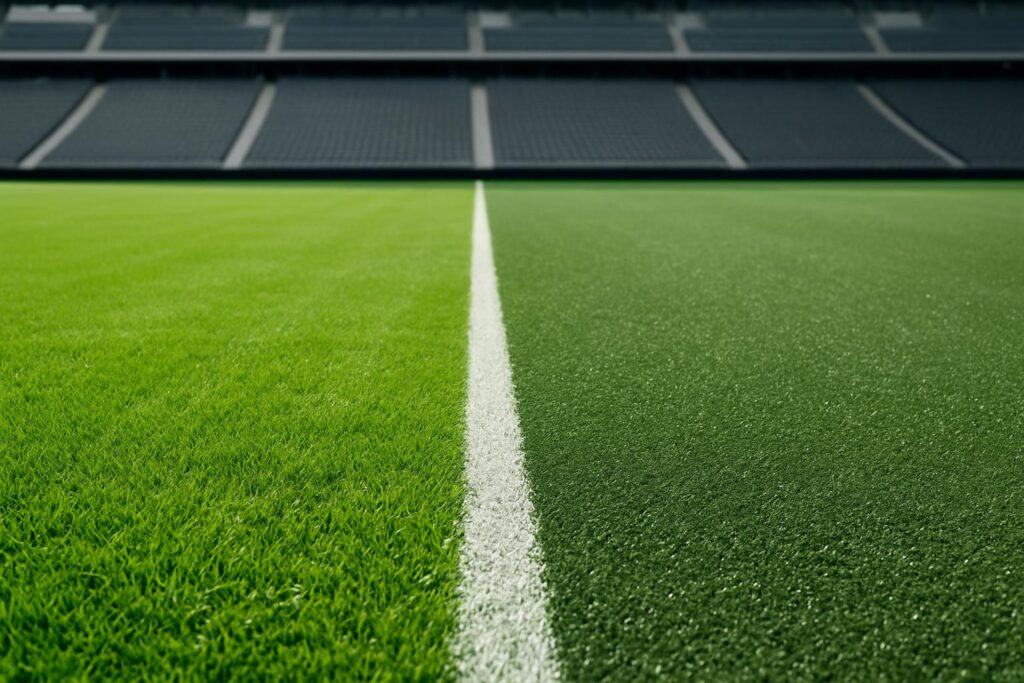
Across the 30 NFL stadiums, 15 have real grass and 15 have artificial turf. Two turf venues host two teams each, so more teams than stadiums play home games on turf. These numbers are current through the 2024 season and expected to hold for 2025 unless noted by the team or venue.
What counts as grass or turf
Natural grass
Natural grass means real, living grass on a sand-based root zone with drainage, irrigation, and a heating system in cold markets. Crews re-sod heavily worn areas during the season. In warm climates, the base is often a Bermuda variety. In colder cities, crews overseed with rye when temperatures drop. The field can feel different week to week depending on weather and maintenance, but when cared for well it provides predictable traction with some give underfoot.
Hybrid reinforced grass
Several grass fields use stitched or injected fibers, often called hybrid systems. These synthetic fibers bind the root zone and reduce divots while keeping the field fundamentally natural. Players still plant and cut on real blades. The reinforcement helps the surface recover after heavy use or bad weather.
Artificial turf
Modern artificial turf has synthetic fibers tufted into a backing with infill on top. The infill is a mix of rubber and sand, sometimes with alternative materials. Fibers vary by brand and profile. Slit-film fibers are thinner and can fray. Monofilament fibers are thicker and hold shape better. Shock pads or elastic layers under the turf adjust force reduction. Turf plays faster, drains well, and handles heavy event schedules. Temperature can run hotter than grass under sun or closed roofs.
Why teams choose one surface over the other
Climate and sunlight
Grass needs sun, air movement, and favorable temperatures. Hot, dry summers and mild winters are kind to Bermuda grass. Shade from canopies, tall seating bowls, or a fixed roof makes it harder. Northern open-air fields can keep grass healthy with heat systems and aggressive maintenance, but it takes planning.
Roofs and venue design
Domes and many retractable roof venues lean toward turf because the interior limits sun and airflow. Two NFL exceptions use roll-out grass trays. These trays grow outdoors and slide inside for games. That approach needs space and engineering and does not fit every site.
Scheduling and business
Multipurpose buildings run dozens of events per year. Concerts, soccer, college games, and shows beat up grass. Turf stands up to quick turnarounds. Teams balance player preference, cost, and event revenue.
Maintenance and cost
Top quality grass requires equipment, agronomy expertise, and frequent re-sodding. Turf requires infill maintenance, grooming, and periodic replacement of the carpet and pad. Over a full life cycle, costs can be comparable depending on usage and climate. The best fields are not cheap in either category.
Player preference and league pressure
Players often voice a clear preference for well maintained grass. The union has urged a move toward grass or at least away from certain turf profiles linked to higher lower extremity injury rates. Several clubs have already replaced older turf systems with newer monofilament or mixed-fiber designs and improved base layers.
NFL stadiums by surface
This section details each building so you can see where every team plays. Surface notes focus on what a player feels underfoot and how the venue manages it.
Natural grass stadiums 15
Allegiant Stadium, Las Vegas Raiders. A natural Bermuda grass tray grows outside in the desert sun and rolls in for game day. The dome protects the surface from extreme heat and wind during games. UNLV uses a separate turf field inside for college games.
State Farm Stadium, Arizona Cardinals. A roll-out natural grass tray lives outdoors and slides into the retractable roof stadium for NFL games. Consistent sun and strong agronomy make the surface reliable late in the season.
Levi’s Stadium, San Francisco 49ers. Natural Bermuda overseeded with rye in cooler months. Grounds crews have refined the system since the venue opened. The field plays firm but with some give.
GEHA Field at Arrowhead Stadium, Kansas City Chiefs. Natural Bermuda in season with winter management for cold games. The surface rewards quick cuts and is maintained aggressively during playoff runs.
Empower Field at Mile High, Denver Broncos. Natural grass with a robust heating and drainage system. Altitude and sun exposure help grass recovery, but winter traffic still demands frequent work.
Lincoln Financial Field, Philadelphia Eagles. Natural grass with hybrid reinforcement. Crews re-sod goal mouths and heavy-use zones multiple times per season. It plays true and has improved steadily since early years.
FedExField, Washington Commanders. Natural grass using a modern Bermuda variety, often overseeded for late season. Recent upgrades improved stability and drainage.
M and T Bank Stadium, Baltimore Ravens. Natural grass restored several years ago after a turf period. The club has invested in drainage, grow lights, and in-season re-sodding.
Acrisure Stadium, Pittsburgh Steelers. Natural grass with heating. The stadium hosts late-season football and college games, so the grounds crew rebuilds worn areas often. Expect a softer top layer in heavy weather.
Cleveland Browns Stadium, Cleveland Browns. Natural Kentucky bluegrass on the lakefront. Wind, lake effect, and cold challenge the surface late in the year, but drainage upgrades have helped.
Soldier Field, Chicago Bears. Natural grass in a tight, windy bowl. The city venue faces heavy use and tough weather. Recent grass variety changes improved shear strength for better footing.
Lambeau Field, Green Bay Packers. Natural grass with a stitched hybrid and full heating system. This is one of the league’s benchmark surfaces for late-season performance.
Raymond James Stadium, Tampa Bay Buccaneers. Warm weather natural grass that drains quickly. The surface holds up well through rain and hosts multiple events with frequent touch-ups.
Hard Rock Stadium, Miami Dolphins. Natural grass tuned for heat and humidity. The canopy creates shade patterns, and the crew manages growth with targeted lighting.
EverBank Stadium, Jacksonville Jaguars. Natural Bermuda designed for heat and frequent rain. It is fast when dry and holds up well through the AFC South schedule.
Artificial turf stadiums 15
AT and T Stadium, Dallas Cowboys. Modern artificial turf system designed for quick play and heavy event turnover in a closed building. The club refreshes the surface on a regular cycle.
Mercedes-Benz Stadium, Atlanta Falcons. Artificial turf supports a dense schedule of NFL, MLS, concerts, and special events. The surface profile balances speed with cushioning.
U.S. Bank Stadium, Minnesota Vikings. Indoor turf optimized for consistent footing and ball response under a fixed roof. The venue handles winter events without weather risk.
Ford Field, Detroit Lions. Artificial turf with a recent upgrade to a newer fiber and infill package. It plays fast and uniform across the field.
NRG Stadium, Houston Texans. Turf replaced an earlier grass tray system several years ago. The current surface is built for durability and consistent traction under a retractable roof.
Caesars Superdome, New Orleans Saints. Turf under a full dome. The building hosts frequent non-football events, so a resilient surface is essential.
Lucas Oil Stadium, Indianapolis Colts. Indoor turf engineered for even energy return and year-round activation. The venue hosts college events and the combine.
Lumen Field, Seattle Seahawks. Outdoor turf in a cool, wet climate. The system manages heavy rainfall and provides consistent footing week to week.
SoFi Stadium, Los Angeles Rams and Los Angeles Chargers. Artificial turf in a covered venue with a translucent roof. The surface supports an intense event calendar and quick reconfigurations.
MetLife Stadium, New York Giants and New York Jets. Outdoor turf with a modern fiber profile installed ahead of the 2023 season. The new system targets improved traction and lower lower-body stress.
Gillette Stadium, New England Patriots. Turf with a recent upgrade focused on fiber shape and infill stability. The club has standardized the surface across the field and practice areas.
Bank of America Stadium, Carolina Panthers. Turf installed to support NFL, MLS, and concerts with fast changeovers. The field keeps a consistent profile through the calendar.
Nissan Stadium, Tennessee Titans. Turf installed in 2023 to handle climate swings and heavy usage. The stadium is moving toward a new domed home later in the decade that is also expected to use turf.
Highmark Stadium, Buffalo Bills. Outdoor turf tuned for cold and snow. The current venue will be replaced by a new open-air stadium under construction that is planned to stay with turf.
Paycor Stadium, Cincinnati Bengals. Outdoor turf with a modern monofilament focus. The surface supports late-season play in a cold river climate.
Injuries and performance
The league and union have studied injuries by surface for years. Results show that surface type alone does not tell the whole story. Field condition, maintenance, weather, shoe choice, and player movement patterns all matter. That said, league reports and independent analyses have often found slightly higher rates of certain lower-body non-contact injuries on some turf systems compared with high quality grass, especially with older slit-film designs.
Since those findings, several clubs have moved away from older slit-film turf to newer monofilament or mixed-fiber systems and added shock pads to manage impact forces. Lab testing and game audits are now standard before each season. Crews measure hardness, traction, and infill depth regularly. The goal is a surface that allows controlled deceleration without grabby hotspots.
Players still tend to favor good grass because the root zone shears under extreme force, which can reduce torque at the ankle and knee. On turf, the infill and fiber hold the foot differently. A stable turf field can be very consistent, but if the system gets under-filled or the fibers mat down, traction can change. With grass, overuse and weather can produce soft or muddy patches that also raise risk. The safest path is not one material but a well maintained field with strict standards and fast repairs when data shows a problem.
Special cases and international games
The NFL now plays outside the United States each season. Tottenham Hotspur Stadium in London has two fields. A soccer grass pitch sits on a tray above a dedicated NFL synthetic field. For NFL games in that venue, teams play on the synthetic field. Wembley Stadium in London uses natural grass reinforced for soccer and football. Germany venues used for NFL games have been natural grass.
These games do not change the count of NFL home stadiums, but they do matter for seasonal planning and for teams that switch surface types when traveling. Coaching staffs review cleat plans and traction data before each international trip.
How surface shapes game style
Speed and acceleration
Turf tends to feel faster because energy return is more uniform and the top layer does not give as much underfoot. Receivers and defensive backs often note the difference in burst. On firm, dry grass, speed is close, especially on hybrid-reinforced fields.
Cutting and change of direction
Grass shears under heavy lateral load, which many players prefer during hard cuts. Turf can grab if infill is low or fibers mat. When maintained well, both surfaces can support precise route running and coverage.
Trench play
Linemen value footing in first steps and sustained contact. Grass that is too soft can lead to slips on power steps. Turf that is overfilled can feel unstable. The best fields aim for a middle ground with enough bite and controlled give.
Kicking and footing
Kickers and punters adjust plant depth and approach angle based on surface firmness. New sod can be slick if not knitted in. Turf gives a consistent plant spot but can feel bouncy if the pad is soft. Special teams crews test pregame and adjust.
Cleat selection
On grass, longer studs help penetration when the top layer is soft, and shorter studs suit firmer conditions. On turf, molded studs or turf-specific patterns reduce grab and spread load. Equipment staff carry multiple plates and patterns to match each field and weather change.
Why some grass stadiums succeed in winter
Several northern teams keep strong grass late into January. Heating systems prevent the root zone from freezing. Drainage design moves water away fast. Hybrid stitching holds the profile together after repeated games. Grow lights and covers protect the grass in short daylight. Re-sodding is planned around home stretches, not just done in emergencies.
What might change next
Stadium plans evolve. Here is the current outlook based on public commitments and common practice.
The Bills are building a new open-air stadium scheduled to open in 2026. The team has indicated it will use synthetic turf. Expect a modern monofilament profile with a shock pad and strict maintenance targets for cold-weather performance.
The Titans are building a new domed stadium planned for the late 2020s. The market demands frequent major events year-round, which points to turf. The current stadium already switched to turf in 2023.
The Bears have proposed a new enclosed lakefront stadium. The final surface choice is not confirmed. A flexible event calendar and a roof often push projects toward turf unless a roll-out grass system is designed from day one.
Clubs with current turf have been updating to newer systems as data and testing standards improve. The trend within turf is away from older slit-film toward monofilament or hybrid fiber blends with better traction curves and lower rotational resistance.
Any change to this list will likely come from a new building or a turf-to-turf upgrade. A full turf-to-grass shift in a fixed-roof venue would require major engineering. A grass-to-turf shift can happen faster if scheduling pressure grows or if a club pursues year-round events.
What fans and bettors should watch
Field reports and weekly testing
Teams and the league test hardness and traction before games. Media sometimes report when a field is re-sodded or when infill is topped off. Note those updates. Fresh sod can be slick early. Recently groomed turf can play tighter or looser depending on infill work.
Weather swing
Rain on grass raises divot risk and slows speed after the first series of cuts. Rain on turf drains well but can create a thin water film that affects first steps and ball skids. Cold snaps on grass can stiffen the top if heating lags. Wind matters for special teams regardless of surface.
Cleft plate and footwear notes
Some teams disclose footwear changes in broadcast or beat reports. A shift from long studs to molded or vice versa is a tell about expected footing. This can nudge route depths, timing, and pass rush wins.
Injury clusters
Track lower-body injury clusters by team and venue. A run of foot and ankle tweaks can reflect surface plus shoe mismatch. Adjust your read on explosive plays and coverage stickiness accordingly.
Stadium-by-stadium quick recap
Grass 15. Allegiant Raiders. State Farm Cardinals. Levi’s 49ers. GEHA Field at Arrowhead Chiefs. Empower Field at Mile High Broncos. Lincoln Financial Field Eagles. FedExField Commanders. M and T Bank Stadium Ravens. Acrisure Stadium Steelers. Cleveland Browns Stadium Browns. Soldier Field Bears. Lambeau Field Packers. Raymond James Stadium Buccaneers. Hard Rock Stadium Dolphins. EverBank Stadium Jaguars.
Turf 15. AT and T Stadium Cowboys. Mercedes-Benz Stadium Falcons. U.S. Bank Stadium Vikings. Ford Field Lions. NRG Stadium Texans. Caesars Superdome Saints. Lucas Oil Stadium Colts. Lumen Field Seahawks. SoFi Stadium Rams and Chargers. MetLife Stadium Giants and Jets. Gillette Stadium Patriots. Bank of America Stadium Panthers. Nissan Stadium Titans. Highmark Stadium Bills. Paycor Stadium Bengals.
Frequently asked points
Why do some turf stadiums look and play differently from others
Not all turf is the same. Fiber shape, infill mix, pad underlayment, and maintenance routines change traction and energy return. A modern monofilament system with a tuned pad can feel closer to grass than older designs.
Is hybrid grass still grass
Yes. The upper layer is natural grass. The synthetic stitching reinforces the soil profile. Players interact with real blades and roots. The reinforcement reduces divots and improves durability without turning the surface into turf.
Do retractable roofs guarantee grass
No. A retractable roof helps, but without sun and airflow when the roof is closed, grass can struggle. The most reliable approach is a roll-out tray that stays outdoors between events. Only a couple of NFL venues use that system.
How we got to a 15 and 15 split
The league used to lean more toward grass. As multipurpose venues and enclosed designs spread, turf grew. Some grass venues also switched to turf to support heavy schedules or address climate challenges. On the other hand, several clubs moved back to grass when data and player feedback supported the change, and when stadium design allowed it. The result today is an even split by stadiums, with a slight lean toward turf by teams because two turf venues host four teams.
What this means on Sundays
Surface is part of the matchup. Edge rushers get a fraction more burst on firm turf. Power run games like firm, reinforced grass that allows clean drive steps. Kickers factor plant stability and top-layer moisture into range. Trainers adjust taping patterns and cleat pairings during warmups. Scripted plays may feature more quick-game on softer grass and more vertical concepts on firm turf. None of this decides games by itself, but it shapes the margins where many games are won.
Conclusion
The NFL today is split evenly by stadium between real grass and artificial turf. Fifteen venues use natural grass, including several with hybrid reinforcement. Fifteen use turf tuned for consistency and event-heavy schedules. Players and coaches plan for each surface. Grounds crews and vendors keep improving designs, data, and maintenance. Watch the surface report each week. It will not replace film study, but it will clarify what your team can expect under its feet.