
We are reader supported. When you purchase through links on our site, we may earn an affiliate commission. Also, as an Amazon affiliate, we earn from qualifying purchases.
Here’s the short version: “five seconds” in basketball isn’t one rule—it’s a family of counts that cover four different situations. Across all major rule sets, you can violate for taking more than five seconds on a throw-in. In many non-NBA leagues, a ballhandler who’s closely guarded must act within five seconds. The NBA has a unique five-second “back-to-the-basket” dribble rule. And only under FIBA, a shooter has five seconds to release a free throw. This guide explains exactly how each version works, how referees judge it, and how players and coaches can avoid it.
Quick Answer
Five-second violations occur when a team or player fails to act within five seconds in specific scenarios: inbounding the ball (all leagues), being closely guarded (NCAA, NFHS, FIBA), dribbling with your back to the basket (NBA only), or releasing a free throw (FIBA only). These are violations, not fouls—no free throws—so the common penalty is a turnover with a throw-in to the opponent at the nearest spot (different procedures apply after FIBA free-throw violations).
| Situation | NBA | WNBA | NCAA (Men/Women) | NFHS (High School) | FIBA |
|---|---|---|---|---|---|
| Throw-in must be released in 5 seconds | Yes | Yes | Yes | Yes | Yes |
| Closely guarded 5-second count | No | No | Yes (holding only, frontcourt) | Yes (holding or dribbling, frontcourt) | Yes (holding only, frontcourt) |
| Back-to-the-basket 5-second dribble | Yes (frontcourt, below FT line extended) | No | No | No | No |
| Free throw must be released in 5 seconds | No (10 sec) | No (10 sec) | No (10 sec) | No (10 sec) | Yes (5 sec) |
What Is a Five-Second Violation?
It’s a timing violation called when a player or team fails to meet a required action within five seconds, based on the situation and rule set. It’s not a personal or team foul, so it does not lead to free throws. The usual penalty is loss of the ball to the opponent for a throw-in.
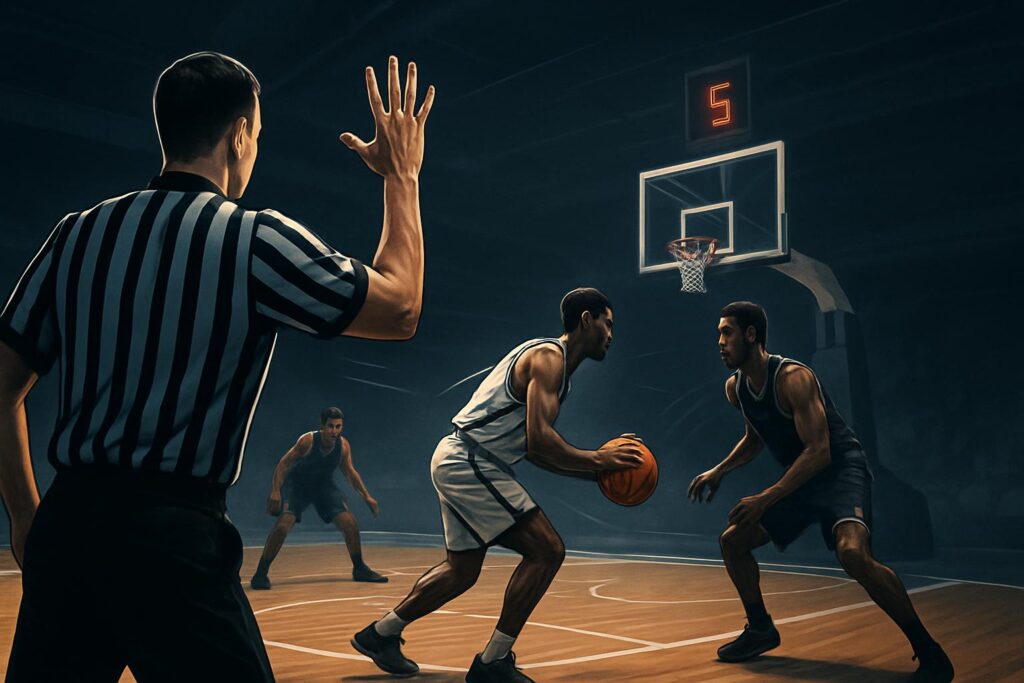
Referees enforce these counts with a visible arm count and precise start/stop criteria. The count begins only when the ball is “at the player’s disposal” or when specific positional and distance conditions are met (for closely guarded or back-to-the-basket rules).
Every Version, By Rule Set
1) Throw-In: Five Seconds to Release (All Leagues)
Definition: The thrower-in must release the ball within five seconds after it’s at their disposal. “At disposal” typically means when the official hands or bounces the ball to the thrower-in, or places it on the floor at the spot of the throw-in.
Referee count: A visible five-second count begins once the ball is at disposal. The count stops the instant the ball is released on the pass.
Violation moment: When the count reaches five and the ball has not left the thrower’s hands. The whistle sounds immediately.
Penalty and resumption: It’s a violation. The opponent gets a throw-in at the original throw-in spot (nearest spot in the NBA). No free throws.
Common situations: After a made basket, after timeouts, after violations, after fouls, or during designated throw-ins under pressure. If the inbounder calls a timeout before five seconds elapse and it’s granted, the count resets after the timeout.
2) Closely Guarded: Five Seconds Under Pressure
Definition: In rule sets that use it, a player holding (and, for NFHS, sometimes dribbling) the ball while closely guarded in the frontcourt must pass, shoot, or start/stop a dribble within five seconds.
- NBA: No closely guarded five-second count.
- WNBA: No closely guarded five-second count.
- NCAA (Men and Women): Applies in the frontcourt to a player holding the ball and closely guarded by a defender within 6 feet. The player must pass, shoot, or begin a dribble within five seconds. There is no dribbling closely guarded count.
- NFHS (High School): Applies in the frontcourt while holding or dribbling, if a defender is within 6 feet. Starting a dribble or stopping it affects which count applies, but in both cases a five-second closely guarded violation can occur.
- FIBA: Applies in the frontcourt while holding the ball when a defender is within 1 meter (approximately 3.3 feet). No dribbling closely guarded count.
Referee count: The visible count starts when the ballhandler is in control, in the frontcourt, and a defender is within the required distance. The count continues as long as the defender maintains that distance. The count stops if the offensive player passes, shoots, starts a dribble (in NCAA/FIBA), loses control, or creates legal separation beyond the distance threshold. In NFHS, if the player is dribbling while closely guarded, the dribble count applies; it ends when the player ends the dribble, passes, shoots, or gains separation.
Violation moment: When the arm count reaches five while the ballhandler is still holding (NCAA/FIBA) or holding/dribbling (NFHS) with a defender still within the distance requirement.
Penalty and resumption: Violation; opponent gets the ball for a throw-in at the nearest spot. No free throws.
3) NBA-Only: Five-Second Back-to-the-Basket Dribble
Definition: In the NBA, an offensive player in the frontcourt may not dribble with his back or side to the basket for more than five seconds while positioned below the free-throw line extended.
Referee count: The count begins once the player starts or continues a dribble while his back or side is to the basket below the free-throw line extended. Officials use a visible count and observe court position relative to the free-throw line extended.
Ending the count: The count stops if the player picks up the dribble, faces the basket (no longer back/side), or dribbles above the free-throw line extended. A pass, shot, or a loss/deflection of the ball also ends the count.
Violation moment: When the count reaches five without any of the above actions. The whistle sounds immediately.
Penalty and resumption: Violation; the defensive team gets a throw-in at the nearest spot out of bounds. No free throws.
Notes: This is an NBA-only rule designed to prevent excessive “backing down” in the post and improve pace/spacing.
4) FIBA-Only: Five Seconds to Release a Free Throw
Definition: Under FIBA rules, the free-throw shooter must release the ball within five seconds after it is at their disposal.
Referee count: Officials start the internal count when the ball is at the shooter’s disposal (usually when handed). There’s no visible arm count for free throws like a throw-in, but the timing is enforced strictly.
Violation moment: If the shooter has not released the ball by the end of five seconds.
Penalty and resumption: It’s a free-throw violation by the shooter. If it’s not the last free throw, any make is canceled and the next free throw proceeds. If it’s the last or only free throw, the defensive team is awarded the ball for a throw-in. No additional free throws are awarded for this delay.
Comparisons: NBA, WNBA, NCAA, and NFHS all allow 10 seconds to release a free throw (not a five-second count).
How Officials Judge the Count
- Starting the count:
- Throw-in: When the ball is at the thrower-in’s disposal.
- Closely guarded: When the ballhandler is in control in the frontcourt and a defender is within the defined distance (6 feet NCAA/NFHS, 1 meter FIBA).
- NBA back-to-the-basket: When dribbling with back/side to the basket below the free-throw line extended.
- FIBA free throw: When the ball is at the shooter’s disposal.
- Stopping/resetting the count:
- Throw-in: On legal release of the pass; a granted timeout before five resets the process.
- Closely guarded: On a pass, shot, loss of control, or separation beyond the distance. In NCAA/FIBA, starting a dribble stops the holding count. In NFHS, dribbling can itself be counted if closely guarded.
- NBA back-to-the-basket: On pickup of the dribble, facing the basket, or dribbling above the FT line extended.
- FIBA free throw: On release; if time expires first, it’s a violation.
- Signal: Officials use visible arm counts for throw-ins, closely guarded, and the NBA post count; free-throw timing is enforced without a visible “five” arm signal.
Game Situations and Concrete Examples
- Example 1 (All leagues – Throw-in): After a timeout, Team A’s inbounder struggles to find a target. The official’s count reaches five before the pass is released. Violation. Team B gets the ball at the spot.
- Example 2 (NFHS – Closely guarded while dribbling): A high school point guard dribbles near the top of the key with a defender within 6 feet. The official begins the dribbling closely guarded count. After five seconds of continuous dribble without creating space or passing/shooting, the whistle blows—violation and turnover.
- Example 3 (NCAA – Closely guarded while holding): In the frontcourt, a wing catches and holds the ball. A defender is within 6 feet and maintains that distance. The official starts the count. The player pump-fakes but neither passes nor starts a dribble by “five.” Violation. Ball to the defense.
- Example 4 (NBA – Back-to-the-basket): A post player catches the ball below the free-throw line extended, then backs down with a series of dribbles. The official starts the count. On “five,” as the player is still backing down, the whistle sounds. Turnover; sideline throw-in for the defense.
- Example 5 (FIBA – Free throw): A shooter fidgets at the line and takes too long after receiving the ball. Before release, five seconds elapse. Violation; if it was the last free throw, the defensive team is awarded the ball for a throw-in.
Similar Rules You Might Confuse
- Three-second lane violation: Offensive players can’t remain in the paint for more than three seconds while their team controls the ball. It’s unrelated to five-second counts.
- Eight-/Ten-second backcourt count: Teams must advance the ball to the frontcourt in 8 seconds (NBA/WNBA/FIBA) or 10 seconds (NCAA/NFHS). This is a team possession count, not a five-second rule.
- Ten-second free throw (non-FIBA): In NBA, WNBA, NCAA, and NFHS, shooters have 10 seconds at the line. Only FIBA uses five seconds for free throws.
- Five-second throw-in vs. delay-of-game: Knocking the ball away after a made basket can be a delay-of-game warning/technical; the five-second throw-in count applies to the inbounding team’s release, not to defensive delays.
Practical Impact and Coaching Tips
- Players:
- Throw-ins: Assign a pressure-release option and use a safety valve. If trapped, call timeout before the count hits five.
- Closely guarded (NCAA/NFHS/FIBA): Use a live dribble (where applicable), create space with quick pivots and rip-throughs, or pass and cut. Know your distance (6 feet or 1 meter).
- NBA post play: Don’t live on the backdown. Mix in face-ups, quick moves, and re-posts above the free-throw line extended.
- FIBA free throws: Establish a consistent routine that fits comfortably within five seconds.
- Coaches:
- Practice five-second pressure with sideline/baseline inbound drills and a coach’s visible count.
- Teach spacing and “early pass” principles to avoid closely guarded violations.
- Scout officiating tendencies—some crews are very strict on visible counts and inbounds timing.
- Referees:
- Be consistent with visible counts and the start/stop criteria specific to each rule set.
- On closely guarded, maintain a steady count through switches as long as legal proximity is maintained.
- On throw-ins, ensure the ball is clearly at the thrower’s disposal before starting the count.
Common Mistakes and Misunderstandings
- “The NBA has a closely guarded rule.” It doesn’t. NBA uses a back-to-the-basket five-second dribble rule instead.
- “WNBA has the NBA backdown rule.” It doesn’t. The WNBA does not use the five-second back-to-the-basket violation.
- “Any pressure triggers a closely guarded count.” Not necessarily. Distance must be within 6 feet (NCAA/NFHS) or 1 meter (FIBA), and it must be in the frontcourt.
- “A shot fakes the defender—so the count stops.” The count stops only if the player passes, shoots, starts/stops a dribble (as applicable), or gains separation. Faking alone doesn’t stop the count.
- “Free throws are always 10 seconds.” Not in FIBA, where it’s five seconds.
- “The throw-in count starts when the ref hands the ball to his partner.” No—the count starts when the ball is at the thrower’s disposal, typically when handed/bounced to the inbounder.
Frequently Asked Questions
Does the closely guarded count continue through defensive switches?
Yes. As long as a defender remains within the required distance without illegal contact, the official’s count continues, even if a different defender picks up the ballhandler.
If an inbounder breaks the plane of the boundary line, does it affect the five-second count?
It can lead to a separate violation if illegal, but it does not reset the five-second count. The count is about releasing the pass within five seconds after the ball is at disposal.
In NCAA or FIBA, does starting a dribble stop the closely guarded count?
Yes. In NCAA and FIBA, the closely guarded rule applies to a player holding the ball. Starting a dribble stops the holding count. Note: In NFHS, a separate closely guarded count applies when dribbling.
How do officials judge the six feet or one meter?
Officials use visual judgment based on floor markings and spacing. It’s not measured with a device, but with consistent officiating mechanics and angles. If separation exceeds the required distance, the count ends.
Is the five-second back-to-the-basket count affected by double-teams?
No. The NBA count is about the dribbler’s orientation to the basket below the free-throw line extended, not the number of defenders. Double-teams don’t pause or reset that count.
What if the defense knocks away the throw-in pass at 4.9 seconds?
Once the inbounder legally releases the ball, the five-second count ends. A deflected or tipped pass after release is live and the throw-in requirement has been met.
Can a timeout be used to avoid a five-second inbound violation?
Yes. If a team still has a timeout and requests it before the count reaches five and it’s granted, the violation is avoided and the throw-in restarts after the timeout.
Do five-second violations ever result in free throws?
No. Five-second infractions are violations. The typical penalty is a throw-in to the opponent. Free throws are not awarded for these timing violations.
Final Thoughts
“Five seconds” can mean different things depending on the league and the situation: inbounding everywhere, closely guarded in NCAA/NFHS/FIBA, an NBA-specific backdown limit, and FIBA’s free-throw release time. For players and coaches, the keys are spacing, decisiveness, and awareness of league-specific nuances. For referees, consistent counts and clear start/stop criteria keep these calls credible. Master the details, and your team will turn a common source of turnovers into a competitive edge.