
We are reader supported. When you purchase through links on our site, we may earn an affiliate commission. Also, as an Amazon affiliate, we earn from qualifying purchases.
Home plate is the fixed point every play returns to. It starts each at-bat, defines the strike zone, anchors the foul lines, and decides every run. You can watch a game for years and still miss how much of baseball and softball flows from this one white shape on the ground. This guide breaks it down in clear steps. You will learn what home plate is, how it is built, where it sits, how it controls the strike zone and scoring, and how players and umpires use it on every pitch. Keep reading to turn a simple shape into a clear mental model you can use the next time you watch or play.
What Is Home Plate
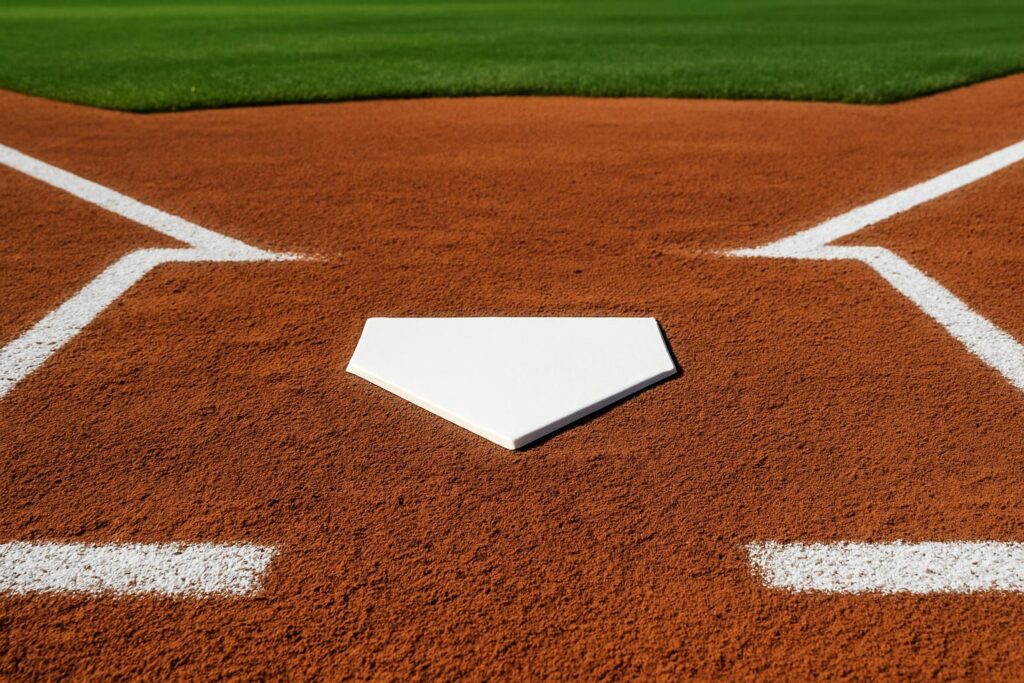
Home plate is the five-sided, flat, white base set flush with the ground at one corner of the diamond. The pitcher throws toward it. The batter stands beside it. The catcher receives over it. The umpire judges pitches by it. A runner scores by touching it. Every key rule about balls, strikes, fair and foul, and runs connects back to this plate.
Unlike the other three bases, home plate is not a soft bag. It is a solid slab made to hold its shape, resist wear, and sit level with the dirt or turf. It anchors the geometry of the field and the logic of the rules.
Shape, Size, and Orientation
The pentagon shape
Home plate is a pentagon. The side that faces the pitcher is 17 inches wide. The two sides that run back from that front edge are 8.5 inches each. The two slanted sides are 12 inches and meet at a sharp point. That back point faces the catcher and the backstop. This shape is not cosmetic. It fixes the width of the strike zone and sets the direction of the foul lines.
How it sits in the ground
Home plate is usually a hard rubber slab, bright white, secured in a frame or sleeve so it sits flush. Grounds crews brush and tamp the dirt around it so there is no lip. The top edges are clear to the eye for the umpire and catcher. The plate must not rock or shift. Even a slight tilt can change bounce and footing and can cause bad calls or injuries.
Orientation to the field
The 17 inch front edge faces the pitcher and must be square to the pitching rubber. The two 12 inch slanted edges extend back to the sharp rear point. The foul lines extend along the outside edges that meet at that rear point and run through first and third base. The plate sits inside fair territory. The chalk lines run along the edges, not through the middle of the plate.
Where Home Plate Sits on the Field
The diamond layout
Home plate, first base, second base, and third base form a square, often called the diamond. In professional baseball, each side is 90 feet. Youth and some amateur leagues use shorter distances. The rear point of home plate is the reference for these measurements and for the direction of the foul lines. If you know where that point is, you can rebuild the entire infield.
The mound and the plate
The pitcher throws from the pitching plate on the mound toward home plate. In professional baseball, the front edge of the pitching plate is 60 feet 6 inches from the rear point of home plate. Other levels use shorter distances, but the logic is the same. The pitch must cross above the plate to be a strike. That is why alignment and exact placement matter.
Batter and catcher positions
There is a batter box on each side of home plate. These boxes define legal foot positions for the batter at contact. The front of the boxes sits near the 17 inch front edge, and the inner lines sit a short distance off the plate so the batter cannot crowd onto it. Behind the plate is the catcher box. It defines where the catcher sets up before a pitch and during a pitch. These boxes keep play fair and clear for the umpire.
Home Plate and the Strike Zone
Horizontal limit
The strike zone covers the width of home plate. If any part of the baseball passes over any part of the 17 inch width as it reaches the front edge of the plate, it can be called a strike, as long as it is also within the top and bottom limits. A pitch that nicks the corner is eligible to be called a strike. A pitch that misses the plate entirely to either side is a ball.
Vertical limit
The top of the strike zone sits around the midpoint between the batter shoulders and the top of the uniform pants. The bottom sits at the hollow beneath the kneecap. This zone is set by the batter stance as the batter is ready to swing, not by full height. Taller hitters have a taller zone. Shorter hitters have a shorter zone. The plate umpire reads this in real time for every pitch.
Timing and location
The pitch is judged as it crosses the front edge of home plate. Where the catcher catches the ball is only a hint. A pitch that crosses the zone and then tails low after the plate is still a strike. A pitch caught over the black can be a ball if it hooked away and missed the plate earlier. Good receivers try to present the ball near the edges to help the umpire see the strike.
Hits, Fouls, and Balls Around the Plate
When a batted ball hits the plate
Home plate is in fair territory. A ball that bounces off the plate is not automatically foul. Treat it like any ground ball. It is fair if it settles or is first touched in fair ground before passing first or third base, or if it passes over first or third base in fair territory. It is foul if it settles or is first touched in foul ground before passing first or third, or if it goes over first or third in foul territory. The plate is part of the fair field.
Foul lines and edges
The foul lines run along the edges of home plate. The lines themselves are in fair territory. If a batted ball rolls along chalk that touches the plate edge and stays on the line until it crosses the bag, it is fair. If it veers outside the line before it reaches the bag and settles there, it is foul. Umpires read spin, bounce, and direction from inches away.
Foul tips and catches
A foul tip is a ball that goes sharply from the bat directly to the catcher glove or hand and is caught. It counts as a strike and the ball stays live. It is different from a routine foul ball, which is dead and sends runners back unless already put out on a play. Most foul tips happen within a step of home plate. Sound, spin, and the quick glove close tell the difference.
Contact near the batter
If the ball hits the batter in the batter box on a batted ball, it is usually a foul ball and dead. If the ball spins out in front of the plate in fair territory and then hits the bat a second time while the bat is in the hands and in the box, most codes call that a foul ball as well. If the bat or batter steps out and intentionally hits a fair ball, that is interference and the batter is out. The area around home plate demands clean, immediate reactions from umpires.
Scoring a Run at Home Plate
Touching the plate
A run scores when a runner legally touches home plate before the third out of the inning is made on a force play or on the same runner. The touch must be clear. If the runner misses the plate, the defense can make a live or dead ball appeal. If the appeal is upheld, the run does not count.
Force plays versus tag plays
Not every out at home is a force. If the runner from third is forced by a batter becoming a runner and the catcher steps on home plate while holding the ball before the runner arrives, that is a force out. A force out for the third out cancels any runs that might have crossed. If the force is off, such as on a fly ball where the runner was tagging, the catcher must tag the runner. On a tag play, a run can score ahead of a different third out at another base on a timing play.
Timing matters
If a runner touches home plate before a non force third out is made on another runner, the run counts. If the third out is a force, the run does not count no matter when the touch happened. That is why in close innings you will see coaches shout about force or no force. It decides the scoreboard.
Plays at the Plate and Safety Rules
Blocking the plate
The catcher cannot block the pathway of a runner to home plate without possession of the ball. If the catcher blocks without the ball and that blocks access, it is obstruction. The umpire can award the runner home. When the catcher has the ball, the catcher can legally block while attempting a tag.
Runner responsibility
The runner cannot veer to initiate avoidable contact. The runner should slide or give up when beaten. Collisions are restricted by rule at many levels to protect both players. Clean tags, clear lanes, and controlled slides reduce injury risk and preserve the play.
Tag mechanics
On a tag play at the plate, the catcher must apply the tag with secure control of the ball. Sweeping tags along the third base line or knee-down tags near the point of the plate are common. If the tag misses and the runner touches the plate, the run scores. If the ball is dropped on contact, there is no tag unless control is regained and the tag reapplied before the touch.
Umpiring at Home Plate
Pre game plate meeting
Before the first pitch, managers and the plate umpire meet at home plate to exchange lineups and go over ground rules. This sets the official batting order and clarifies any unique field issues, such as live ball areas near the backstop and in play fences.
Plate umpire duties
The plate umpire calls balls and strikes, fair and foul around the plate, check swings, catcher interference, and hit by pitch. The umpire also manages tempo, enforces batter box rules, and keeps the game moving. Clear signals and a consistent zone keep both teams informed. The plate umpire is the authority on pitch location relative to the plate.
Positioning and vision
The plate umpire sets up behind the catcher, offset to see the outside corner and the bottom of the zone. Head height and slot angle matter. A slight move on breaking balls helps read whether the pitch caught any part of the plate. Brushing the plate between batters keeps the edges visible for everyone.
Catcher Work at Home Plate
Receiving the strike
The catcher sets the target on or just off the edges of home plate to guide the pitcher. Good receiving presents the ball smoothly without dragging it. If the pitch clipped the plate, steady hands make the strike clear. If it missed, quiet hands avoid fooling the umpire and reduce borderline disputes.
Blocking and recovery
Wild pitches and dirt balls break toward the plate. The catcher must drop, center the chest behind the plate line, and deaden the ball in front. A quick locate and throw can still cut down a runner trying to score. The plate shape helps the catcher read ricochets. The front edge and the point can create odd bounces. Good catchers learn the tendencies of their home field.
Tags and footwork
On throws from the outfield, the catcher sets up to receive in fair territory with a clear lane for the throw, then moves into the lane only as the ball arrives. This avoids obstruction and keeps a path for the runner to slide. Footwork matters. One foot to the front corner allows a reach back to the third base line for swipe tags or a reach forward for a runner coming from a wide slide.
Pitcher Strategy With the Plate
Working the 17 inches
The width of home plate is the pitcher friend. Hitting both edges keeps hitters honest. Pitchers change eye level top to bottom and work east and west across the plate. A fastball inside at the hands sets up a breaking ball that nicks the outside edge. A well placed changeup that starts on the plate and fades off can win a chase. Command of the 17 inches is the foundation of pitching.
Getting borderline calls
Borderline strikes often come from sequences. Show the umpire you can find the plate often. Stay in rhythm with your catcher. Miss small. If you miss wide, reset to cover the plate again. The more pitches that cross some part of the plate, the more trust you earn on the edges.
Adjusting to the batter
Tall hitters offer a taller zone but the same 17 inch width. Short hitters have a shorter zone. Pitchers read the stance and aim for parts of the plate that exploit holes. When in doubt, attack the plate early in the count to avoid free bases. The plate never changes size, so plan around that constant.
Baserunner and Hitter Awareness at the Plate
Approaching the plate as a runner
Know the situation. On a force play, you must beat the ball to the plate. On a tag play, you can slide around the tag and reach for the corner. A low, controlled slide to the outside corner reduces contact and increases reach. Touch the plate clearly. If you are knocked off the plate after a legal touch on a tag play, the run still counts.
Batting stance and the plate
Set up with balance inside the batter box. Track the ball to the front edge of the plate. Decide early on inside pitches that will jam you and outside pitches that will run off the plate. Use the back point of the plate as a reference for the depth of breaking balls. If the ball is still up above the back point, you likely have time. If it is already dropping below the hollow of the knee as it crosses, take it.
Staying clear of interference
After contact, drop the bat in fair territory in front of you and move up the line. Avoid stepping on the ball near home plate. Do not pick up a spinning ball. Let the catcher and fielders play it. Contact with a live ball in fair ground can be interference and an out.
Maintenance and Field Care
Visibility and safety
Home plate must be clean and flush. Dirt builds up during innings. Umpires brush it off to keep the black edges visible. Grounds crews water and tamp the clay around the plate to prevent holes. The batter boxes need solid chalk lines for foot placement and for umpiring. A clear plate lets everyone judge location fast.
Weather and wear
Rain makes the clay around the plate sticky or slick. Crews cover the area with a tarp during delays. After rain, they rake, add drying agent, and compact to safe firmness. In hot conditions, watering keeps dust down and holds the plate level. Frequent checks reduce bad hops and slips that can shift at bats and runs.
Differences Across Levels and Formats
Field distances
Professional baseball uses 90 foot basepaths and a 60 feet 6 inches mound to plate distance. High school and youth fields often use shorter basepaths and closer mounds. Softball uses a shorter distance from pitcher to plate. The job of home plate stays the same at every level. It defines the strike zone width, fair and foul, and the scoring touch.
Rule emphasis
Collision rules and obstruction language can vary by code, but the core principle is constant. The catcher cannot block the runner without the ball. The runner must avoid avoidable contact. Umpires protect a clear lane and a fair tag. Each league educates teams on its specific interpretations during the season.
Common Myths and Quick Checks
Myth: A ball that hits home plate is always foul
False. Home plate is in fair territory. A ball that hits the plate can be fair or foul based on where it settles or is first touched before passing first or third, or whether it passes over first or third in fair territory. Watch the ball, not the point of first contact.
Myth: The catcher can block the plate to save a run
Not without the ball. Blocking without the ball is obstruction. With the ball, the catcher can block as part of a legal tag. That is the balance between safety and defense.
Myth: The strike zone changes with the count
The zone is tied to the plate and the batter stance, not to the count. Human judgment can vary, but the rule is the same with two strikes or none. Any part of the ball over any part of the 17 inch width within the top and bottom limits is eligible to be called a strike.
How to Teach Beginners Using Home Plate
Pitching to the edges
Lay string or flat markers along the 17 inch width to show the true corners. Have pitchers throw sequences to the glove at the inside corner, then the outside corner, then a high fastball above the front edge, then a low fastball that barely clears the bottom. The goal is simple. Own the plate. Miss small.
Hitting with plate awareness
Place a bat or marker along the front edge. Take pitches and call them out loud as ball or strike before the umpire. Track where the ball crosses the front edge. Learn how a pitch that starts over the plate can break off late, and how a pitch that starts outside can backdoor the edge. Train your eyes to the plate, not the catcher glove.
Catching reps at the plate
Do receiving drills on the black edges of the plate. Catch breaking balls that start on one half and finish on the other. Work block and recover drills that drop balls in front of the plate and require a quick locate. Practice tag footwork that starts with a lane open and closes only as the ball arrives.
Scoring plays
Run sliding drills that target the front outside corner of the plate. Practice pops to the feet and immediate moves to the dugout path to avoid loose equipment and catcher throws. End each rep by touching the plate firmly and looking for an umpire signal. Build the habit under control.
Conclusion
Home plate is the anchor of the game. Its shape fixes the strike zone. Its edges draw the foul lines. Its location frames every pitch. Its touch decides every run. Learn the 17 inches, the front edge, the rear point, and the rules that flow from them. You will see pitching plans more clearly, understand umpire calls faster, and read scoring plays with confidence. Master home plate and the rest of the field makes more sense.
FAQ
Q: What is home plate and why is it important
A: Home plate is the five sided white base that defines the strike zone width, anchors the foul lines, starts each at bat, and decides every run when a runner touches it.
Q: What are the exact dimensions and shape of home plate
A: Home plate is 17 inches wide across the front, with two 8.5 inch sides running back, and two 12 inch slanted sides that meet at a point facing the catcher.
Q: Is a ball that hits home plate fair or foul
A: A ball that hits home plate can be fair or foul. The plate is in fair territory. Fair or foul is judged by where the ball settles or is first touched before passing first or third, or whether it passes over first or third in fair territory.
Q: How does a runner score at home plate
A: A run scores when a runner legally touches home plate before the third out is made on a force play or on the same runner. If the runner misses the plate and the defense appeals, the run does not count.
Q: Can a catcher block home plate without the ball
A: No. Blocking home plate without the ball is obstruction. With the ball, the catcher can legally block while attempting a tag.