
We are reader supported. When you purchase through links on our site, we may earn an affiliate commission. Also, as an Amazon affiliate, we earn from qualifying purchases.
The Gold Glove Award is the highest mark of defensive excellence in Major League Baseball. It tells fans which fielders showed the most skill, focus, and consistency over a long season. If you are new to baseball or want a clear guide, this article explains what the Gold Glove is, how it works, what metrics matter, how the process has changed, and how to watch it with a sharper eye. By the end, you will understand why a shiny glove on a mantle means more than a highlight catch. It represents a full season of elite defense.
What Is the Gold Glove Award
The core idea
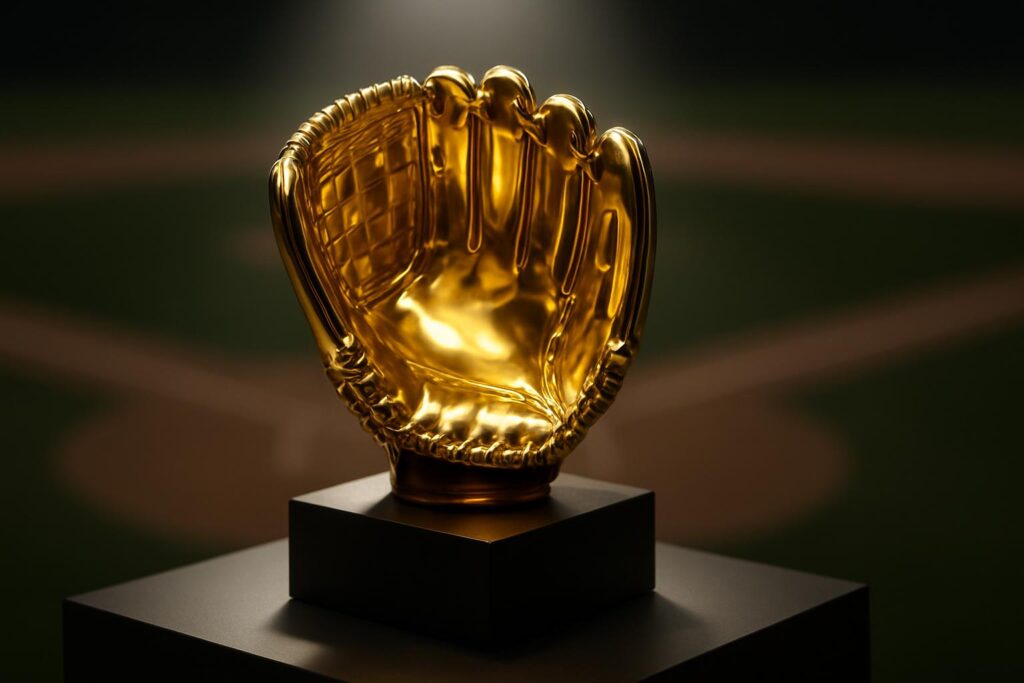
The Gold Glove Award is an annual honor that recognizes the best defensive players at each position in both Major League Baseball leagues. There is one winner per position in the American League and one per position in the National League. In recent seasons, there is also a Utility award in each league for players who provide top-level defense at multiple positions.
Who presents it
Rawlings, a baseball equipment company known for gloves, presents the award each year. The brand created and manages the award program, including the voting system and the trophy presentation.
A brief history
Launch and early years
The Gold Glove Award began in 1957 as a way to honor great defense. In the first year, there was one team of winners across all of Major League Baseball. Starting in 1958, the award split into separate winners for the American League and the National League, which remains the standard today.
Evolution of selection
Over time, the voting process has adapted to better reflect defensive performance. Today it blends the opinions of baseball professionals with a data model that draws from advanced fielding metrics. This framework reduces bias and balances traditional scouting views with objective analysis.
New categories and modern focus
In recent seasons, the award set also added a Utility category in each league. The goal is to recognize defenders who move around the diamond and provide strong value in multiple roles. This reflects how modern teams use versatility to win games.
How voting works today
The ballot and the voters
Gold Glove winners are chosen by a vote of MLB managers and coaches. Voters cannot choose players on their own team. This keeps the process fair and reduces conflicts of interest.
The SABR Defensive Index
To support the ballots, the process includes the SABR Defensive Index, often called the SDI. The SDI is a blended defensive metric created in partnership with the Society for American Baseball Research. It gathers information from multiple advanced defensive systems and compiles it into a single score for each player at each position. The SDI accounts for 25 percent of the total voting results. The remaining 75 percent comes from the managers and coaches ballot.
Eligibility and positions
Players must meet playing time requirements at the position to qualify. The award covers nine defensive positions in each league: pitcher, catcher, first base, second base, third base, shortstop, left field, center field, and right field. The Utility award recognizes qualifying players who deliver elite defense while playing more than one position over the season.
What makes a Gold Glove defender
Pitcher
A Gold Glove pitcher fields bunts, handles comebackers, and covers first base on grounders to the right side. Good pitchers manage the running game with quick pickoffs and smart timing. They also show clean footwork during fielding drills, consistent throws to bases, and focus on not creating extra outs for the opponent.
Catcher
The catcher position is defense-first. Key skills include framing borderline pitches into strikes, blocking balls in the dirt, and limiting the running game. Catchers with fast pop time and strong accuracy stop steals. They also control the field by guiding pitchers, directing infield positioning, and managing bunt and cutoff plays. Durability matters, since top catchers repeat these tasks for months.
First base
Great first basemen pick low throws, secure tough hops, and protect their infield from throwing errors. They stretch with safe footwork and hold runners without losing position. Range helps too, especially on grounders hit to the line or into shallow right. Smooth double play turns and immediate decisions on when to cut a throw also matter.
Second base
Second basemen need quick hands, strong internal timing, and reliable feeds to shortstop. They handle turning double plays under traffic and pressure. Range to the glove side and pivot skill around the bag separate elite players. Communication with the shortstop and proper positioning against each batter type enhance value.
Shortstop
Shortstop is a marquee defensive role. The best shortstops combine range, sure hands, and arm strength. They take high-quality angles to both the hole and the middle. They also set infield alignment, call relays, and anchor the left side. Consistency and decision making are vital, especially with two outs or a runner on third.
Third base
Third basemen must charge bunts, handle hard-hit one-hoppers, and throw across the diamond with power and accuracy. Quick reactions on liners, body control on backhand plays, and precise footwork around the bag build a strong profile. Many tough plays at third demand fast transfer from glove to hand and a consistent internal clock.
Left field
Left fielders often handle line drives and tricky caroms in the corner. Good positioning and reads on balls hit to the gap are key. While arm strength is less critical than in right field, clean throws to second and quick relays save extra bases. Efficient routes and smart decision making on when to hold the ball versus risk a throw cut off wasted runs.
Center field
Center fielders cover the most ground in the outfield. First step, route efficiency, and closing speed stand out. They call off corner outfielders and set alignment. Good center fielders track deep balls, navigate wall plays, and deliver strong, accurate throws to cut runners. Jump quality and anticipation make the difference on balls that hang in the air.
Right field
Right fielders often show the strongest arms in the outfield. They deter runners from taking extra bases. Reads on slicing line drives and control of the corner are essential. Solid right fielders build value with accurate throws to third base and a calm presence on short hops to the line.
Utility defender
Utility defenders must adapt fast. They move among infield spots or between the infield and outfield depending on team need. To stand out, a utility player has to be close to position-specific experts wherever they play. Consistency across roles is the key. Sound footwork, strong pre-pitch planning, and a clear understanding of angles allow these players to limit mistakes while shifting positions.
The role of modern defensive metrics
Why metrics matter
Great defense is not only about errors or fielding percentage. Range, positioning, throw strength, and play difficulty all influence run prevention. Modern systems track where each ball is hit, how fast it travels, how long it stays in the air, and where the defender starts. Metrics then estimate how many runs a player saves relative to an average fielder.
Defensive Runs Saved
Defensive Runs Saved, often called DRS, translates plays into runs. It credits players who make above-average plays and debits those who do not convert routine chances. It adjusts for batted ball type, speed, and location. As a result, DRS captures range and play difficulty far better than simple error counts.
Ultimate Zone Rating
Ultimate Zone Rating, or UZR, breaks the field into zones and tracks outcomes by batted ball type. It estimates how many runs a fielder saves or costs in those zones relative to average. UZR historically helped quantify outfield range and infield positioning impact.
Outs Above Average
Outs Above Average, or OAA, comes from tracking system data. It evaluates the probability of turning a batted ball into an out based on its speed, angle, and hang time, plus the fielder’s starting point. It then compares actual outs to expected outs. OAA is strong for outfield range and also provides infield measures with distance and direction detail.
Catcher framing and pop time
For catchers, specialized metrics matter. Framing measures how well a catcher turns borderline pitches into called strikes by presenting the ball cleanly. Pop time measures the time from the moment the ball hits the catcher’s glove to the moment the throw reaches the fielder at second base on a steal attempt. Combined with caught stealing rate, blocking, and passed balls, these metrics reveal total catcher value beyond traditional stats.
Common debates and pitfalls
Reputation versus results
One long-running debate is whether reputation and past success influence voting too much. The inclusion of the SABR Defensive Index helps counter this. It gives each candidate a data-based check. The best approach is to consider both sides. Trust informed eyes on mechanics and leadership, while also trusting numbers to weigh range and play difficulty.
Ballpark and positioning effects
Not all ballparks play the same. Some have deep alleys or high walls. Weather patterns also affect carry. On top of that, teams now use detailed positioning and pre-pitch shifts. Strong metrics attempt to control for these factors, but context still matters. When you assess a player, keep the environment in mind.
Limits of errors and fielding percentage
Fielding percentage treats a missed routine grounder and the failure to reach a tough ball as equal, which is not realistic. A player with little range might look clean but not get to many balls. Error counts miss the opportunities never reached. That is why modern Gold Glove analysis compares players by how many tough plays they convert and how many runs they prevent.
How to follow the award each fall
Timing and announcements
Voting happens after the regular season ends. Winners are announced in the weeks after the World Series, often in early November. The reveal usually comes by position and league, with separate spotlights on finalists and winners.
Reading a winner’s profile
When you evaluate a Gold Glove winner, look for a well-rounded case. That means strong metrics like DRS, UZR, or OAA, clean play on routine chances, and visible impact plays in key moments. For catchers, add framing, blocking, and controlling the running game. For infielders, add double play efficiency and tough backhand conversions. For outfielders, check jumps, route quality, and throwing accuracy.
Gold Glove versus other baseball awards
Gold Glove and Silver Slugger
The Gold Glove recognizes defense. The Silver Slugger recognizes offense. It is common for different players to win each at the same position. A complete player might compete for both, but the awards judge separate skills.
Gold Glove and Platinum Glove
The Platinum Glove recognizes the single best overall defender in each league from the pool of Gold Glove winners. Gold Gloves tell you who was best at each position. Platinum Gloves tell you who stood above the field entirely.
Notable streaks and milestones
Longevity at the top
Sustained defensive excellence is rare. Some players have set long records for wins at a position. Greg Maddux set the all-time record with 18 Gold Gloves. Brooks Robinson and Jim Kaat each won 16. Ozzie Smith and Ivan Rodriguez both earned 13. Andruw Jones won 10 in center field. These totals show how challenging it is to maintain elite defense year after year.
What streaks reveal
Streaks often reflect more than talent. They show durability, daily preparation, and the ability to adapt as hitters, parks, and strategies change. They also show trust from coaches, peers, and analysts who watch how a player manages plays that do not always make highlights.
How a player builds a Gold Glove profile
Master the fundamentals
Defense begins with posture, footwork, and clean hands. At every position, the best players repeat high-quality reps. They keep their head still through the catch, move their feet before they move their glove, and align shoulders and hips before they throw. They practice situational throws and practice them with speed to simulate game pressure.
Win the pre-pitch
Great defenders prepare before contact. They set a ready position, understand hitter tendencies, and scale their depth based on the situation. They talk through cuts and relays. They also trust scouting and make small shifts that convert a 60 percent play into an 80 percent play.
Make the routine play automatic
Gold Glove defenders separate themselves by never giving away outs. Routine grounders, simple fly balls, short throws across the diamond, and standard tags cannot slip. That is where elite defenders collect value over six months. Once the routine is secure, the tough plays become the bonus.
Use data and video
Modern players study heat maps of batted balls and review their routes and angles on video. They work with coaches to adjust starting points, first steps, and exchange speed. They track pop time and arm slot changes. Small tweaks over hundreds of plays add up to runs saved that show up in metrics and in wins.
Value communication
Defense is teamwork. The best defenders do not only make their own plays. They help teammates align, call priority on pop-ups, and move the infield or outfield a step. That support cuts down on gaps and missed coverages. It also improves relay precision, which reduces extra bases for opponents.
How fans can evaluate defense better
Watch the details
On grounders, watch the first step, angle to the ball, and exchange speed. On throws, watch the feet and where the ball finishes relative to the bag. For outfielders, track the initial jump and the line to the ball. For catchers, watch body quietness when receiving and the transfer on throwdowns.
Use a small stat set
Combine a few advanced stats with basic ones. Start with DRS or OAA as your main signal. Add fielding percentage and errors only as a check. For catchers, look at framing value, pop time, and caught stealing rate. For infielders, include double play participation and throwing accuracy. For outfielders, check assists and advancement prevention.
Mind the sample
Defensive numbers can move around in small samples. A month of great plays does not always hold for a season. Multi-year performance helps confirm skill. When you compare players for an award, use the full season and read multiple metrics rather than only one line.
Why the Gold Glove still matters
Defense wins margins
Many tight games turn on a single play that prevents a run. The Gold Glove shines a light on those plays and the players who make them. It validates the daily work of positioning, communication, and fundamentals. It also teaches fans what good defense looks like in a measured, repeatable way.
Recognition across roles
Because winners are named at every position, the award respects the unique demands of each role. It does not try to compare a catcher to a left fielder head-to-head without context. It lets players stand out within their defensive lane. The Utility category further shows how teams win with flexible role players as well as specialists.
Conclusion
The Gold Glove Award cuts through noise and highlights the players who prevent runs with skill and consistency. It blends expert voting with trusted defensive metrics. It honors each position’s unique challenges and adapts as the game evolves. If you learn to read the award with a balanced view of both numbers and on-field detail, you can better appreciate the craft of defense. The best defenders save outs you do not always notice on first watch. The Gold Glove helps you notice them and understand their impact on winning baseball.
FAQ
Q: What is the Gold Glove Award
A: The Gold Glove Award is an annual honor that recognizes the best defensive players at each position in both Major League Baseball leagues, with one winner per position in the American League and the National League and a Utility award in each league for multi-position defenders.
Q: How are Gold Glove winners chosen
A: Gold Glove winners are chosen by a vote of MLB managers and coaches who cannot vote for their own players, and the SABR Defensive Index accounts for 25 percent of the total voting results.
Q: Which positions receive a Gold Glove
A: The award covers pitcher, catcher, first base, second base, third base, shortstop, left field, center field, and right field in each league, plus a Utility award for players who deliver elite defense at multiple positions.
Q: What defensive stats matter most for the Gold Glove
A: Key metrics include Defensive Runs Saved, Ultimate Zone Rating, and Outs Above Average, along with catcher framing, pop time, caught stealing rate, and traditional stats like fielding percentage, errors, assists, and double plays.
Q: What is the difference between a Gold Glove and a Platinum Glove
A: Gold Gloves honor the best defender at each position in each league, while the Platinum Glove recognizes the single best overall defender in each league from the pool of Gold Glove winners.