
We are reader supported. When you purchase through links on our site, we may earn an affiliate commission. Also, as an Amazon affiliate, we earn from qualifying purchases.
You do not have to get caught in confusion on the bases. Once you understand exactly when the defense can simply step on a base and when they must tag a runner, you start reading every play faster and making better decisions. This guide breaks down the difference between a force out and a tag out with clear rules, clean examples, and on-field checklists. By the end, you will know how to keep innings alive as a runner and how to finish them as a fielder.
The core idea: two ways to retire a runner
Every defensive play in baseball and softball aims at one result. Record three outs before the offense scores. In the infield, outs happen in two main ways. A force out or a tag out. Both remove a runner, but they require different conditions and mechanics. If you mix them up, you waste time or miss outs. If you master them, you control the inning.
Force out explained
What a force out is
A force happens when a runner must advance because another runner is entitled to his base. The most common trigger is the batted ball that makes the hitter become the batter-runner. That batter-runner is entitled to first base, so the runner on first is forced to second, and the chain can continue.
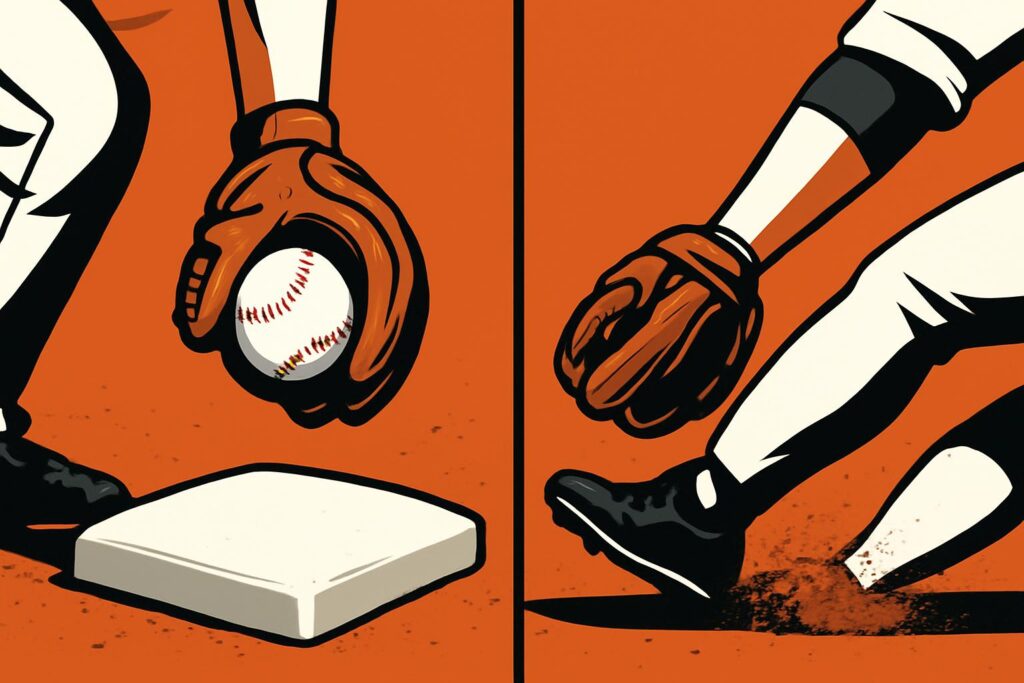
A force out happens when a runner is required to advance to the next base and a fielder, with the ball under control, either tags that next base before the runner gets there or tags the forced runner before he reaches that base.
On a force play, the defense does not need to tag the runner to get the out. Touching the forced base with the ball under control is enough. The out is recorded the moment the fielder has firm control of the ball and makes contact with the base while the runner has not yet reached it.
Where forces exist
Forces exist anywhere a runner must move forward to make room for a following runner who has the right to a base. Common spots include:
- First base on any fair batted ball in play, because the batter becomes a runner and must try for first.
- Second base when there is a runner on first and the ball is put in play on the ground.
- Third base when there are runners on first and second.
- Home plate when the bases are loaded.
Force chains
Forces stack in order. The batter-runner forces the runner on first to second. That runner forces the runner on second to third. That runner forces the runner on third to home. The defense can get an out at any forced base in that chain by touching the base with the ball or by tagging the forced runner before he reaches it.
How a force ends
Forces are not permanent. They can disappear during a play. Here is the rule you need to recognize in real time:
A force is removed when the batter-runner is retired before he reaches first, when a runner behind you who created your force is retired, or when a fly ball is legally caught.
Examples:
- Runner on first. Ground ball. Shortstop throws out the batter-runner at first. The runner who had been on first is no longer forced to second, because there is no longer a batter-runner coming to claim first.
- Runners on first and second. Ground ball. Second baseman tags the runner from first before he reaches second. That removes the force on the runner who started on second, because the runner behind him who created the force is now out. A tag is now required to retire the remaining runner if he is standing on or returning to second.
- Any runners. Fly ball is legally caught. The batter-runner is out, so there is no force anywhere. Runners must tag up to advance, and the defense must tag a runner or appeal a base touch to retire them.
Double plays and the force
Double plays often start with a force out because they are fast and require less precision than tag plays. The defense designs footwork to maximize the force mechanic:
- Ground ball to short with a runner on first. Shortstop flips to second base. The second baseman touches the bag while on the move for the force on the runner from first, then throws to first for the force on the batter-runner.
- Ground ball to first with a runner on third and less than two outs. If the first baseman tags first before throwing home, he removes the force on the runner from third. The catcher now needs a tag at the plate to get that runner. If the first baseman instead throws home first and the catcher steps on the plate before the runner from third arrives, that is a force out and the defense can still retire the batter-runner at first with a force for a potential double play.
Force at home
With the bases loaded and a ground ball, the catcher can stand on the plate awaiting a throw. Touching the plate with control of the ball before the runner from third arrives is enough for an out. With the bases loaded on a ground ball, the catcher can record a force at home by touching the plate while holding the ball before the runner from third touches it; no tag of the runner is required.
If the bases are not loaded and the runner from third is not forced, the catcher must tag the runner to retire him at the plate. Stepping on home alone does nothing in that case.
Force and appeals
Appeal plays can involve forces. If a runner misses a forced base and the defense properly appeals by touching that base with the ball while the ball is live, the out is a force out. That matters for run scoring on the third out.
Common force play mistakes
- Assuming the force still applies after a catch. Once a fly ball is caught, all forces vanish. Do not step on a base expecting an out. You need a tag or a proper appeal of a missed retouch.
- Tagging the runner when a faster force at the base is available. Use your feet and the base when you can. Save tags for when the force is off or when the tag path is clearly shorter than the step-and-throw option.
- Stepping off the base early on a throw. Control the ball, then touch the base. If the ball is bobbled as your foot hits the base without secure control, the runner is safe.
- Forgetting the force at home with bases loaded. Step on the plate first, then look for the next out.
Tag out explained
What a tag out is
A tag is contact by a fielder with a runner using the ball or the glove with the ball inside. The ball must be firmly held at the moment of contact. If the ball pops out on contact, the tag does not count.
A tag out happens when a fielder, holding the ball in the hand or glove that makes contact, tags a runner who is not safely on a base.
When a tag is required
Any time a runner is not forced and is advancing or leading off a base, the defense must tag that runner to retire him. Touching the base alone does not retire a non-forced runner who is standing on it. Key tag situations include:
- Pickoffs. The runner is off the base. The fielder must tag the runner before he gets back.
- Steals of second or third. If there is no force, the fielder must tag the runner.
- Plays at the plate when the bases are not loaded. The catcher must tag the runner before he touches home.
- After a fly ball is caught. All runners must tag up before advancing. The defense must tag a runner who left early or execute an appeal if the runner misses a base.
Tagging mechanics that matter
- Ball control. Secure the ball before and through contact. If the ball pops out during or immediately after the tag, expect the runner to be ruled safe.
- Tag with the ball. Your hand or glove that touches the runner must be holding the ball at that moment.
- Footwork and lane. Present a tag where the runner arrives. Do not reach across your body late and lose balance. Beat the runner to the spot and bring the tag to the ball side.
- Swipe and block with care. Quick, low swipes reduce the runner’s reach angle. Do not obstruct the runner without the ball.
Tagging a runner who is on a base
Being on a base protects a runner unless he is forced to advance. If a runner is forced and has not yet reached his next base, he is not protected by the base he is leaving. The defense may tag that runner anywhere before he reaches the forced base, or they may touch the forced base first.
If a runner is not forced, touching his current base shields him from a tag. The defense must induce him off the base or tag him before he gets back.
Rundowns
Rundowns are pure tag plays. The goal is to shorten throwing distance, close space, and force the runner to commit. Run hard at the runner with the ball, throw early to a teammate who has stepped up to the next angle, and keep the ball moving until you have the tag. Do not chase across the diamond with long throws.
Force out vs tag out: practical differences
Speed and certainty
- Force out. Faster and simpler. Step on the base with the ball under control. No need to touch the runner.
- Tag out. Slower and riskier. You must physically touch a moving runner with control of the ball.
Decision rule for fielders
If a runner is forced to a base you can reach or touch quickly, take the force. If the force has ended or the runner is not forced, commit to a tag and close space with your feet before trying to apply it.
Decision rule for runners
- Under a force. Sprint directly to your next base. Sliding through the front of the bag can beat the force. You are not protected by the base you are leaving.
- With no force. Protect the base you have. Lead off only as far as you can return safely. On contact plays, avoid the tag with smart angles and late slides.
Plays at home
- Force on. Bases loaded on a grounder. The catcher steps on home with the ball before the runner from third touches it for a quick out, then throws to first or third for a second out.
- Force off. Runner on third only. The catcher must tag the runner. Set the angle and show the glove to the runner’s lane. Do not rely on the plate for an out.
Third out and runs
If the third out of an inning is a force play, no runs score on that play. If the third out is a tag play on a runner who is not forced, a run can score if it touches home before that third out is recorded. Time the ball and runners accordingly.
Situational breakdowns
Bases empty
Ground ball to any infielder. The batter-runner is forced to first. The fielder steps on first or throws to first. Simple force. No tag needed unless the fielder misses the base and the runner is off the bag.
Runner on first
Ground ball to the left side. The shortstop can take the force at second for the lead out by stepping on the bag, then throw to first for a double play. If the shortstop has no time to reach second, throw to first for the force on the batter-runner.
Ground ball to first baseman. If the first baseman tags first immediately, the force on the runner going to second remains until the batter-runner is out. If the first baseman wants the lead runner at second, he can throw to second for the force and then the shortstop may throw back to first for a second force.
Runners on first and second
Ground ball to third baseman. The simplest path is often to step on third for the force on the runner from second, then throw across the diamond to first for the force on the batter-runner. If the third baseman tags the runner advancing to third before the runner touches the base, that is still a force out because that runner was required to advance. After that out, the runner who started on first is still forced to second until the batter-runner is out or reaches first.
Bases loaded
Any ground ball creates a force at every base. Touch any forced base before its runner arrives to record an out. Catchers prioritize the plate because it cuts off the run. Infielders prioritize the easiest bag they can reach while keeping the double-play path open.
With the infield in and a grounder to shortstop, the shortstop can throw home for the force. The catcher touches the plate and fires to first for a potential double play. If the shortstop hesitates and takes the out at first first, the force at home disappears and the catcher must tag the runner from third if he tries to score.
Fly balls and the force
Once a fly ball is caught, the batter-runner is out and no runner is forced. Runners must tag up at their time-of-pitch base before advancing. The defense retires runners with tags or with appeals if a runner leaves early or misses a base. Stepping on a base without a tag does not retire a runner after a legal catch unless it is part of a proper appeal.
Ground balls where a tag is smarter
Some grounders give the defense a short path to a tag before the runner reaches the next base. Example. Runner on first, soft grounder right in front of the plate. The catcher can charge, tag the runner from first in fair territory, then throw to first for a second out. That is faster than retreating to the plate and waiting for a throw to second.
Another example. Runner on third only, chopper to first. The first baseman should not step on first if he wants the out at home. If he steps on first, the force at home disappears and the catcher must make a tag play. Instead, the first baseman can fire home early for the tag at the plate, then the catcher can throw to first for the batter-runner if time allows.
Fielding fundamentals to win both plays
Pre-pitch communication
- Middle infielders confirm who covers second on a ground ball.
- Catcher and corners decide the plan with runners on third or bases loaded.
- Everyone knows the number of outs and the speed of the runners.
First step reads
- Hard grounder right at you. Look for the nearest force base and take it quickly.
- Slow roller or swinging bunt. Consider the quick tag path if a lead runner is exposed.
- High chopper. Think one sure out. Do not chase an uncertain tag and miss the force.
Footwork at the bag
- Arrive early. Present a target, secure the ball, then touch the base.
- Use the inside corner of the bag to avoid collisions and set your throw line.
- Keep your eyes on the ball into the glove. Do not pull off the bag early.
Throwing and receiving
- Lead the bag, not the fielder. Throw to a spot that guides the receiver onto the base in stride.
- Short hops are better than air mail on double play feeds. Keep the ball on the infield side.
- Receivers show the bag with one foot, the glove to the ball, and secure the catch through the touch.
Tag technique
- Ball first, then body. Secure the catch before swinging the tag.
- Low and through. Apply the tag below the belt and hold through contact.
- Two hands near contact to reduce the chance of a drop on collision.
- Do not obstruct. Without the ball, do not block the base path.
Baserunning fundamentals to beat both plays
Know when you are forced
At the crack of the bat, run your checklist. If the batter becomes a runner and you are sitting on a base that must be vacated, you are forced. Go full speed to your next base. Do not hesitate waiting to see if the ball gets through if you are forced.
Lead size and risk
With no force, your lead and steal attempt must respect the need to return on a throw. If you draw a throw, aim to beat the tag with quick feet and a low slide to the back of the bag. With a force, get your best jump and aim for the front corner of the bag to beat the base touch.
Slides that match the play
- Force play slide. Straight, on time, and through the bag. Reduce contact with the fielder and make the throw harder.
- Tag play slide. Late and evasive. Use a pop-up slide, hook slide, or swim move to avoid the tag hand while keeping a hand on the bag.
- Home plate. If forced, aim at the plate edge for speed and reach. If not forced, choose a path that avoids the catcher’s tag lane.
Fly ball discipline
When a fly ball is hit and you are on a base, freeze and read. If it is caught, tag and then go. Do not run on contact unless there are two outs or you are sure the ball will drop. The defense needs tags and appeals only after a catch. Make them earn that tag.
Quick checklists
Fielder checklist
- Is there a force at a base I can reach faster than a tag
- If yes, take the force by touching the base with control of the ball.
- If no, close space and apply a firm, controlled tag.
- Know where the next out is and whether the force still exists.
- On third out potential, know if a force out will erase a run.
Runner checklist
- Am I forced If yes, go full speed to the next base.
- If not forced, protect the base and expand only as far as you can return safely.
- On grounders, slide to beat the base on force plays; slide to avoid the glove on tag plays.
- On flies, tag up if caught. Advance only with certainty.
Catcher and first baseman guidelines
- Catcher with bases loaded. Set on the plate edge, receive, step on the plate, then look for the next out.
- Catcher with runner on third only. Set the lane, secure the ball, and tag. Stepping on the plate alone does not retire the runner.
- First baseman on a chopper with a runner at third. Decide before the catch. If you want the out at home, throw home first. If you step on first, the force at home disappears and the catcher needs a tag.
Scoring and recordkeeping notes
Scorekeepers mark a force play as a putout at the base touched, with assists as needed. Tag outs credit the fielder who makes the tag. Double plays that begin with a force are common and often the fastest path out of a jam. If the third out is recorded on a force, no runs that cross the plate on that play count. If the third out is a tag on a non-forced runner and a different runner has already scored, that run can count if it scored before the tag out.
Common myths corrected
- Myth. Stepping on a base always gets an out. Reality. It only gets an out if the runner going to that base is forced or if it is a proper appeal.
- Myth. A runner standing on his base is always safe. Reality. If he is forced to the next base, he can be retired by a tag on him or a touch of his next base before he gets there.
- Myth. The catcher always needs to tag at the plate. Reality. With the bases loaded on a grounder, the catcher can step on the plate for a force.
- Myth. Any tag with the glove counts. Reality. The glove must contain the ball at the moment of contact or the hand that tags must be holding the ball.
Drills to build instincts
Force footwork ladder
Set cones at second and first. Roll grounders and demand the receiver get to the base early, present the glove, secure the ball, and then touch the bag while balanced for the throw. Add a clock to reinforce tempo for the double play.
Tag window drill
At second base, have runners slide to both sides of the bag while the middle infielder practices low, two-hand tags that hold the ball through contact. Focus on receiving, then tagging. No blind swipes.
Force off, tag on read
Simulate bases loaded and runner on third only. Catcher receives throws from the infield. Coach calls force on or force off. On force on, catcher steps on the plate and throws to first. On force off, catcher turns into the runner and applies a clean tag.
Conclusion
Games swing on whether you recognize the status of the force and act on it without delay. When the force is on, the base is your friend. Touch it with control and move on. When the force is off, the runner is your target. Close space and tag through the catch. You now know how to track where forces exist, how and when they end, and how to apply tags that hold up. Use the checklists. Train the footwork. Communicate before the pitch. You will stop giving away outs, you will take extra ones, and you will keep runs off the board.
FAQ
Q: What is a force out?
A: A force out happens when a runner is required to advance to the next base and a fielder, with the ball under control, either tags that next base before the runner gets there or tags the forced runner before he reaches that base.
Q: What is a tag out?
A: A tag out happens when a fielder, holding the ball in the hand or glove that makes contact, tags a runner who is not safely on a base.
Q: When does a force end?
A: A force is removed when the batter-runner is retired before he reaches first, when a runner behind you who created your force is retired, or when a fly ball is legally caught.
Q: Do you have to tag the runner at home with the bases loaded?
A: With the bases loaded on a ground ball, the catcher can record a force at home by touching the plate while holding the ball before the runner from third touches it; no tag of the runner is required.
Q: Do runs score on a third out force play?
A: If the third out of an inning is a force play, no runs score on that play.