
We are reader supported. When you purchase through links on our site, we may earn an affiliate commission. Also, as an Amazon affiliate, we earn from qualifying purchases.
The red zone looks the same on TV in the NFL and college football, but what happens inside it can be very different. Rules about hash marks, pass interference, catches, clock, and penalties change how teams call plays and how defenses respond. If you want to understand why the same concept works on Saturdays but stalls on Sundays, or why some college kicks look impossible from the hash, this breakdown will give you a clear, practical map of the differences.
Introduction
Coaches say games are won or lost in the red zone. That is true at every level, but the details behind those wins change from college to the NFL. The ball is the same shape, the end zone is the same size, and a touchdown is still six points. Yet small rule differences add up to real changes in spacing, leverage, and decision-making. Learn those differences and you will watch late-game drives with new clarity.
What Exactly Is the Red Zone
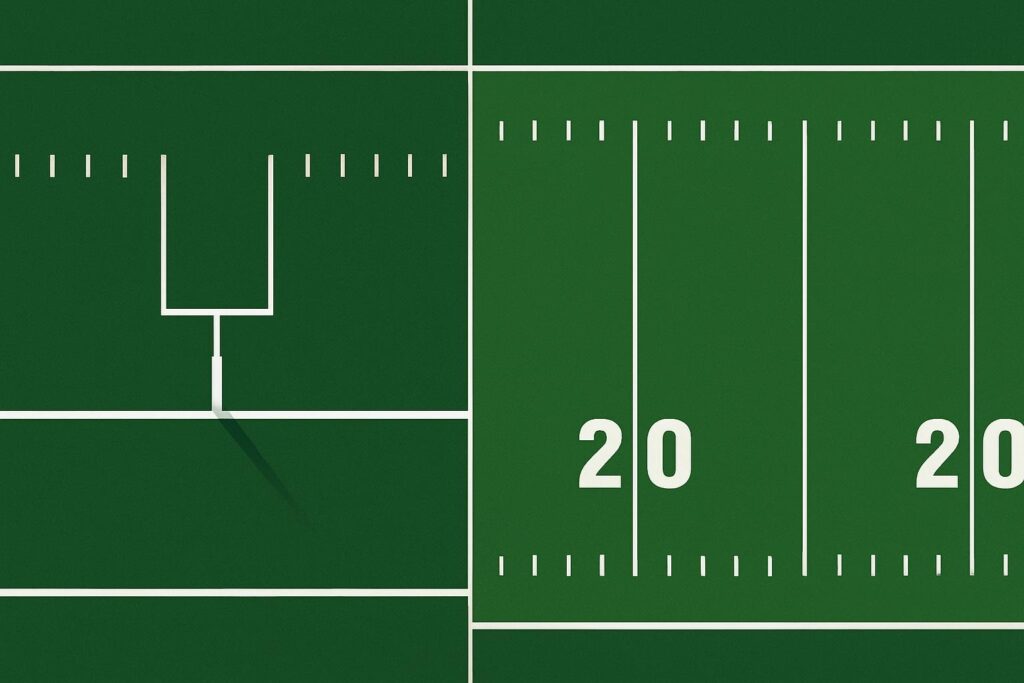
The red zone is the area from the opponent’s 20-yard line to the goal line. Offenses expect points here. Defenses try to force field goals or takeaways. Space is tight, windows get smaller, and every yard matters. When rules adjust how space and penalties work, strategies also shift.
Field Geometry: The Hash Marks Drive Everything
NFL vs NCAA hash mark locations
This is the biggest on-field difference you can feel right away.
NFL hash marks are almost in the middle of the field. Each hash is 70 feet 9 inches from its nearest sideline. The distance between the hashes matches the width of the goalposts at 18 feet 6 inches. That keeps the ball near the center on most snaps and creates balanced angles.
NCAA hash marks are much wider. Each hash is 60 feet from its sideline, so the hashes are 40 feet apart. That puts the ball much closer to one sideline after many plays. The angle to the far side is longer, and the angle to the near pylon is sharper.
How hash marks change red zone plays
In college, you see more short-side runs, bunch sets into the boundary, and quick throws to the wide side because there is more room to outflank the defense. Kicks from the hash can be tricky because of the steep angle. Rollouts and sprintouts toward the open side are common.
In the NFL, spacing is more balanced. You see more full-field concepts, high-low reads across the middle, and fewer extreme-angle kicks. The playbook stays wide open in any spot because you are rarely stuck on a severe hash.
Scoring After Touchdowns: Extra Points and Two-Point Tries
Try distances
NFL: Kicked extra points are snapped from the 15-yard line, creating a 33-yard attempt. Two-point tries snap from the 2-yard line.
NCAA: Both the kick and the two-point try snap from the 3-yard line. The kick is about a 20-yard attempt, which is much easier than the NFL kick.
Red zone effect
College teams kick far more extra points because the distance is short and the angle is manageable even from the hash. In the NFL, the longer PAT adds risk, so two-point attempts become a real calculus late in games.
Defense can score on conversion returns
Both levels allow the defense to return a blocked kick, fumble, or interception on a conversion for two points. That risk matters for play design near the goal line when the protection or throw might be loose.
Catch Rules Near the Sideline and Back Line
Feet down in bounds
NFL: A receiver must control the ball and get two feet or a body part equivalent in bounds. Tight red zone throws to the sideline and back line demand excellent footwork.
NCAA: One foot in bounds with control is enough. College offenses can call more fades, quick outs, and back-shoulder throws with less risk of an incomplete ruling.
Why this changes play calls
In college, the one-foot rule increases the success rate of boundary throws. In the NFL, coordinators often prefer route concepts that create space inside the end zone or use crossers and rubs to free a receiver because toe-tap catches are harder and riskier.
Pass Interference and Defensive Contact
Defensive pass interference enforcement
NFL: Defensive pass interference is a spot foul and an automatic first down. If it occurs in the end zone, the ball goes to the 1-yard line. This is massive leverage. Even a small tug on a deep crosser can move the ball to the doorstep.
NCAA: Defensive pass interference is a 15-yard penalty from the previous spot and an automatic first down. If the foul is close to the goal line, enforcement becomes half the distance. There is no automatic placement at the 1 on end zone DPI.
Strategic impact
In the NFL, throwing into tight coverage can be a win because DPI can put the ball on the 1. That encourages fades, crossers into traffic, and shots that force the defender to play perfectly. In college, the reward is capped at 15 yards, so quarterbacks must be more precise. You will still see fades and posts, but less fishing for a flag to gain the 1-yard line.
Illegal contact and holding
NFL: Illegal contact beyond 5 yards is 5 yards and an automatic first down. Defensive holding is also 5 yards and an automatic first down. In the red zone, those first downs are painful because the offense often ends up with goal-to-go.
NCAA: There is no separate illegal contact rule like the NFL 5-yard zone. Defensive holding is 10 yards and an automatic first down. Because the ball starts closer to the end zone in the red zone, a 10-yard enforcement can swing the drive.
Pick routes and rubs
Both levels allow natural rubs but not illegal picks that initiate obvious blocking on a defender before the ball is touched. In the NFL, officials scrutinize tight bunch sets near the goal line because the defense has limited space. In college, wider hashes often create clearer traffic and more separation, making rub timing easier.
Ineligible Linemen Downfield and RPOs
The yardage limit difference
NFL: Ineligible players cannot be more than 1 yard downfield on a forward pass that crosses the line of scrimmage.
NCAA: The limit is 3 yards downfield.
Red zone effect
This one rule explains a lot of the RPO explosion in college, especially near the goal line. With a 3-yard cushion, linemen can sell the run and still be legal when the quarterback pulls and throws a slant or glance route. That stretches second-level defenders and opens easy throws inside the 10. In the NFL, the 1-yard limit forces quicker decisions and tighter windows. You still see RPOs, but the timing is stricter and throws often occur at or behind the line of scrimmage.
Running Game, Sneaks, and Assists
Pushing the pile
Both levels allow teammates to push the ball carrier. Pulling is still illegal. The push helps short-yardage plays and the quarterback sneak from the 1. Expect more tight formations, double teams, and low pad-level runs near the goal line at both levels.
Low blocks and safety
Both codes restrict blocking below the waist, crackbacks, and chop blocks, with the NFL generally stricter outside the tackle box. In the condensed red zone, most runs hit inside anyway, but teams stay careful with motion and crack timing to avoid flags that would kill a drive.
Turnovers at the Goal Line and Touchbacks
Fumble through the end zone
At both levels, if the offense fumbles the ball into and out of the opponent’s end zone, the result is a touchback. The defense gets the ball at its 20-yard line. It is a harsh outcome for the offense and a key coaching point about ball security near the pylon.
Interceptions and momentum exception
If a defender intercepts the ball near his goal line and momentum carries him into the end zone where he is downed, the ball can be placed at the spot of the catch under the momentum exception. Both the NFL and NCAA have versions of this rule to avoid punishing smart defensive plays near the goal line.
End zone catches and safeties
A ball caught by the defense in the end zone and downed there is typically a touchback. If the ball comes out of the end zone and then the runner retreats and is downed in the end zone, it can be a safety. Ball security and awareness are vital in the chaos after turnovers.
Kicking in the Red Zone
Goalpost width and leverage
Goalposts are the same width in the NFL and NCAA at 18 feet 6 inches. That is crucial because NFL hash marks are aligned with the uprights, keeping angles friendly. In college, the wide hashes create severe angles on short field goals, especially inside the 10. You will see more college teams choose the middle of the field on runs before a kick to reduce the angle.
Roughing the kicker
Both levels protect the kicker and holder. A roughing foul brings 15 yards and an automatic first down. In the red zone, that penalty often flips a field goal attempt into a new set of downs and a high chance at a touchdown. Leapers and players hurdling protection are also limited by safety rules, more tightly in recent seasons.
Clock and Replay: Game Management Inside the 20
First down clock rules
NFL: The clock does not stop for first downs except for normal reasons like out of bounds or incomplete passes.
NCAA: Since 2023 in Division I, the clock stops for first downs only inside the last two minutes of each half. Outside of that window, it behaves like the NFL and keeps running once the ball is ready for play.
Red zone effect
Late in halves, college offenses get a brief clock stop on first downs, which helps them reach the line and run another play without spending a timeout. In the NFL, you must be sharper with sideline throws, quick spikes, and timeout usage to manage the clock in the red zone.
Play clock and substitutions
Both levels use a 40-second play clock after routine plays and a 25-second clock after administrative stoppages. If the offense substitutes, officials allow the defense time to match. In the red zone, that slows down quick-snap tricks off substitutions. Tempo offenses try to avoid substituting to keep the defense stuck on the field.
Replay reviews
Both levels automatically review all scoring plays and turnovers. Red zone catches, goal line breaks, and pylon touches will be checked. Coaches still manage tempo to prevent the booth from stopping play on non-scoring calls if they want to get a snap off, but inside the 2-minute warning or with a scoring play, you should expect a stoppage.
Ten-second runoffs
Both codes can apply a ten-second runoff in the final minute for certain fouls that stop a running clock. Offenses must keep formation clean and avoid false starts or illegal shifts in hurry-up red zone settings, or they could lose both yardage and precious time.
Overtime: Why College Feels Like Permanent Red Zone
Starting field position
NCAA overtime starts each possession at the opponent’s 25-yard line. That is already the red zone or one first down away. Offensive coordinators script red zone sequences immediately. After the second overtime, teams must go for two after touchdowns. From the third overtime, play converts to alternating two-point attempts only. Everything is short-field football.
NFL overtime
NFL overtime is drive-based and starts with a kickoff. Field position varies, so it is not automatically red zone play. In the postseason, both teams are guaranteed one possession, but the general drive nature stays the same.
Formations, Motion, and Eligibility Tricks
Eligible receiver rules
NFL: Players with ineligible numbers can report as eligible for a snap, which opens trick formations near the goal line. You will see tackle-eligible passes and heavy sets with surprise routes by a sixth lineman. The player must report and be announced to the defense.
NCAA: Numbers 50 to 79 are ineligible by rule for forward passes and cannot simply report eligible. To change eligibility, players must actually change jerseys. This limits tackle-eligible trick plays and keeps personnel groups more predictable in the red zone.
Motion and shifts
Both levels allow one player in motion at the snap and require all players to be set for at least one second before the snap after a shift. The motion player cannot be moving toward the line of scrimmage at the snap. Red zone play often uses short jet motions, stacks, and bunches to create leverage, with enforcement similar across levels.
Penalty Enforcement Nuances Near the Goal Line
Half-the-distance matters
When the line to gain or penalty yardage would place the ball beyond the goal line, both levels enforce half the distance. This comes up often for defensive fouls inside the 10 and for false starts or holds by the offense that backfire near the goal line.
Offensive fouls that kill drives
Offensive pass interference is 10 yards in the NFL and 15 yards in the NCAA, both with a loss of down enforcement on some illegal touching acts. A pick that crosses the line into blocking can ruin a goal-to-go series. So can a hold that sets up first-and-goal from the 20 in college or outside the 20 in the NFL.
Unnecessary roughness and targeting
Both levels penalize dangerous hits with 15 yards and an automatic first down. The NCAA has a specific targeting rule that includes ejection upon confirmation. In tight red zone windows, defenders must lower strike zones and time hits cleanly, especially on high throws to the middle.
Common Situations, Different Outcomes
Back-shoulder fade at the pylon
NFL: Receiver must control and get two feet down, so throws are lower and closer to the body with careful sideline management. PI can put the ball at the 1, which encourages aggressive throws.
NCAA: One foot makes it easier, so quarterbacks can place the ball higher and wider. DPI is capped at 15 yards or half the distance, so you do not automatically gain the 1-yard line on a foul.
Third-and-goal from the 7
NFL: Expect pick-resistant concepts, quick crossers, pivots, and tight end option routes. Illegal contact or holding can gift an automatic first down. A DPI in the end zone places the ball at the 1.
NCAA: More use of sprintouts, quick speed-outs to the wide side, and RPO slants if the box is light. The defense can sit in condensed zones and rally. DPI yields a new set of downs but not the 1-yard line by rule.
Run or kick on fourth-and-2 from the 4
NFL: Kick odds are strong even from a hash because the hash is near center. Two-point style plays from the 2 are well-repped and can be adapted on fourth down if the matchup is favorable.
NCAA: The hash can make a short field goal awkward. Many coaches choose a run toward the open field or a quick rollout to simplify the throw and protect the kick from the angle.
Defense: How Rules Shape Red Zone Coverage
Press and contact
NFL defenders must stop significant contact after 5 yards unless they are making a legal play on the ball. That limits how sticky they can be inside the red zone and gives quick-game routes an edge. The payoff is the risk of automatic first downs on small fouls.
NCAA defenders do not have a 5-yard illegal contact rule. They can be physical before the ball is thrown but cannot hold, grab, or impede. The result is more zone disguises, pattern-matching, and bracket coverage that squeeze windows without drawing automatic first down flags as easily.
Handling rubs and bunches
NFL defenses pass routes off quickly to avoid getting picked, then drive downhill on quick outs and speed-ins. Communication and leverage are critical because a small mistake can become first-and-goal at the 1 on a DPI call.
NCAA defenses may sit softer in the low red zone and dare offenses to execute multiple short plays without a mistake, knowing that DPI does not move the ball to the 1. They also use the sideline and the wide hash leverage to trap corner routes and outs.
Coaching the Details: What Offenses Focus On
Spacing and leverage
NFL: Build concepts that cross the field, use tight splits to create inside access, and pair shallow and backline routes to stress zones. Plan for two-feet catches and teach back-shoulder timing against press.
NCAA: Use the wide hash to stretch horizontally, sprint to the field, and use RPOs to punish overhang defenders. Teach quarterbacks to move throwing lanes with rollouts and sprintouts when on a tough hash.
Penalty-aware play calls
NFL: Do not fear tight coverage on fades or crossers, because DPI can be a big reward. Protect against illegal formation and motion penalties that lead to a costly ten-second runoff late.
NCAA: Emphasize clean rub timing to avoid offensive pass interference. Use tempo and the first-down clock stop late to steal an extra snap or force the defense into a vanilla call.
Short-yardage menus
Both levels keep a package of goal line runs, sneaks, and quick play-action. NFL teams feature wedge sneaks and interior doubles. College teams add more option elements, sprintouts, and RPO bubbles to make defenders cover every gap and flat.
Quick Reference: The Most Impactful Differences
Top rules that change red zone strategy
– Hash marks: NFL narrow; NCAA wide. College angles are tougher for kicks and create more field-side tactics.
– Pass interference: NFL is a spot foul to the 1 in the end zone; NCAA is 15 yards or half the distance. NFL offenses get rewarded more for aggressive throws.
– Feet down: NFL needs two feet; NCAA needs one. College boundary throws are easier to complete.
– Ineligible downfield: NFL 1 yard; NCAA 3 yards. College RPOs near the goal line are more flexible.
– Extra points: NFL kick is longer; NCAA kick is short. College teams kick more, NFL teams calculate two-pointers more often late.
– First down clock: NFL does not stop; NCAA stops inside two minutes. College teams can save a timeout and still set up a shot in the low red zone.
– Eligibility tricks: NFL allows reporting as eligible; NCAA requires jersey changes. NFL heavy sets hide surprise receivers more easily.
Case Study: Same Concept, Two Different Outcomes
Corner route from a tight split
In the NFL at the 8-yard line, a tight-split receiver releases inside to sell the post, then breaks to the back pylon. The quarterback must throw early and high. The receiver needs two feet down. A light grab by the corner risks a DPI that places the ball at the 1. The defense often brackets the route or plays trail with help to avoid that flag.
In college from the same spot on a harsh hash, the quarterback will often move the launch point with a sprintout to the field. The throw angle improves, and one foot is enough for a catch at the pylon. The defense sits on the corner and dares the quarterback to hit the flat or the back of the end zone, knowing DPI will not hand over the 1-yard line.
Special Situations to Remember
Bad snap on a try
If a kick try goes wrong, both levels still allow a scramble play to count for two if the offense advances the ball into the end zone. The defense can also return it for two. That risk-reward is part of coaching the protection unit, especially when the hash angle is tough in college.
Goal line fumble out of bounds
If the offense fumbles forward and the ball goes out of bounds short of the goal line, it returns to the spot of the fumble. If it goes out in the end zone, it is a touchback for the defense. Ball security at the pylon is coached hard at both levels.
Sneak mechanics
Offenses practice fast sneaks in both games. Defenses counter with submarine techniques and interior penetration. Since pushing the runner is legal, units drill coordinated pushes, pad level, and immediate wedge formation. On the NFL goal line, sneaks are frequent because the hash is friendly and the windows are tight. In college, more teams use speed option or shovel passes because of the hash leverage and RPO-friendly rules.
Practical Takeaways for Fans and New Players
What to expect on Saturdays
– More field-side throws and sprintouts because of wide hashes
– RPO slants and glances near the 10 due to the 3-yard downfield buffer
– Easier boundary catches with one foot in
– DPI that helps but rarely gifts the 1-yard line
– Short kicks from the hash that demand careful pre-kick positioning
What to expect on Sundays
– More full-field passing concepts because spacing is balanced
– Two-feet catches on the back line and sideline with precise ball placement
– DPI that can place the ball at the 1 and change a game
– Fewer RPOs that throw downfield because of the 1-yard limit
– Longer extra points that affect late-game math
Conclusion
The red zone is where detail wins. In the NFL and NCAA, the differences are not about heart or effort. They are about space, leverage, penalties, and time. Narrow hashes in the NFL support balanced concepts and reward aggressive throws with big DPI gains. Wide hashes in college open up sprintouts, field-side spacing, and RPOs with linemen able to climb farther. One foot vs two feet shifts which boundary throws are smart. A longer NFL PAT changes late-game choices. A college first-down clock stop inside two minutes changes tempo.
Once you see these rules at work, you can predict calls before the snap. On Sundays, expect crossers, tight windows, and penalty leverage that can move the ball to the doorstep. On Saturdays, watch for sprintouts, RPO slants, and one-foot toe taps that finish drives. The field is the same, but the rulebook changes the shape of every play. Learn the rules and the red zone becomes more than a tense final act. It becomes a clear and readable story, one snap at a time.