
We are reader supported. When you purchase through links on our site, we may earn an affiliate commission. Also, as an Amazon affiliate, we earn from qualifying purchases.
NFL sidelines look chaotic until you understand the quiet system holding it together. Headsets are the backbone of how coaches think, adjust, and make split-second decisions. This guide breaks down exactly why coaches wear headsets, how the technology works, what the rules allow, and how teams prepare for failure. You will also find a few gear picks that mirror parts of NFL workflows for youth, high school, or college staff who want smoother communication.
What The Headset Actually Does On Game Day
Two Separate Systems: Coach-to-Coach and Coach-to-Player
Headsets in the NFL serve two distinct jobs.
First, there is coach-to-coach communication. This is a full-duplex intercom network linking the sideline with assistants in the booth. Coordinators, position coaches, and analysts talk on selected channels to manage offense, defense, and special teams. These conversations run constantly between plays.
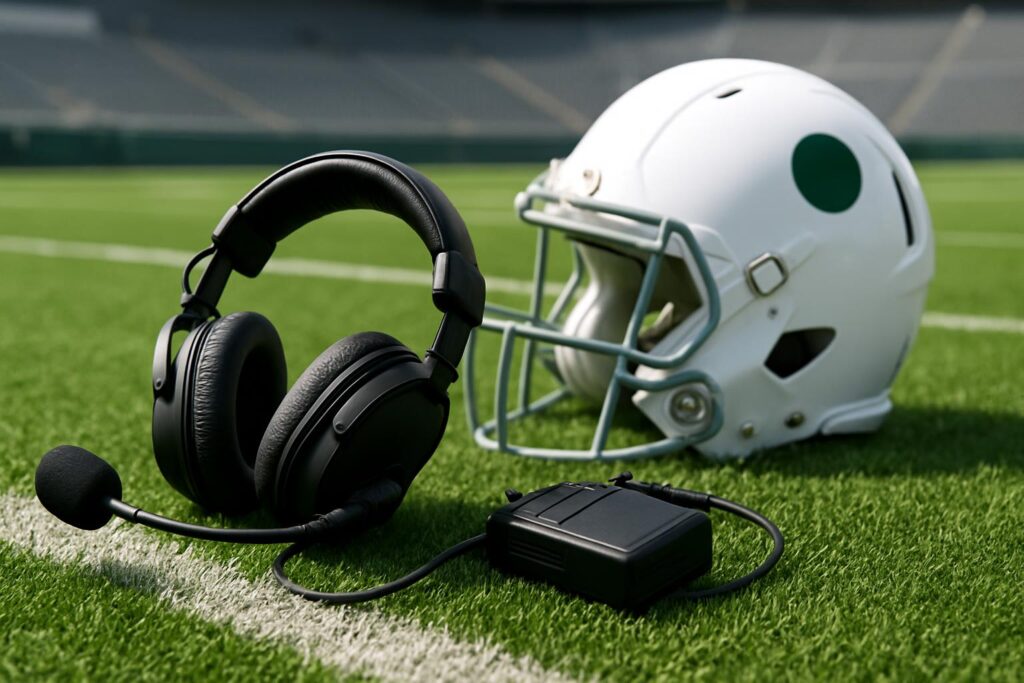
Second, there is the coach-to-player radio inside one offensive player’s helmet and one defensive player’s helmet. These helmets are marked with a visible green dot. A coach can speak directly to the quarterback on offense and to the designated signal-caller on defense. That line is one-way only and shuts off automatically as the play clock winds down.
Who Is Wearing What On The Sideline
Head coaches and coordinators typically wear over-ear headsets with noise reduction and a boom mic. Many assistants use lighter belt packs with custom earpieces. In the booth, coordinators often use broadcast-style headsets for clear audio in a quieter setting. Quarterbacks and defensive captains have a sealed receiver unit inside the helmet that plays the coach’s voice in their ear.
Why Do NFL Coaches Wear Headsets? The Core Reasons
Real-Time Play Calling and Adjustments
Coaches must process down-and-distance, defensive structure, personnel groupings, and game flow in seconds. Headsets allow the play-caller to:
- Confirm what the booth sees on the wide-angle vantage point
- Sequence plays based on tendencies and matchups
- Check that the right personnel package is on the field
- Deliver a clean call to the quarterback before the huddle
Without headsets, every adjustment would require hand signals, runners, or guesswork. The headset compresses the decision pipeline into a crisp, repeatable cycle every snap.
Fast Staff Coordination, Substitutions, and Special Teams
On every play, someone is confirming substitutions, someone is watching the clock, and someone is readying the next call based on the result. Special teams adds its own timing: getting the right unit out for punt or field goal with no confusion. Headsets let different roles handle their piece without getting in the way of the play-caller. Clear channels avoid cross-talk and keep the sideline orderly when seconds matter.
Better Decision-Making Under Time Pressure
The head coach relies on input from an analytics assistant tracking win probability, timeout strategy, and fourth-down math. A replay advisor confirms whether to challenge. A situational coach may cue two-point conversions or clock-kill mechanics. Headsets keep that input flowing while the head coach retains final say. The structure helps prevent emotional swings from derailing sound decisions.
Communication In Hostile Environments
Loud stadiums compress thinking time. Noise-reducing headsets help coaches hear clearly and speak at normal volume. Signal clarity reduces miscommunication and wasted timeouts. The quarterback also hears the play faster and with less chance of misunderstanding. Over a full game, that clarity is worth yards and points.
Keeping Secrets Secure
Signals are encrypted and separated by channels to prevent interception. Coaching staffs protect terminology, hand signals, and checks. The headset network keeps private what must stay private, even in crowded venues packed with cameras, microphones, and opposing scouts.
Health and Safety Coordination
Trainers, medical staff, and spotters need to communicate quickly on suspected injuries. Headsets provide a direct line to the head coach for substitution and game management. Fast, quiet coordination keeps players safe while the game moves on schedule.
How The Technology Works Behind The Scenes
Noise Reduction and Microphone Design
Sideline headsets use closed-back earcups with padding to block external sound. The boom mic uses directional pickup to focus on the speaker’s voice, often paired with digital noise reduction to cancel crowd noise. This combination keeps voices clear without shouting, which reduces fatigue and errors.
Channels, Push-to-Talk, and Roles
Teams use multiple channels divided by role: offensive staff, defensive staff, special teams, and sometimes situational or analytics. Many belt packs and headsets have buttons for push-to-talk or quick channel switch. This prevents cross-talk and ensures the right people hear the right messages instantly.
The 15-Second Cutoff Explained
The coach-to-player radio in the green-dot helmet is one-way and time-limited. It automatically shuts off with 15 seconds left on the play clock or at the snap, whichever comes first. That rule ensures the quarterback and defensive signal-caller take ownership of the huddle, cadence, and adjustments post-huddle. Coaches cannot talk through the play or camouflage calls in real time.
Encryption and Frequency Management
NFL game day operations coordinate radio frequencies to avoid conflicts with broadcasters, stadium systems, and public safety. The coach-to-player system is encrypted to prevent eavesdropping. Coach-to-coach intercoms also use controlled channels and interference mitigation. A dedicated onsite frequency team monitors performance and adjusts if issues arise.
Redundancy and Contingencies
Teams bring redundant headsets, cables, batteries, and belt packs. Many systems include wired fallbacks if wireless links struggle. Staff are trained to hot-swap a failing unit during a drive with minimal disruption. Coordinators in the booth often have alternate audio paths to survive failures without losing contact with the sideline.
Rules Coaches Must Follow With Headsets
Green Dot Helmets
Only one offensive player and one defensive player are permitted to use an in-helmet radio on a given play. Teams can equip backups with green-dot helmets, but only one is active per unit at a time. Officials and broadcast crews rely on the green dot to identify the eligible communicator quickly.
What Is And Is Not Allowed
- One-way communication only, coach to player
- Shutoff at 15 seconds remaining on the play clock or at the snap
- No in-helmet communication to multiple players simultaneously on the same unit
- No use for real-time instruction during the play
These guardrails maintain competitive balance while enabling efficient operations between snaps.
Common Problems And How Teams Manage Them
Crowd Noise and Interference
Hostile environments can cause interference and force coaches to lean on specific channels that perform best at that venue. Teams prepare by testing channels pregame, mapping stadium hot spots, and planning quiet handoffs between play-caller and quarterback if a cutout occurs. Noise-reducing headsets and strict communication discipline help keep messages clear.
Weather and Durability
Rain, snow, and cold stress every piece of equipment. Teams use weather covers, wipe-down routines, and protective cases. Coordinators in the booth benefit from a controlled environment, but sideline gear must handle sweat, contact, and elements all game. Redundant units are staged with a quick-swap plan.
Battery and Hardware Failures
Battery rotation is scheduled. Staff check charge levels during possession changes. Coaches know how to switch to a spare on the fly without leaving the sideline. Wired backups are ready if needed. The goal is simple: never lose a down to a gear problem.
Myths vs Reality
Myth: If One Team’s Headsets Fail, The Other Team Must Turn Theirs Off
Reality: There is no standing requirement that both teams shut down if one side experiences issues. Game officials and technical staff work to restore service quickly and may allow reasonable accommodations, but wholesale shutdowns are not automatic. Teams prepare to operate through temporary failures.
Myth: Players Can Talk Back To Coaches Through The Helmet
Reality: The in-helmet system is one-way only. Players cannot reply via the helmet radio. Quarterbacks and defensive leaders communicate back through huddles, signals, and sideline discussions.
Myth: Headsets Call The Plays For Coaches
Reality: Headsets are delivery systems. The quality of decisions still comes from scouting, game-planning, and calm under pressure. Great headsets do not fix poor process.
Best Practices Teams Use To Maximize Headset Value
Pre-Game Checks
- Test every channel in the stadium and booth
- Practice substitutions and special teams calls with headsets on
- Run through emergency procedures for signal loss
- Stage backups with labeled roles for fast swaps
In-Game Communication Discipline
- Short, specific language focused on intent and assignment
- One voice at a time on each channel
- Consistent terminology so everyone processes at speed
- Clear handoffs between analytics, replay, and play-caller
Post-Game Review and Continuous Improvement
- Audit missed or late communications
- Refine channel maps and code words
- Update battery and backup schedules
- Practice under simulated noise and weather
Helpful Gear Inspired By NFL Headset Workflows
These picks mirror core ideas from NFL sideline operations: clear audio, quick coordination, and reliable backups. They help youth, high school, and college staffs communicate cleanly, especially in noisy venues.
Eartec UltraLITE 2-Person Wireless Intercom Headset System
The UltraLITE system gives two coaches a hands-free, full-duplex link with no base station. Setup is fast and the headsets are light, which is ideal for practices and game day. Full-duplex means you can talk naturally without push-to-talk. The range suits most fields and the battery swaps quickly between sessions.
Why it helps: Keeps play-caller and spotter in constant contact without yelling across the sideline.
Best for: Youth and high school staffs who want plug-and-play comms for offense-defense handoffs, special teams timing, and substitutions.
Potential downsides: Not built for massive stadium interference; treat it as a field-level solution, not a broadcast-grade system.
Notable features: Lightweight on-ear design, simple pairing, and rechargeable batteries you can swap in seconds.
Audio-Technica BPHS1 Broadcast Stereo Headset With Dynamic Boom Mic
In the booth, you want a broadcast-style headset that keeps voice intelligibility high and blocks ambient sound. The BPHS1 delivers clear vocal pickup and sturdy build quality at a sensible price point. It works well with small mixers, intercoms, and USB audio interfaces for coordinators who prefer a familiar studio feel.
Why it helps: Clarity in the booth means faster reads and cleaner instructions down to the sideline.
Best for: Coordinators and analysts who need reliable voice isolation and all-day comfort during film review and games.
Potential downsides: Requires an interface or mixer for best results; not a wireless sideline unit.
Notable features: Closed-back cups for isolation, cardioid dynamic mic for focused pickup, detachable cables for flexibility.
Bose QuietComfort Ultra Headphones

While not a team intercom, strong noise cancellation has real value for coaches during travel, film study, and pregame planning. Reducing background noise helps you focus on cut-ups, scouting calls, and scripting without fatigue. The audio quality supports clear calls with staff when paired with a laptop or phone.
Why it helps: Clearer thinking and less fatigue translate into better decisions on game day.
Best for: Coaches who spend hours on the road or in loud environments reviewing film and preparing callsheets.
Potential downsides: Not a sideline communications solution; it is a personal focus tool.
Notable features: Adaptive noise cancellation, comfortable fit for long sessions, and solid voice pickup for meetings.
FAQ: Quick Hits
Do all coaches wear the same headset?
No. Head coaches and coordinators usually wear over-ear models with boom mics. Some assistants use lighter headsets or belt packs. In the booth, broadcast-style headsets are common for clarity.
Can the quarterback talk back through the helmet?
No. The in-helmet radio is one-way from coach to player. The player responds in the huddle or at the sideline.
When does the in-helmet audio cut off?
It shuts off automatically with 15 seconds left on the play clock or at the snap, whichever comes first.
What happens if a team’s headsets fail mid-game?
Teams switch to backups and may use wired fallbacks. Technical staff work to restore service, but the game continues. There is no automatic requirement for both teams to shut down headsets.
Why do coaches still cover their mouths?
They reduce the chance of lip-reading by cameras or opponents. Even with headsets, protecting terminology matters.
Conclusion
Headsets are not gadgets; they are the operating system of NFL coaching. They connect the booth’s vantage point with the sideline’s urgency. They keep special teams synchronized, analytics aligned, and play calls crisp. Encryption and cutoff rules protect fairness while still giving staffs the tools they need. When problems happen, redundancy and disciplined communication keep the game on track.
If you coach at any level, take the same mindset. Build a clear channel map. Use noise reduction to protect clarity. Practice swaps and backups. Keep language short and specific. The pros rely on structure, not volume. With the right approach and the right tools, you will communicate faster, adjust cleaner, and win more close situations.