
We are reader supported. When you purchase through links on our site, we may earn an affiliate commission. Also, as an Amazon affiliate, we earn from qualifying purchases.
Yes, the strike zone called by MLB umpires did get bigger during the late 2000s and early 2010s. However, the biggest change was not an expansion in every direction. Instead, umpires began calling more strikes near and below the knees, effectively extending the bottom of the zone.
Research using pitch-tracking data found that the called strike zone expanded significantly between 2008 and 2014. MLB subsequently worked to bring the lower boundary closer to the official rulebook definition.
Today, the discussion has entered a new phase. Beginning with the 2026 season, MLB introduced the Automated Ball-Strike (ABS) Challenge System, allowing players to challenge certain ball-and-strike calls while keeping human umpires behind home plate.
Understanding these changes helps explain why the strike zone sometimes looks different from one season to another—and why a pitch that appears outside the television strike-zone box may still be called a strike.
What Is the Official MLB Strike Zone?
The MLB strike zone is a three-dimensional area above home plate. Its boundaries are defined by the batter’s stance and the dimensions of home plate.
According to the official rules, the strike zone extends:
- From the midpoint between the top of the batter’s shoulders and the top of the uniform pants.
- Down to the hollow beneath the kneecap.
- Across the entire width of home plate, which measures 17 inches.
The vertical boundaries depend on the batter’s stance as the batter prepares to swing at a pitched ball.
This means taller and shorter hitters naturally have different strike zones.
A pitch does not need to pass directly through the center of the plate to be a strike. If any part of the baseball passes through any part of the strike zone, it can qualify as a strike.
That distinction is important because the strike zone is a volume of space rather than a flat rectangle.
Why the TV Strike Zone Is Not Always Accurate
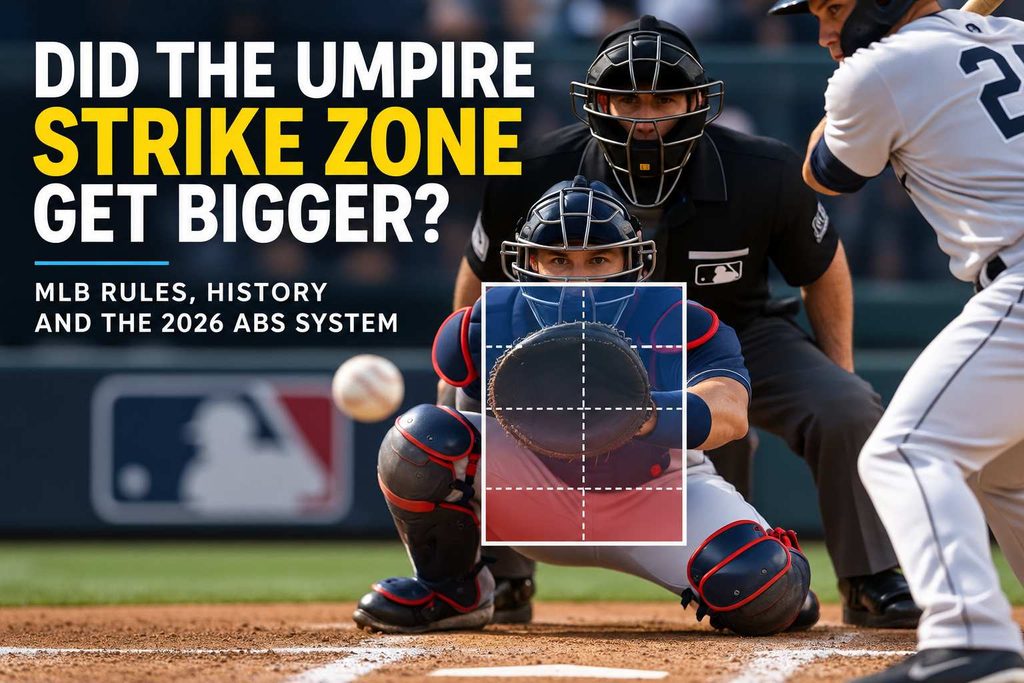
Television broadcasts often display a rectangular box over home plate.
Although useful, this graphic is not the official ruling.
Broadcast graphics may differ slightly from the batter-specific strike zone, and the camera angle can make pitches appear higher, lower, or farther outside than they actually are.
A breaking ball can also cross the strike zone before dropping below the catcher’s glove.
When evaluating a pitch, the important question is where the baseball traveled as it crossed home plate—not simply where the catcher received it.
How Did the MLB Strike Zone Change Over Time?
The strike zone has changed through both official rule modifications and differences in how umpires enforce existing rules.
These are two separate developments.
An official rule change alters the legal boundaries of the strike zone. A change in umpire enforcement affects which pitches are actually called strikes.
The 1960s: A Larger Official Strike Zone
During the early 1960s, MLB expanded the official strike zone.
The larger zone contributed to an environment that favored pitchers, although other factors also influenced offensive production.
In 1968, MLB experienced one of the most pitcher-dominated seasons in modern baseball history.
The league responded by lowering the pitching mound and modifying the strike zone for the 1969 season.
These changes were intended to restore a better balance between pitching and hitting.
The 1990s and Early 2000s
MLB continued refining the definition and enforcement of the strike zone.
In 1996, the league adjusted the rulebook definition of the lower boundary.
Beginning in 2001, MLB also emphasized calling the strike zone more consistently, including pitches near its upper boundary.
However, accurately measuring the called strike zone remained difficult because comprehensive pitch-tracking technology was not yet available.
2008–2014: The Called Strike Zone Expanded
The introduction of PITCHf/x technology gave researchers a much clearer understanding of umpire decisions.
By tracking individual pitches, analysts could compare the location of each pitch with the umpire’s ruling.
Research found that the called strike zone expanded during this period, particularly along its lower boundary.
More pitches near or below the knees were being called strikes.
This was especially important because pitchers could take advantage of the additional space without necessarily throwing harder or improving their control.
A sinker or breaking ball that previously might have been called a ball could now receive a strike call.
After 2014: The Lower Boundary Adjusted
The expansion did not continue indefinitely.
During the following seasons, the called zone’s lower boundary began moving upward again.
The league’s use of pitch-tracking data, umpire evaluations, and enforcement guidance helped improve consistency.
Rather than continuing to expand, the called strike zone moved toward a more stable shape.
However, that did not eliminate disagreements about borderline pitches.
Even experienced umpires can interpret the same pitch differently when it travels close to the boundary.
How Much Bigger Did the Strike Zone Get?
One of the most frequently cited studies of the modern strike zone was conducted by baseball researchers examining PITCHf/x data.
The research found that the effective called strike zone increased substantially between 2008 and 2014.
Importantly, the expansion was not evenly distributed.
The largest changes occurred near the bottom of the zone.
Why the Lower Strike Zone Matters
A larger lower boundary gives pitchers more opportunities to throw difficult pitches for called strikes.
Consider a sinker that crosses the plate near the batter’s knees.
If umpires consistently call that pitch a strike, hitters must adjust their approach.
They can no longer confidently take the pitch and expect a ball.
That forces hitters to protect a larger area, potentially making them more vulnerable to other pitches.
Did the Zone Get Wider Too?
Some studies identified changes along the horizontal edges of the called strike zone.
However, these differences were generally smaller than the changes near the knees.
The called zone also varied according to factors such as batter handedness, catcher receiving, and pitch location.
Therefore, describing the strike zone as simply getting wider does not capture the full picture.
The more accurate explanation is that its shape changed, especially at the bottom.
Why Do Different Umpires Have Different Strike Zones?
Although every MLB umpire works under the same rulebook, calling balls and strikes requires extremely fast visual judgments.
A pitch can travel toward home plate at more than 95 mph while moving horizontally or vertically.
The umpire must determine whether any part of that pitch passed through the strike zone.
Several factors can influence the decision.
1. Viewing Angle
Home plate umpires position themselves behind the catcher.
Their viewing angle is not identical to the television camera’s perspective.
The catcher, batter, and pitch movement can also affect visibility.
2. Catcher Framing
Pitch framing refers to how catchers receive and present pitches near the strike-zone boundaries.
A skilled catcher can make a borderline pitch easier for an umpire to recognize as a strike.
Traditionally, teams have placed considerable value on catchers who consistently receive borderline pitches well.
However, framing cannot change the actual trajectory of a pitch.
Its influence comes from how the pitch is perceived by the human umpire.
3. Pitch Movement
Modern pitchers use fastballs, sliders, sweepers, curveballs, and changeups with different movement profiles.
A pitch may cross part of the strike zone before dropping sharply.
This can make it appear outside the zone when the catcher receives it.
4. Individual Umpire Tendencies
Some umpires historically called a slightly larger zone than others.
Others were more restrictive along particular boundaries.
These differences became easier to study once pitch-tracking data became widely available.
However, a single questionable call does not establish that an umpire has a consistently large or small strike zone.
Meaningful comparisons require large samples of pitches.
How Does a Bigger Strike Zone Affect Baseball?
Changes in the called strike zone influence both pitching and hitting strategies.
Even relatively small differences can matter over thousands of pitches.
Pitchers Can Attack More Locations
When the lower boundary becomes more generous, pitchers can throw sinkers and breaking balls near the knees with greater confidence.
A pitch that produces a called strike rather than a ball can significantly change an at-bat.
For example, an 0-1 count generally favors the pitcher more than a 1-0 count.
Getting an additional borderline strike can therefore create an advantage beyond the individual pitch.
Hitters Must Protect More of the Plate
A larger strike zone forces hitters to consider swinging at pitches they might otherwise ignore.
This can make plate discipline more difficult.
Low pitches are particularly challenging because they can be harder to drive for extra-base hits.
However, strike-zone expansion alone does not explain changes in league-wide offensive production.
Pitch velocity, defensive positioning, baseball construction, player development, and hitting strategies also affect scoring.
Catcher Framing Becomes More Valuable
Under traditional human umpiring, catchers can influence borderline calls through receiving technique.
Teams have used framing statistics to evaluate how many additional strikes a catcher may contribute.
The introduction of automated strike-zone challenges changes this calculation because successfully challenged calls are determined by technology rather than receiving presentation.
What Is the Automated Ball-Strike (ABS) Challenge System?
The Automated Ball-Strike Challenge System represents one of the most significant developments in modern strike-zone enforcement.
After testing automated ball-and-strike technology in the minor leagues and during MLB exhibition games, the league approved a challenge-based system for the 2026 regular season.
Under this approach, human umpires continue calling balls and strikes.
However, eligible players can challenge certain decisions.
How ABS Challenges Work
The system allows a batter, pitcher, or catcher to challenge a ball-or-strike ruling.
A challenge must be requested immediately after the pitch.
The automated tracking system then determines whether the pitch crossed the defined strike zone.
The result is displayed to the stadium and broadcast audience.
If the original call was incorrect, it is overturned.
If the original call was correct, the ruling remains unchanged.
How Many Challenges Do Teams Get?
Under the 2026 system, teams begin regulation games with two challenges.
A successful challenge is retained, while an unsuccessful challenge is lost.
Additional provisions apply in extra innings.
The system is designed to correct important mistakes without replacing the home plate umpire or interrupting every pitch.
Does ABS Make the Strike Zone Bigger?
Not necessarily.
ABS is intended to make the application of the strike zone more consistent.
A machine-defined zone removes much of the individual variation associated with human umpiring.
However, the automated zone’s exact dimensions and measurement method matter.
A technologically consistent strike zone does not automatically mean it is identical to the historical human-called zone.
Some pitches previously called strikes may become balls, while some previously called balls may become strikes.
The impact depends on where the pitch crosses the automated boundary.
Will ABS Eliminate Catcher Framing?
ABS could reduce the value of catcher framing, but the challenge system does not eliminate it entirely.
Human umpires still make the initial ball-and-strike decisions.
Because teams have limited unsuccessful challenges available, not every borderline pitch will receive an automated review.
Catchers therefore still benefit from receiving pitches cleanly and presenting them consistently.
However, their ability to influence especially important borderline calls may be reduced when those calls are challenged successfully.
Over time, teams may place greater emphasis on other catching skills, including blocking, throwing, game management, and defensive positioning.
How Can Fans Tell Whether a Pitch Is Really a Strike?
There are several useful ways to evaluate borderline pitches while watching a game.
Watch Where the Ball Crosses Home Plate
Do not judge the pitch solely by where the catcher catches it.
Breaking balls can cross the strike zone before finishing outside it.
Remember That the Strike Zone Is Three-Dimensional
A pitch can clip part of the zone without traveling directly through its center.
This is one reason the television graphic may not tell the entire story.
Consider the Batter’s Height
The strike zone changes according to the batter.
A pitch that is high for a shorter player might be within the zone for a taller player.
Look for Patterns Instead of Individual Calls
One borderline pitch does not prove that an umpire has a large strike zone.
Watch how similar pitches are called throughout the game.
A consistent pattern is more informative than a single controversial decision.
Understand the Limits of Broadcast Graphics
The television strike-zone box is a useful reference, but it should not be treated as a perfect measurement.
Automated challenge results provide a more standardized assessment under the system’s defined boundaries.
Frequently Asked Questions
Did MLB officially make the strike zone bigger?
MLB has changed the official strike zone at different points in baseball history.
However, the expansion observed between approximately 2008 and 2014 was primarily a change in how umpires called pitches, rather than a new rule expanding the zone.
When was the MLB strike zone at its biggest?
Modern pitch-tracking studies identified a substantial expansion in the early-to-mid 2010s, particularly around 2014.
Comparisons with earlier decades are more difficult because equivalent pitch-level tracking data was unavailable.
Why did umpires call more low strikes?
The expansion reflected changes in how umpires judged pitches near the knees.
Pitch movement, catcher receiving, and umpire evaluation practices may also have contributed.
It should not be interpreted as evidence that MLB deliberately instructed umpires to favor pitchers.
Is the MLB strike zone the same for every player?
No.
The horizontal boundaries are based on home plate, but the vertical boundaries depend on each batter’s stance.
Taller and shorter batters therefore have different strike-zone heights.
Is the strike zone bigger for left-handed hitters?
The official rules do not establish different strike zones for left-handed and right-handed hitters.
However, historical studies have identified differences in how some pitches were called depending on batter handedness and pitch location.
Are robot umpires replacing MLB umpires?
No.
The 2026 ABS Challenge System retains human home plate umpires.
Automated technology is used to resolve eligible challenges rather than calling every pitch automatically.
Can catchers still frame pitches with ABS?
Yes.
Because human umpires continue making initial calls, receiving technique remains relevant.
However, automated challenges can overturn incorrect borderline decisions.
Will the strike zone continue changing?
The official rulebook definition can change if MLB adopts new rules.
The called zone can also change as technology, evaluation methods, and enforcement practices evolve.
ABS may reduce some forms of human inconsistency, but it does not eliminate the possibility of future rule adjustments.
Conclusion: Did the Umpire Strike Zone Really Get Bigger?
Yes. Pitch-tracking research shows that the strike zone called by MLB umpires expanded during the late 2000s and early 2010s, particularly along the lower boundary near the knees.
The expansion was not simply a matter of the official rulebook becoming more generous. It reflected how umpires interpreted and enforced the existing zone.
Subsequent adjustments helped bring the lower boundary closer to the intended rulebook standard.
Now, with the introduction of ABS challenges in 2026, MLB has entered a new era of strike-zone enforcement.
Human umpires remain responsible for calling pitches, but technology provides an additional method for correcting certain mistakes.
For fans, the most important lesson is simple: the strike zone is not merely the rectangle shown on television.
It is a batter-specific, three-dimensional area whose enforcement has evolved throughout baseball history.
Understanding that difference makes it easier to evaluate borderline calls, recognize pitching strategies, and appreciate how even small changes in the strike zone can influence the game.